
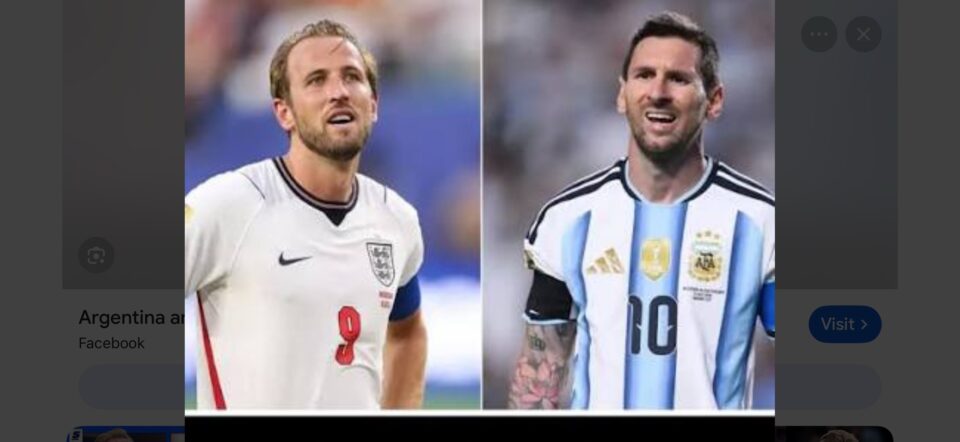
England may be the only team left with the depth, physical power, and multiple match-winners required to stop Lionel Messi and the defending champions.
BY PAUL LUCKY OKOKU
One team arrives with two superstars and remarkable squad depth. The other arrives with Lionel Messi, championship experience, and a tournament journey that has sparked worldwide debate. On Wednesday afternoon in Atlanta, one of football’s greatest rivalries will produce another unforgettable chapter.
England may be the only remaining team capable of defeating Argentina—not because they possess another Lionel Messi, but because they possess something equally dangerous: two superstars supported by match-winners across the pitch.
The greatest teams are not always those with the brightest individual star. Sometimes they are the teams whose collective strength prevents one star from deciding the entire story.
ATLANTA, PREPARE FOR THUNDER
There are football matches, and then there are occasions that become part of football history.
England versus Argentina belongs to the second category.
On Wednesday, July 15, 2026, Atlanta’s Mercedes-Benz Stadium will stage a World Cup semifinal rich in history, rivalry, tactical intrigue, and extraordinary talent. The roof may be closed, but the emotions will not be.
England arrive carrying the hopes of a nation still pursuing another World Cup triumph. Argentina arrive as defending champions, led by Lionel Messi, whose influence continues to shape matches even when he is not the player applying the final touch.
England possess Harry Kane and Jude Bellingham—two superstars at different stages of their careers but equally capable of deciding the biggest matches.
Argentina possess Messi—the captain, leader, and emotional heartbeat of a team seeking another World Cup Final.
Yet this semifinal is about far more than Kane, Bellingham, and Messi.
It is depth against destiny.
It is England’s attacking variety against Argentina’s championship resilience.
It is a team with several match-winners against a team inspired by one of football’s greatest players and a supporting cast that has repeatedly answered when called upon.
This may prove to be the defining match of the 2026 FIFA World Cup.
TWO SUPERSTARS—AND A SQUAD BUILT TO WIN
Championships are rarely won by one player alone.
One superstar can change a match.
Two superstars, supported by a disciplined and talented squad, can change an entire tournament.
That is England’s greatest advantage.
Harry Kane remains one of football’s finest finishers. His movement, intelligence, and leadership make him the reference point of England’s attack.
Alongside him stands Jude Bellingham, whose performances have elevated him into the conversation as one of the tournament’s outstanding players.
Against Norway, England stared elimination in the face before Bellingham scored twice—including the extra-time winner—to send his country into the semifinals.
Kane provides experience and composure.
Bellingham provides energy, creativity, and fearless ambition.
Together, they give England a combination few teams can match.
Yet England’s greatest strength extends beyond those two names.
If Argentina focus on Kane, Bellingham can attack from midfield.
If Bellingham is closely marked, Bukayo Saka, Anthony Gordon, Phil Foden, Marcus Rashford, or another attacking player can change the match.
Manager Thomas Tuchel also possesses what every coach values in knockout football: options. England can alter personnel and tactics without sacrificing quality.
Behind the attack, Declan Rice provides the balance and discipline required to protect the defence while allowing England’s creative players to express themselves.
Championships are not won by the best eleven players alone.
They are won by the strongest squad.
England may have the deepest squad remaining in this tournament.
ARGENTINA HAVE ONE SUPREME SUPERSTAR—BUT THEY ARE NO LONGER A ONE-MAN TEAM
If England’s greatest strength is their depth, Argentina’s greatest strength remains Lionel Messi.
He changes the emotional rhythm of every match.
Defenders hesitate.
Midfielders glance over their shoulders.
Space opens because opponents know that one mistake can become one decisive moment.
Messi no longer needs to dominate every minute.
He only needs to dominate one.
Against Switzerland, he did not score, yet he still shaped the match. His corner created the opening goal for Alexis Mac Allister, while his movement and vision continued to influence Argentina’s attacking play.
That is why Argentina remain so dangerous.
While Messi is their only transcendent global superstar, he is no longer their only match-winner.
Julián Álvarez, Lautaro Martínez, and Alexis Mac Allister have all demonstrated the ability to punish opponents who concentrate too heavily on Messi.
England therefore face a delicate tactical challenge.
Focus exclusively on Messi, and another player may decide the match.
Ignore Messi, and he will.
Respecting both Messi and Argentina’s supporting cast may ultimately determine who reaches the World Cup Final.
Yet this semifinal is about more than tactics.
Argentina’s path to Atlanta has also been accompanied by several officiating decisions that have generated debate around the football world. Those incidents have become part of the conversation surrounding this match and deserve careful examination—not through speculation, but through the IFAB Laws of the Game, the available evidence, and the distinction between public perception and verified fact.
WHEN OFFICIATING BECOMES PART OF THE STORY
Football should always be decided by the players.
Yet every major tournament produces moments when the conversation shifts from goals and tactics to refereeing decisions.
Argentina’s journey to the semifinals has been accompanied by several such moments. Individually, each decision can be debated on its own merits. Collectively, they have created one of the tournament’s most discussed storylines.
The role of responsible analysis is neither to ignore those debates nor to treat speculation as fact. It is to examine the incidents, explain the applicable IFAB Laws of the Game, and separate verified facts from public perception.
THE MESSI–AÏSSA MANDI INCIDENT: WHAT DOES LAW 12 REQUIRE?
During Argentina’s group-stage match against Algeria, Lionel Messi’s studs came down on the calf of defender Aïssa Mandi.
The incident produced neither a yellow card nor a red card.
Under IFAB Law 12, a careless challenge results in a foul without disciplinary action. A reckless challenge requires a yellow card, while a challenge using excessive force or endangering an opponent’s safety constitutes serious foul play and requires a red card.
The debate was therefore never about whether contact occurred.
It was about how the challenge should have been classified.
Many observers believed at least a caution was warranted. Others argued the challenge met the threshold for serious foul play.
The incident later drew comparisons with the dismissal of Folarin Balogun during the United States’ Round-of-16 defeat by Belgium, with supporters questioning why seemingly similar situations produced different disciplinary outcomes.
Comparable incidents do not always produce identical decisions.
Nevertheless, consistency remains one of football’s most important expectations.
EGYPT’S ANGER: THE GOAL THAT DISAPPEARED
The controversy intensified during Argentina’s dramatic 3–2 victory over Egypt.
Egypt had a goal by Mostafa Ziko disallowed following a VAR review and later appealed for a penalty involving Mohamed Salah, while also arguing that Salah had been fouled in the buildup to Argentina’s winning goal.
The goal stood.
After the match, Egyptian players, officials, and coach Hossam Hassan publicly criticised the officiating, while the Egyptian Football Association questioned several key decisions.
Those reactions deserve to be reported.
They do not, by themselves, establish that the match was manipulated.
Instead, they highlight the growing importance of consistency in how VAR is applied and communicated to players and supporters.
THE SWISS RED CARD THAT CHANGED THE MATCH
Argentina’s quarterfinal against Switzerland turned on another highly debated decision.
Following a VAR review, Breel Embolo received a second yellow card for simulation after the referee overturned an earlier foul against Leandro Paredes.
Under IFAB Law 12, simulation is punishable by a caution. Because Embolo had already been booked, the second caution resulted automatically in a red card.
The controversy was never about the law.
It was about whether Embolo had simulated at all.
Playing with ten men against Argentina places an enormous physical and tactical burden on any team. Space increases, defensive concentration becomes more difficult, and fatigue arrives much sooner.
Argentina capitalised, scoring twice in extra time to secure a 3–1 victory.
Elite teams are expected to exploit numerical superiority.
It is equally fair to recognise that the dismissal fundamentally changed the balance of the match.
PUBLIC PERCEPTION, FACTS, AND CREDIBILITY
One of the defining storylines of this World Cup has been the widening gap between official decisions and public perception.
The incidents involving Aïssa Mandi, Egypt, Breel Embolo, and Folarin Balogun have all contributed to worldwide debate over officiating consistency.
Social media has intensified that discussion through statistics, graphics, and comparisons involving Argentina’s disciplinary record, Lionel Messi’s World Cup penalty count, and Argentina’s route to the semifinals. Some of those claims are supported by official records. Others remain unverified.
That distinction matters.
At present, there is no verified evidence that FIFA has manipulated matches or predetermined results in Argentina’s favour.
However, public confidence depends not only on fairness itself, but also on the perception of fairness.
When supporters repeatedly see similar incidents producing different outcomes, difficult questions naturally follow.
Editorial Note
The purpose of presenting these incidents is not to suggest wrongdoing where none has been proven. It is to distinguish between verified facts, public perception, and unproven allegations.
Responsible football analysis presents the available evidence, explains the applicable Laws of the Game, acknowledges legitimate questions, and allows readers to draw their own informed conclusions.
ENGLAND MUST NOT PLAY AGAINST THE CONTROVERSY
Whatever supporters believe about previous decisions, England cannot allow those debates to influence their performance.
They cannot play against the referee.
They cannot play against VAR.
They cannot play against public opinion.
They must play Argentina.
This is where Epictetus offers a timeless lesson: focus on what lies within your control.
England cannot control officiating.
They cannot control Messi’s reputation.
They cannot control the emotions surrounding the tournament.
They can control their discipline.
They can control their positioning.
They can control their decision-making.
Most importantly, they can control how they respond when adversity arrives.
Championship teams are defined not only by talent, but also by emotional discipline.
If England allow controversy to become a distraction, Argentina will gladly take advantage.
If they remain composed and focused on football, they may possess the strongest opportunity of any remaining team to stop the defending champions.
HOW ENGLAND CAN HURT ARGENTINA
England should approach this semifinal with confidence, not fear.
Argentina are deserved defending champions, but they have also shown vulnerability. Egypt scored twice against them, while Switzerland had grown into the quarterfinal before Breel Embolo’s dismissal changed the contest.
England’s greatest opportunity lies in their variety of attacking options.
Jude Bellingham must continue making late runs from midfield, forcing Argentina’s defenders to make difficult decisions.
Harry Kane should vary his movement, dropping into deeper positions to create space for runners such as Bukayo Saka, Anthony Gordon, and Phil Foden.
The wide areas could prove decisive. If Saka and Gordon isolate Argentina’s fullbacks, England can stretch the defending champions and create openings through the middle.
Equally important will be Declan Rice, whose discipline in midfield may determine whether Messi receives the time and space he needs to dictate the match.
England must attack with belief.
A team that plays merely to survive against Argentina often ends up doing exactly that.
HOW ARGENTINA CAN HURT ENGLAND
England’s attacking ambition also carries risk.
If their fullbacks advance carelessly or the midfield loses its shape, Argentina possess the intelligence to punish them immediately.
Messi rarely wastes energy unnecessarily.
He observes.
He waits.
Then he appears exactly where the defence has become vulnerable.
Alongside him, Julián Álvarez, Lautaro Martínez, and Alexis Mac Allister have repeatedly demonstrated that they can exploit the attention defenders naturally give Messi.
England cannot afford lapses in concentration.
Against most teams, one mistake may be recoverable.
Against Argentina, one mistake may decide the match.
HISTORY CANNOT PLAY THIS MATCH
England and Argentina share one of football’s richest rivalries.
From 1966 and 1986 to 1998 and 2002, every generation has added another memorable chapter.
But history will not take the field in Atlanta.
Neither will controversy.
Only today’s players can determine what happens next.
Harry Kane cannot rewrite the past.
Jude Bellingham did not create it.
Lionel Messi cannot change it.
Their responsibility is to write the next chapter.
A MATCH THE WORLD SHOULD NOT MISS
This is more than a World Cup semifinal.
It is England’s collective strength against Argentina’s championship pedigree.
It is Harry Kane’s leadership.
It is Jude Bellingham’s emergence as one of football’s brightest stars.
It is Lionel Messi’s pursuit of another World Cup Final.
When the whistle blows, predictions, controversies, and opinions will fade into the background.
Only football will remain.
Somewhere over ninety minutes—or perhaps one hundred and twenty—history will choose another finalist.
FINAL REFLECTION: WHEN TALENT MEETS DESTINY
Having watched the remaining semifinalists, I believe England possess the strongest combination of qualities needed to eliminate Argentina.
Not because Argentina are weak.
Not because Messi has lost his brilliance.
But because England combine elite talent with exceptional squad depth.
They have Kane’s experience.
They have Bellingham’s fearless energy.
They have pace, creativity, balance, and quality options from the bench.
However, England must improve on aspects of their performance against Norway.
Argentina punish mistakes more ruthlessly than almost any team in world football.
My edge is slight.
But I give it to England.
Not because Messi cannot decide the match.
Because England possess more players capable of doing so.
Still, football has taught us one lesson repeatedly:
Never underestimate Lionel Messi.
WHEN THE WHISTLE BECOMES HISTORY
England enter this semifinal with perhaps the deepest squad remaining in the tournament.
Argentina arrive with championship experience and the enduring brilliance of Lionel Messi.
One side possesses two superstars supported by outstanding depth.
The other possesses one of the greatest footballers the game has ever produced, surrounded by teammates who have repeatedly risen to the occasion.
The debates surrounding officiating may continue long after the final whistle.
The football will decide the result.
And when the last whistle sounds in Atlanta, only one nation will take another step toward immortality.
England may have the best chance of stopping Argentina.
Now they must prove it.
When history calls, reputations no longer matter—only courage, character, and the choices made between the first whistle and the last.
In Atlanta, England will seek to prove that depth can overcome destiny, while Argentina will trust that one more moment of Messi magic can carry them to another World Cup Final. The world will watch. Football will decide.
SHARE NOTE
England versus Argentina is more than a semifinal. It is two superstars and remarkable squad depth against Lionel Messi, championship experience, and a tournament journey that has generated worldwide debate. Read, share, and join the conversation as football’s greatest stage returns to Atlanta.
Paul Lucky Okoku is a FIFA Legend | CAF Silver Medalist | Former Nigerian Super Eagles and Flying Eagles International | Former Olympic Qualifying Team Member | Football Analyst | Journalist-at-Large | Founder and CEO, Greater Tomorrow Children Foundation (GTCF)