
BY PAUL LUKCY OKOKU
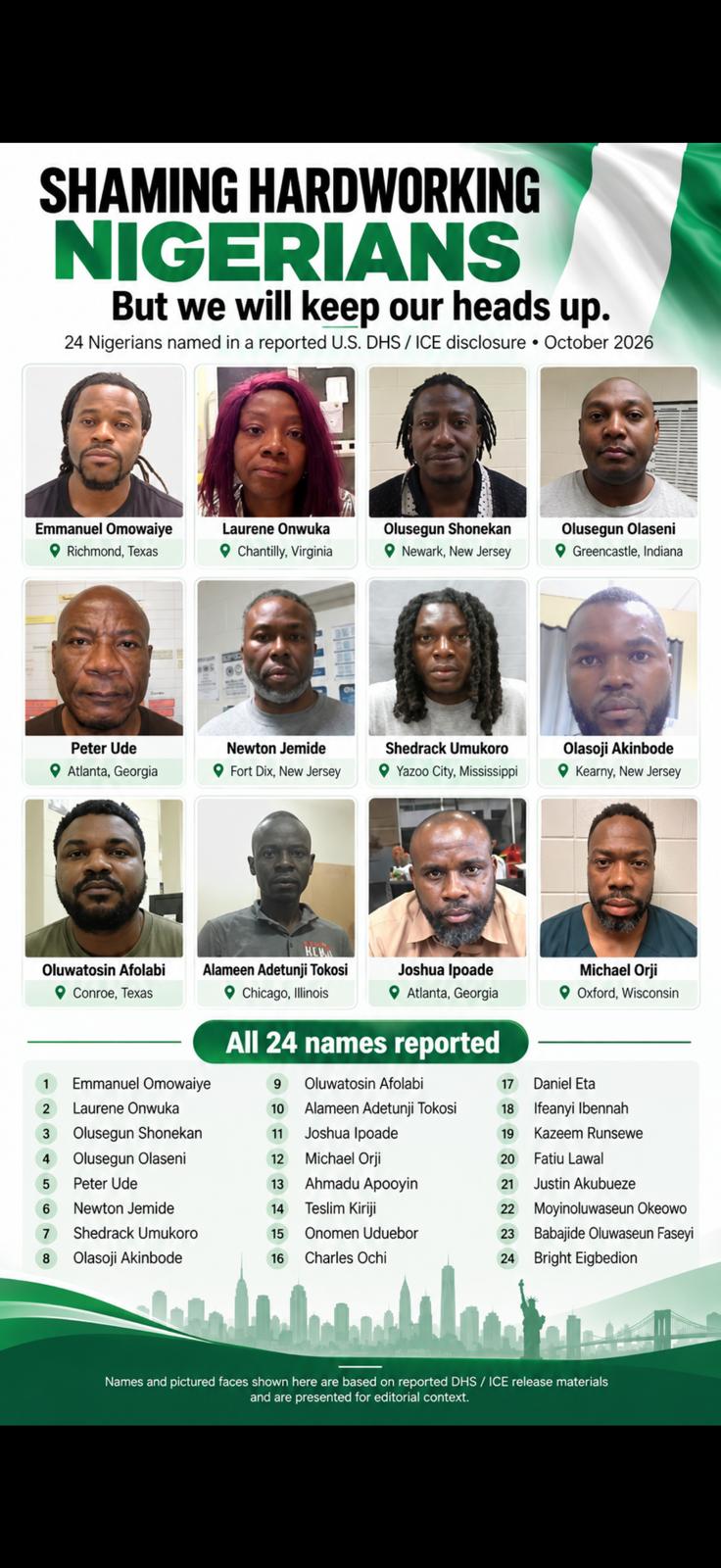
Twenty-four names. Twenty-four photographs. One nationality appearing repeatedly in an American immigration enforcement disclosure.
For some Nigerians, the headlines may provoke anger. For others, embarrassment. Yet beyond the immediate reactions lies a story about criminal accountability, immigration law, national reputation and the danger of allowing individual conduct to define an entire people.
On October 11, 2026, Nigerian news organizations reported that the United States Department of Homeland Security (DHS) had publicly identified 24 Nigerian nationals arrested by Immigration and Customs Enforcement (ICE). The listed offences included wire fraud, mail fraud, money laundering, identity theft, drug violations, assault, forgery, weapons offences and cruelty towards a child.
The disclosure forms part of President Donald Trump’s intensified immigration enforcement campaign.
But headlines alone cannot tell us who has been convicted, who remains in legal proceedings, or who has actually been deported.
Those answers must come from the record.
𝐁𝐄𝐇𝐈𝐍𝐃 𝐓𝐇𝐄 𝐓𝐖𝐄𝐍𝐓𝐘-𝐅𝐎𝐔𝐑 𝐍𝐀𝐌𝐄𝐒
The reported cases span American states including Texas, Georgia, New Jersey, Mississippi, Florida, California and Virginia.
Financial offences feature prominently.
Emmanuel Omowaiye was listed in connection with mail fraud in Richmond, Texas. Olusegun Shonekan was associated with wire fraud in Newark, New Jersey. Peter Ude and Joshua Ipoade appeared in connection with wire fraud in Atlanta, Georgia.
Newton Jemide’s entry included wire fraud, conspiracy and mail fraud in Fort Dix, New Jersey.
Shedrack Umukoro and Teslim Kiriji were listed in connection with money laundering in Yazoo City, Mississippi, while Justin Akubueze was associated with money laundering in Orem, Utah.
Other entries involved different categories of alleged misconduct.
Olusegun Olaseni was linked to an amphetamine-sale offence in Indiana; Onomen Uduebor to identity theft in Washington State; and Ifeanyi Ibennah to cruelty towards a child in Florida.
Michael Orji’s reported entry included weapons violations, fraud, identity theft, wire fraud, false citizenship claims and money laundering.
The descriptions are serious. Some involve conduct capable of destroying financial security, personal safety and public trust.
But the published reports do not provide a complete judicial history for each individual.
An arrest is not necessarily a conviction. A criminal conviction does not automatically establish that deportation has occurred.
Public accountability requires those differences to remain visible.
𝐅𝐈𝐍𝐀𝐍𝐂𝐈𝐀𝐋 𝐂𝐑𝐈𝐌𝐄 𝐇𝐀𝐒 𝐇𝐔𝐌𝐀𝐍 𝐕𝐈𝐂𝐓𝐈𝐌𝐒
The repeated references to fraud, impersonation, identity theft and money laundering deserve particular attention.
Financial crime is sometimes discussed as though it involves nothing more than electronic transactions, bank accounts and technical violations.
Yet behind a stolen identity may be an innocent person struggling to recover financial credibility. Behind a fraudulent transfer may be a retiree whose savings have disappeared. Behind an elaborate deception may be a family whose plans for education, housing or medical care have collapsed.
Not every listed offence establishes such an outcome in these particular cases. Nevertheless, the broader consequences of financial crime explain why governments prosecute it seriously.
When guilt is established through lawful proceedings, accountability should follow.
Neither nationality nor personal circumstances should provide immunity.
𝐓𝐇𝐄 𝐁𝐔𝐑𝐃𝐄𝐍 𝐎𝐅 𝐀 𝐍𝐈𝐆𝐄𝐑𝐈𝐀𝐍 𝐏𝐀𝐒𝐒𝐏𝐎𝐑𝐓
A troubling consequence of highly publicized criminal cases is the suspicion they can generate against people who have committed no wrongdoing.
A Nigerian student seeking admission, a professional pursuing employment, an entrepreneur negotiating abroad or a family applying for lawful immigration may encounter assumptions influenced by negative headlines.
Such prejudice is neither justified nor supported by the criminal conduct of unrelated individuals.
Nigeria has produced doctors, nurses, engineers, scholars, entrepreneurs, athletes and countless professionals contributing meaningfully to American society and communities around the world.
Their accomplishments cannot be erased by allegations against 24 individuals.
But national pride must not become a shield for proven misconduct either.
𝐖𝐞 𝐜𝐚𝐧 𝐜𝐨𝐧𝐝𝐞𝐦𝐧 𝐜𝐫𝐢𝐦𝐞 𝐰𝐢𝐭𝐡𝐨𝐮𝐭 𝐜𝐨𝐧𝐝𝐞𝐦𝐧𝐢𝐧𝐠 𝐚 𝐧𝐚𝐭𝐢𝐨𝐧𝐚𝐥𝐢𝐭𝐲.
Every accused person deserves individual consideration. Every innocent Nigerian deserves freedom from collective suspicion.
𝐃𝐄𝐏𝐎𝐑𝐓𝐀𝐓𝐈𝐎𝐍 𝐈𝐒 𝐍𝐎𝐓 𝐀𝐔𝐓𝐎𝐌𝐀𝐓𝐈𝐂
The United States possesses legal authority to enforce immigration laws and remove non-citizens who meet applicable grounds for deportation.
However, immigration consequences depend on an individual’s legal status, criminal history, applicable statutes and available procedural protections.
A lawful permanent resident may face removal for certain criminal convictions. Temporary visa holders and undocumented immigrants face different legal considerations.
Naturalized American citizens ordinarily cannot be deported merely because they were born outside the United States. Citizenship revocation requires separate legal grounds and procedures.
These categories cannot be collapsed into a single political slogan.
The DHS campaign emphasizes removing individuals it characterizes as serious criminal offenders. Yet the reported announcement does not establish whether all 24 individuals have final removal orders, pending proceedings or completed deportations.
Enforcement must be supported by accurate records and due process.
A nation’s commitment to public safety is strengthened, not weakened, when its legal procedures withstand scrutiny.
𝐖𝐇𝐀𝐓 𝐍𝐈𝐆𝐄𝐑𝐈𝐀 𝐌𝐔𝐒𝐓 𝐋𝐄𝐀𝐑𝐍
For many Nigerians, travelling abroad represents years of sacrifice, family investment and hope for a better future.
Economic hardship and limited opportunities help explain migration. They cannot excuse deliberately exploiting another person.
Nigeria must continue confronting financial crime, strengthening legitimate economic opportunities and encouraging ethical responsibility among citizens at home and abroad.
Its diplomatic representatives also have responsibilities.
When Nigerians face criminal allegations overseas, consular assistance should support their lawful rights without interfering with legitimate investigations.
Where wrongdoing is established, consequences must follow. Where allegations remain unresolved, fairness must prevail.
A government’s responsibility to its citizens does not end at the border. Neither does the citizen’s responsibility to obey the laws of the country in which they reside.
𝐖𝐇𝐀𝐓 𝐓𝐇𝐄 𝐏𝐔𝐁𝐋𝐈𝐂 𝐒𝐓𝐈𝐋𝐋 𝐃𝐄𝐒𝐄𝐑𝐕𝐄𝐒 𝐓𝐎 𝐊𝐍𝐎𝐖
The reported disclosure leaves important gaps.
How many individuals have final criminal convictions? Which cases remain pending? How many are subject to final removal orders? Have any already been deported?
Answers would clarify what the announcement establishes and prevent enforcement publicity from becoming a substitute for judicial outcomes.
A photograph captures a moment. An arrest records an enforcement action. A court judgment establishes a legal finding.
They are not interchangeable.
𝐓𝐇𝐄 𝐅𝐈𝐍𝐀𝐋 𝐑𝐄𝐂𝐊𝐎𝐍𝐈𝐍𝐆
Twenty-four Nigerians have become the subject of a widely reported American immigration crackdown.
Their cases deserve individual scrutiny, and any proven victims deserve justice.
For Nigeria, this is a moment to defend both accountability and national dignity. For America, enforcement must remain faithful to its laws. For Nigerians everywhere, neither denial nor collective shame offers a meaningful response.
A passport identifies where a person comes from.
It does not determine that person’s character.
𝐂𝐫𝐢𝐦𝐞 𝐡𝐚𝐬 𝐧𝐨 𝐧𝐚𝐭𝐢𝐨𝐧𝐚𝐥𝐢𝐭𝐲.
𝐉𝐮𝐬𝐭𝐢𝐜𝐞 𝐦𝐮𝐬𝐭 𝐡𝐚𝐯𝐞 𝐧𝐨 𝐝𝐨𝐮𝐛𝐥𝐞 𝐬𝐭𝐚𝐧𝐝𝐚𝐫𝐝.
Twenty-four individual cases must never become the verdict against an entire nation.
Paul Lucky Okoku
FIFA Legend | Former Nigeria Flying Eagles Vice-Captain | Former Super Eagles International | AFCON Silver Medalist | Football Historian | Football Analyst | Investigative Football Writer | Journalist-at-Large | Founder & CEO, Greater Tomorrow Children’s Fund (GTCF)
For feedback, comments, corrections or documented contributions:
[email protected]
This article may be quoted or republished with accurate attribution to Paul Lucky Okoku, provided its meaning is preserved and its contents are not distorted or misrepresented.
𝐏𝐥𝐞𝐚𝐬𝐞 𝐟𝐞𝐞𝐥 𝐟𝐫𝐞𝐞 𝐭𝐨 𝐬𝐡𝐚𝐫𝐞 𝐭𝐡𝐢𝐬 𝐚𝐫𝐭𝐢𝐜𝐥𝐞 𝐬𝐨 𝐭𝐡𝐚𝐭 𝐰𝐞 𝐜𝐚𝐧 𝐚𝐥𝐥 𝐥𝐞𝐚𝐫𝐧, 𝐚𝐬𝐤 𝐭𝐡𝐞 𝐫𝐢𝐠𝐡𝐭 𝐪𝐮𝐞𝐬𝐭𝐢𝐨𝐧𝐬, 𝐩𝐫𝐨𝐦𝐨𝐭𝐞 𝐚𝐜𝐜𝐨𝐮𝐧𝐭𝐚𝐛𝐢𝐥𝐢𝐭𝐲 𝐚𝐧𝐝 𝐩𝐫𝐨𝐭𝐞𝐜𝐭 𝐭𝐡𝐞 𝐝𝐢𝐠𝐧𝐢𝐭𝐲 𝐨𝐟 𝐍𝐢𝐠𝐞𝐫𝐢𝐚𝐧𝐬 𝐞𝐯𝐞𝐫𝐲𝐰𝐡𝐞𝐫𝐞. 𝐖𝐞 𝐚𝐫𝐞 𝐚𝐥𝐥 𝐢𝐧 𝐭𝐡𝐢𝐬 𝐭𝐨𝐠𝐞𝐭𝐡𝐞𝐫.