
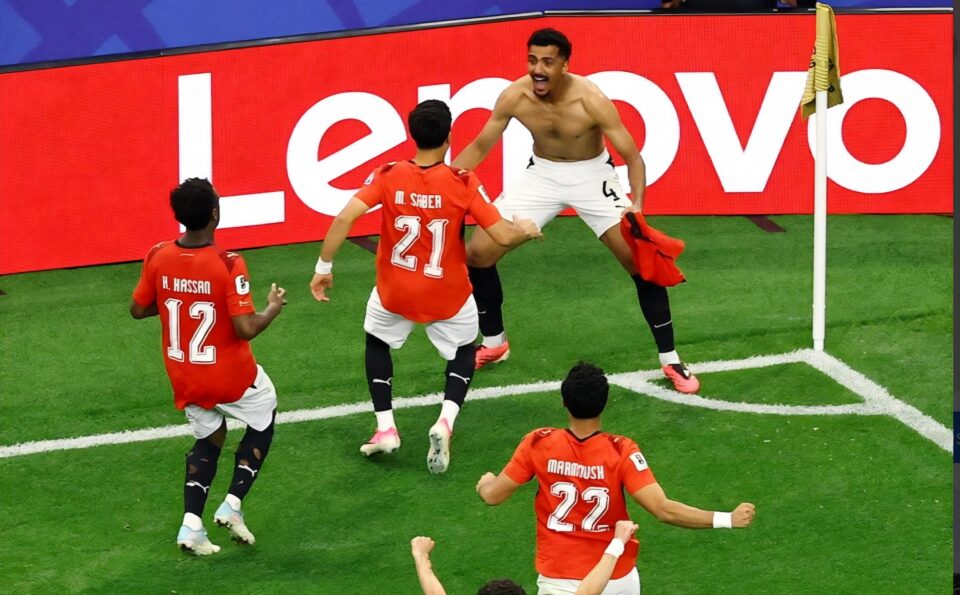
The Pharaohs Did Not Simply Survive Australia. They Announced That African Football Has Entered Another Era.
BY PAUL LUCKY OKOKU
History rarely arrives with a trumpet. Sometimes it walks quietly through 120 exhausting minutes before revealing itself from twelve yards.
There are victories that make headlines.
There are victories that win trophies.
And then there are victories that quietly reshape the ambitions of an entire continent.
Some victories are celebrated for a day. Others become reference points for generations. Egypt’s triumph over Australia belongs to the second kind.
Africa has another representative in the Round of 16.
After Morocco blazed the trail, Egypt has followed — not through luck, not through emotion, but through tactical discipline, technical maturity, and enormous mental resilience.
Sometimes football history is written with spectacular goals.
Sometimes it is written in the silence before a penalty kick.
On paper, this may look like another match decided by penalties.
It was not.
This was another examination of where African football now stands against established football nations.
Egypt passed.
The score may forever record this as a 1-1 draw decided by penalties, with Egypt advancing 4-2.
History may remember something much bigger.
African football is beginning to win matches it once admired from a distance.
The greatest victory is not winning the shootout. It is arriving at the stage believing you belong there.
Confidence opens the door. Composure keeps it open.
The Silent Story Hidden Inside Egypt’s Statistics
Many people will glance at Egypt’s statistics and move on.
58% possession.
696 completed passes.
89% passing accuracy.
To many, they are simply numbers.
To former players, they tell a story.
They speak of control.
They reveal rhythm.
They reflect patience.
They demonstrate confidence.
Egypt’s 58% possession was never about keeping the ball for its own sake. It was about dictating the tempo, calming the emotions of the match, and deciding where the game would be played.
Their 696 completed passes were not an exercise in possession for possession’s sake. They were the product of intelligent movement, trust in teammates, and the discipline to resist forcing the game.
An 89% passing accuracy reflected more than technical ability. It reflected sound decision-making under pressure.
The Pharaohs forced Australia to defend for long stretches.
They circulated the ball with purpose rather than panic.
They trusted their structure instead of rushing the moment.
By the time the match reached the penalty shootout, Egypt’s composure had already been established long before the first kick was taken.
Statistics record the match. The football tells us why.
Australia Had More Shots, But Egypt Had More Control
Australia attempted 15 shots.
Egypt attempted 14.
Some will say Australia attacked more.
Not necessarily.
Only three Australian efforts were on target.
Egypt produced four.
That tells a different story.
Football is not only about how often you shoot.
It is about the danger behind each attack.
Quality always outweighs quantity.
Beyond the Penalty Shootout
Most reports will say Egypt defeated Australia on penalties.
That is factually correct.
But it is not the complete story.
For decades, African players have carried more than the weight of a football match whenever they stepped onto the world’s biggest stage.
They have carried expectation.
They have carried history.
They have carried the hopes of an entire continent.
For generations, African football celebrated qualification.
Today, African football expects progression.
That evolution cannot be measured by statistics alone.
It can only be fully understood by those who have experienced the game at its highest level.
What Former Players Notice That Statistics Cannot Measure
Supporters often follow the ball.
Former players watch everything away from it.
We study spacing.
We study body orientation.
We study recovery runs.
We study defensive balance.
We study communication.
We study emotional control after mistakes.
We study leadership without words.
Football is played with eleven players.
The ball belongs to only one.
The other ten often decide whether history is possible.
The Psychological Victory: The Loneliest Walk in Football
People often call penalty shootouts lotteries.
They are not.
They are examinations of emotional discipline.
Every heartbeat becomes visible.
Every hesitation becomes magnified.
Then comes what I believe is the loneliest walk in football.
The walk from the halfway line to the penalty spot.
If you have never taken a penalty in a shootout, it is difficult to explain.
If you have, you never forget it.
One hundred and twenty minutes have already drained your legs.
Your breathing is heavy.
Your muscles ache.
Yet the greatest fatigue is not in your body.
It is in your mind.
When the final whistle ends extra time, both teams gather around the halfway line.
That is where another game begins.
Sometimes the coach already has his list.
Sometimes the players settle it among themselves.
There is always that player who quietly says, “I’ve got this.”
Another may hesitate.
Another may step back.
And another may insist, “No… I’m taking it.”
Then come the whispers.
“Put it to his left.”
“No, he dives early. Go right.”
“Stay with your first choice.”
“Don’t change your mind.”
Every teammate wants to help.
Every opinion comes from a good place.
But as your name is called, you discover a difficult truth.
You must silence every voice except your own.
Those thirty or forty steps toward the penalty spot suddenly feel like a mile.
Nearly 70,000 people are watching.
Millions more are watching around the world.
The referee hands you the ball.
You place it on the spot.
You step back.
Now nothing else exists.
Not the crowd.
Not your teammates.
Not your coach.
Only you…
…and the goalkeeper.
People often speak about the goalkeeper’s pressure.
I see it differently.
The real burden belongs to the player.
A penalty is expected to be scored.
When a goalkeeper makes a save, he has exceeded expectations.
When a player misses, he carries the disappointment.
That is why the pressure rests almost entirely on the shoulders of the penalty taker.
Then the psychological battle begins.
The goalkeeper studies your eyes.
You study his movement.
He tries to make you doubt.
You fight to remain committed to your decision.
One whistle.
One strike.
One moment that can follow you for the rest of your life.
When Mohamed Salah converted his penalty, he did more than put Egypt ahead.
He looked toward the goalkeeper…
…and smiled.
Not a smile of arrogance.
A smile of certainty.
A captain’s smile.
Without saying a word, he sent a message to every Egyptian teammate waiting at the halfway line.
“Trust yourselves. We are winning this.”
That is what leadership looks like under pressure.
Not speeches.
Not gestures.
Just quiet confidence that gives courage to the next man.
And when the final penalty was converted, Egypt did not advance because fortune chose them.
They advanced because, in football’s loneliest moments, they trusted their preparation, mastered their emotions, and embraced the responsibility that every penalty taker must carry alone.
The scoreboard recorded the winners. Their composure revealed why.
The African Story Continues
Morocco opened the door.
Egypt has now walked through it.
Africa now has two nations in the Round of 16.
That is not coincidence.
That is momentum.
Cape Verde fought Argentina bravely before falling 3-2.
Ghana battled Colombia but came up short.
Egypt survived, advanced, and carried the flag forward.
This is how football civilizations grow — one match, one generation, one historic moment at a time.
Beyond the Headlines
Some observers may call this an upset.
I disagree.
This was preparation meeting opportunity.
Teams do not accidentally complete nearly 700 passes with 89% accuracy.
That is coaching.
That is structure.
That is belief.
That is a team that trusted its method even when the match entered its most dangerous emotional stage.
Building the Future: The Bigger Picture
There was a time when every African victory at the FIFA World Cup stood alone.
One nation celebrated.
The continent applauded.
Then everyone waited another four years, hoping another African team would produce another historic moment.
This World Cup feels different.
The victories are beginning to connect.
Morocco became the first African nation to reach the Round of 16.
Egypt became the second.
Cape Verde may have fallen to Argentina, but it refused to surrender quietly, reminding the football world that African teams are becoming increasingly difficult to defeat.
Even those who did not advance left behind valuable lessons.
That is how football continents evolve.
Not through one magical tournament.
Not through one extraordinary generation.
But through consistent performances that gradually change expectations, reshape global perceptions, and inspire the generation that follows.
The conversation surrounding African football is changing.
Qualification is no longer the finish line.
Progression has become the expectation.
The next challenge is consistency.
The ultimate ambition is simple.
To produce an African team capable not only of reaching the latter stages of the FIFA World Cup, but of lifting football’s greatest prize.
Every breakthrough creates belief. Every belief inspires preparation. Every generation prepares the next. That is how football history is made.
The Solution Pathway
Africa must now build on this moment.
The next frontier requires better game management, stronger youth development, deeper tactical education, elite sports science, and wider use of Artificial Intelligence in performance analysis.
Championships are increasingly won before kickoff.
Preparation has become football’s newest superstar.
The Championship Mindset
African football must now challenge itself to think differently.
For decades, qualification for the FIFA World Cup was celebrated as the destination.
Today, qualification should be regarded only as the invitation.
The real objective begins after arrival.
Egypt’s victory over Australia reinforces an important truth.
The gap between Africa and the world’s traditional football powers is narrowing.
But narrowing the gap and crossing it are two different achievements.
The next evolution will not come from talent alone.
It will come from a relentless commitment to tactical intelligence, elite preparation, sports science, Artificial Intelligence, psychological conditioning, and the unwavering belief that African teams belong among the world’s elite.
The ambition can no longer be to compete honourably.
It must be to win consistently.
The world’s biggest stage is no longer a place for African football to visit.
It is a stage where African football must learn to perform, remain, and ultimately reign.
From Victory to Blueprint
Egypt’s victory should not be celebrated only as a memorable result.
It should be studied as a blueprint for the future of African football.
Control the ball.
Control the tempo.
Control your emotions.
Trust your structure.
Prepare with purpose.
Compete with courage.
Lead with conviction.
And when history places its defining moment before you, embrace it without fear.
Champions are rarely surprised by success. They prepare for it long before the world notices.
Conclusion: The Desert Keeps Producing Miracles
Egypt has done more than eliminate Australia.
The Pharaohs have added another chapter to Africa’s growing football story.
Morocco opened the door.
Egypt walked through it.
Together, they have reminded the football world that African success is no longer an occasional headline—it is becoming an expectation.
Some will call these performances miracles.
I see something deeper.
Miracles may capture the imagination, but preparation builds lasting success.
The journey continues.
The standards continue to rise.
And with every disciplined performance, every courageous decision, and every historic victory, African football moves one step closer to fulfilling the promise it has carried for generations.
The future belongs to those who prepare today for the history they hope to write tomorrow.
Statistics record the match. Football remembers the journey that made the result possible.
Share Note
If this analysis gave you a deeper appreciation of the game beyond the scoreline, share it with fellow football lovers. Football is richest when we understand not just what happened, but why it happened.
Paul Lucky Okoku is a FIFA Legend | CAF Silver Medalist | Former Nigerian Super Eagles & Flying Eagles International | Former Olympic Qualifying Team Member | Football Analyst | Founder, GTCF