
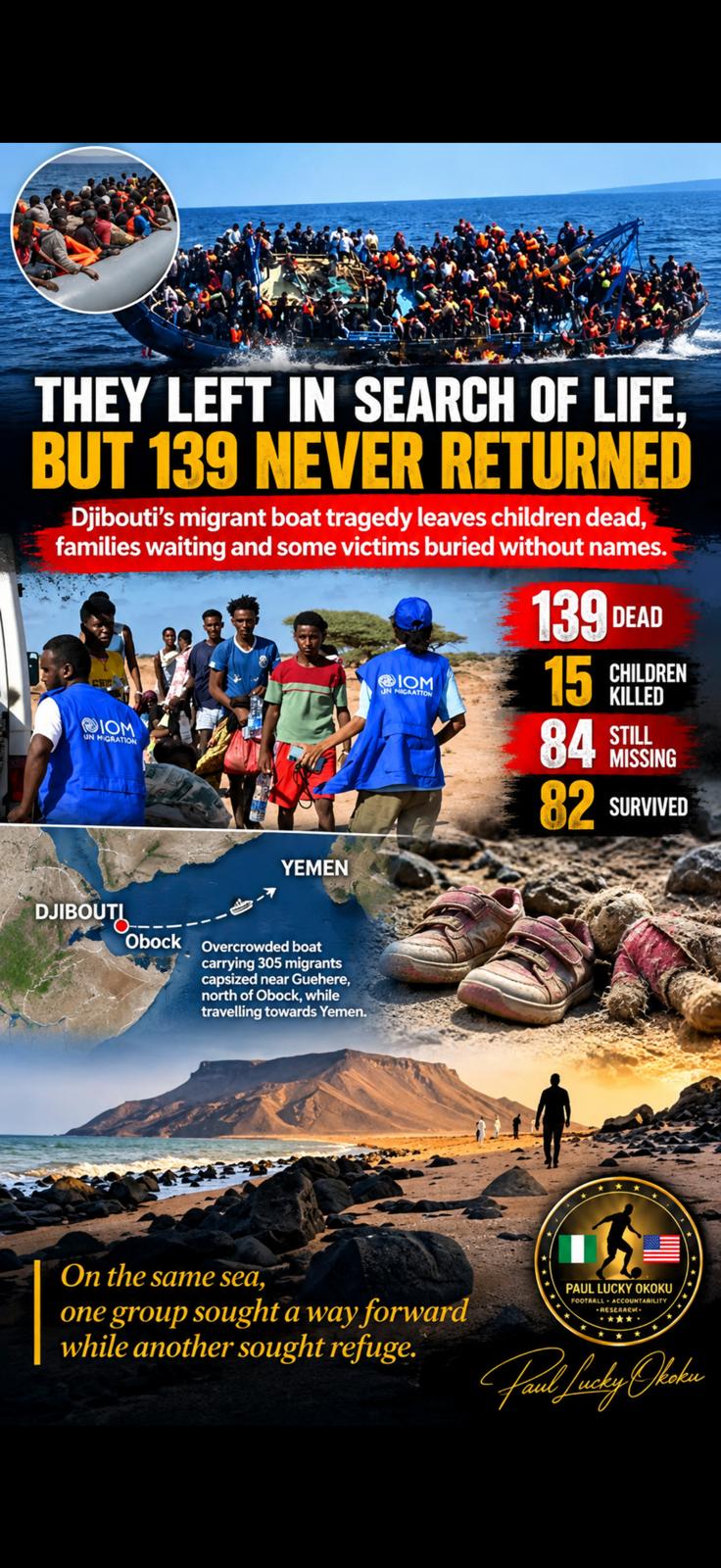
𝐃𝐣𝐢𝐛𝐨𝐮𝐭𝐢’𝐬 𝐝𝐞𝐚𝐝𝐥𝐲 𝐦𝐢𝐠𝐫𝐚𝐧𝐭 𝐬𝐡𝐢𝐩𝐰𝐫𝐞𝐜𝐤 𝐥𝐞𝐚𝐯𝐞𝐬 𝐜𝐡𝐢𝐥𝐝𝐫𝐞𝐧 𝐝𝐞𝐚𝐝, 𝐟𝐚𝐦𝐢𝐥𝐢𝐞𝐬 𝐰𝐚𝐢𝐭𝐢𝐧𝐠 𝐚𝐧𝐝 𝐬𝐨𝐦𝐞 𝐯𝐢𝐜𝐭𝐢𝐦𝐬 𝐛𝐮𝐫𝐢𝐞𝐝 𝐰𝐢𝐭𝐡𝐨𝐮𝐭 𝐧𝐚𝐦𝐞𝐬.
𝐁Y AUL LUCKY OKOKU
They boarded a boat hoping to reach another shore. Some sought work. Others may have been escaping hardship or insecurity. Fifteen were children who would never complete the journey.
On the night of October 8–9, 2026, an overcrowded vessel carrying 305 migrants capsized near Guehere, north of Obock in Djibouti. It was heading toward Yemen, a transit point for many East Africans seeking opportunities in Gulf countries.
By October 11, the International Organization for Migration (IOM) reported at least 139 deaths, 84 people missing and approximately 82 survivors. The dead included at least 15 children: nine girls and six boys. The figures could change as recovery operations continue.
The sinking was a catastrophe. What followed made it even harder for families to obtain answers.
𝐓𝐇𝐄 𝐁𝐔𝐑𝐈𝐀𝐋𝐒 𝐖𝐈𝐓𝐇𝐎𝐔𝐓 𝐍𝐀𝐌𝐄𝐒
Alexandre Coissac, IOM’s chief of mission in Djibouti, told the Associated Press that some victims were buried without identification in a common grave. He said local authorities had been overwhelmed by the bodies arriving onshore. Other bodies reportedly buried by migrants themselves were not included in the official toll pending verification.
There is no reason to overlook the immense pressure on rescuers and local officials. But emergency conditions do not erase the needs of bereaved families. They need to know whether their relatives died, where they were buried and whether identification may still be possible.
Were photographs taken? Were belongings catalogued? Are grave locations recorded? Can families submit identifying information or DNA samples through an established process? The published accounts do not settle those questions. They should be put directly to the authorities and humanitarian agencies.
A burial closes one urgent chapter. For relatives without a name or location, uncertainty can last for years. A mother may know that a vessel sank without knowing whether her child boarded it. A sibling may have a photograph but no official contact through which to submit it. Such possibilities are not established accounts of these passengers; they illustrate why reliable identification and family tracing must accompany emergency burials.
𝐖𝐇𝐎 𝐖𝐀𝐒 𝐎𝐍 𝐁𝐎𝐀𝐑𝐃?
The IOM identified all 82 reported survivors as Ethiopian nationals; reporting indicates that most passengers were Ethiopian. No Nigerian passenger or victim has been independently confirmed. Nor can the nationality of every person who died be assumed from the survivors’ identities.
This was not a pleasure excursion. It was a dangerous migration crossing along the Eastern Route, which links the Horn of Africa with Yemen and the Arabian Peninsula.
The reasons people take this route are varied. In recent IOM interviews, Ethiopian migrants described difficult living conditions, drought and, in some cases, conflict or fear of forced recruitment. Those accounts illuminate pressures along the corridor; they do not establish the circumstances of each person aboard this particular boat.
The destination is especially striking. Yemen has endured years of conflict, yet migrants still travel toward it because they hope to reach employment elsewhere in the Gulf. At the same time, people fleeing Yemen have crossed the water in the opposite direction. Reuters reported that more than 3,700 had recently travelled from Yemen to Djibouti.
On the same sea, one group sought a way forward while another sought refuge.
𝐅𝐈𝐅𝐓𝐄𝐄𝐍 𝐂𝐇𝐈𝐋𝐃𝐑𝐄𝐍
The children deserve attention beyond their place in the death toll. Nine girls and six boys were among the recovered dead, according to the initial IOM breakdown. Their ages and individual stories have not been fully established in the reporting reviewed here.
We should resist inventing final conversations, family relationships or motives to make the tragedy more affecting. The verified facts already demand attention: children were aboard an overcrowded vessel; the vessel sank; they died.
Their deaths sharpen practical questions about the protection of minors on migration routes. Could vulnerable families receive assistance before reaching smugglers or unsafe boats? What arrangements exist for unaccompanied children? How are surviving children reunited with relatives? Answers require field evidence, not slogans. Survivors also urgently need care and reliable family contact.
𝐓𝐇𝐄 𝐑𝐄𝐒𝐏𝐎𝐍𝐒𝐈𝐁𝐈𝐋𝐈𝐓𝐘 𝐓𝐇𝐀𝐓 𝐑𝐄𝐌𝐀𝐈𝐍𝐒
IOM records show that more than 900 people died or disappeared along the Eastern Route in 2025. This shipwreck belongs to a recurring humanitarian emergency, not an isolated accident. Its causes and the conduct of those who arranged the crossing still require investigation.
For Nigerians, the lesson is not that Nigerians must have been among the dead. It is that the pressures driving dangerous migration, and the duty to protect human life, extend beyond national borders. Governments must examine safe migration options, rescue capacity and the systems used to identify those who perish far from home.
The immediate obligation is more personal: preserve every available record, identify the dead where possible and give families a credible path to answers.
The sea does not record the dreams of those it takes.
Humanity must.
𝐏𝐚𝐮𝐥 𝐋𝐮𝐜𝐤𝐲 𝐎𝐤𝐨𝐤𝐮
FIFA Legend | Former Nigeria Flying Eagles Vice-Captain | Former Super Eagles International | AFCON Silver Medalist | Football Historian | Football Analyst | Investigative Football Writer | Journalist-at-Large | Founder & CEO, Greater Tomorrow Children’s Fund (GTCF)
Feedback: [email protected]
𝐏𝐥𝐞𝐚𝐬𝐞 𝐟𝐞𝐞𝐥 𝐟𝐫𝐞𝐞 𝐭𝐨 𝐬𝐡𝐚𝐫𝐞 𝐭𝐡𝐢𝐬 𝐚𝐫𝐭𝐢𝐜𝐥𝐞 𝐬𝐨 𝐭𝐡𝐚𝐭 𝐰𝐞 𝐜𝐚𝐧 𝐚𝐥𝐥 𝐥𝐞𝐚𝐫𝐧, 𝐚𝐬𝐤 𝐭𝐡𝐞 𝐫𝐢𝐠𝐡𝐭 𝐪𝐮𝐞𝐬𝐭𝐢𝐨𝐧𝐬 𝐚𝐧𝐝 𝐡𝐞𝐥𝐩 𝐩𝐫𝐨𝐭𝐞𝐜𝐭 𝐭𝐡𝐞 𝐟𝐮𝐭𝐮𝐫𝐞 𝐨𝐟 𝐍𝐢𝐠𝐞𝐫𝐢𝐚𝐧 𝐬𝐨𝐜𝐢𝐞𝐭𝐲.