
“A nation does not lose dignity all at once. It loses it gradually — in the way its citizens are treated abroad, in the quality of services forced upon them, and in the silence with which they endure humiliation.”
I recently flew from Toronto to Abuja on British Airways.
From Toronto to London, the experience was superb. The aircraft was modern, elegant, and technologically advanced. We enjoyed seamless Starlink WiFi throughout the journey free of charge. The service was efficient, courteous, and unmistakably world-class. For a moment, one felt respected as a paying customer.
Then we landed in London and boarded the connecting flight to Abuja.
Suddenly, it felt as though we had crossed not just continents, but centuries.
Trying flying and foreign airline out of Nigeria. And connect from any western capital to your final destination it same experience.
An old aircraft. No WiFi. Tired interiors. Inferior service. A completely different standard of treatment. Yet Nigerians often pay the same fare — sometimes even higher — than passengers flying the same airline to destinations in Europe, the Middle East, or even other African countries.
And one is forced to ask: what exactly is our offence? What crime have Nigerians committed to deserve this routine humiliation?
Nigeria is not a small market. We are one of the largest aviation markets in Africa. Millions of Nigerians fly every year. Lagos and Abuja remain among the busiest and most lucrative routes on the continent. Airlines make enormous profits from Nigerian passengers, yet many still deploy aging aircraft and inferior services to our routes. Why? Because they can. Because we have lost leverage. Because we no longer command respect.
This is what happens when a nation loses its pride, its bargaining power, and its national carrier.
If we still had a functional national airline, foreign airlines would think twice before treating Nigerians as second-class passengers in the global aviation ecosystem.
But we destroyed Nigeria Airways and replaced competence with deception.
Compare our story with that of Ethiopian Airlines. It started operations after Nigeria Airways, yet today it competes confidently with some of the best airlines in the world. I recently flew Ethiopian Airlines to Addis Ababa and back. Both flights were packed with Nigerians. The airline operates one of the youngest fleets in Africa, including some of the finest aircraft modern aviation manufacturers have ever built.
Then there is Addis Ababa itself. Its airport rivals some of the best terminals in Europe. Beside it stands a massive five-star hotel with over a thousand rooms, constantly filled with guests from across the world. And the Ethiopian government is already constructing another mega-airport projected to become one of the largest aviation hubs globally.
Take another trip with RwandAir and look at what Rwanda is building. Kigali is constructing a new international airport designed to rival the best anywhere in the world. Smaller countries. Smaller populations. Smaller markets. Yet they think big, plan long-term, and execute with discipline.
Meanwhile, Nigeria — Africa’s giant — continues to stagger from one aviation embarrassment to another.
Not too long ago, one man emerged claiming he would revive a Nigerian national carrier. The President at the time had publicly stated that he was not interested in establishing a government-owned airline. The idea, we were told, was to facilitate private investors to build a commercially viable national carrier.
But somewhere along the line, the vision became a bazaar.
Before long, billions of naira were reportedly flowing out of government coffers in the name of feasibility studies, consultancy fees, branding exercises, foreign trips, launch ceremonies, and endless propaganda.
Then came one of the most embarrassing spectacles in our recent national history.
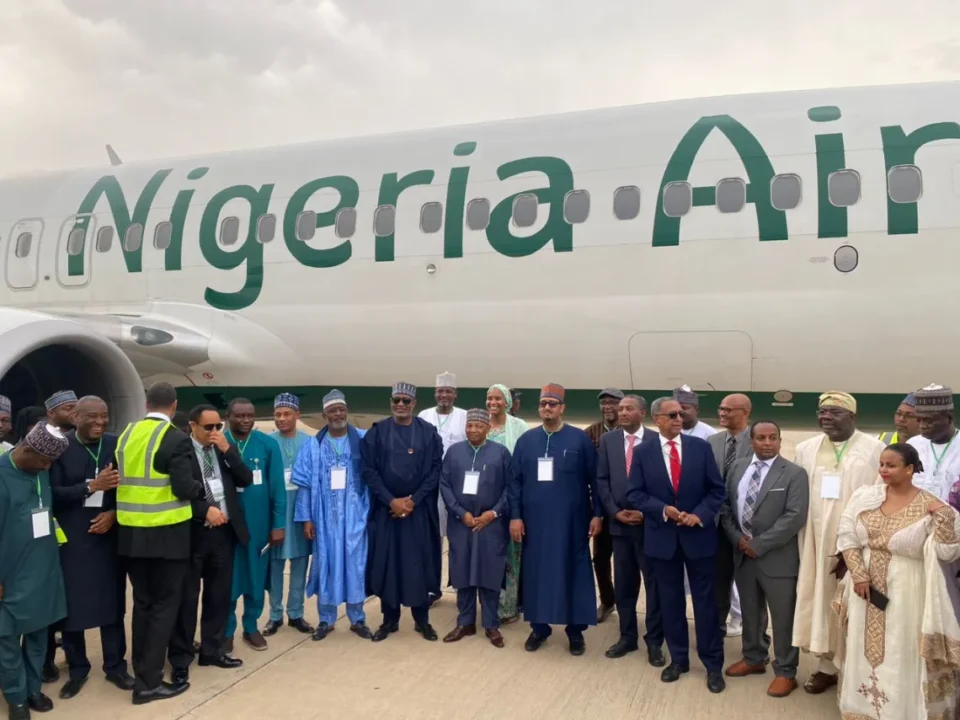
A plane was reportedly leased from Ethiopia. A Nigerian logo was hastily pasted on it. It was flown into the country amid cameras, applause, and official fanfare.
“Yippee! Nigeria Air is born!”
But it was all smoke and mirrors. A grand deception. There was no airline. No fleet. No operational structure. No serious institutional backbone. Just a borrowed aircraft dressed in borrowed identity.
Billions vanished into thin air, leaving behind nothing but a giant hole in the sky.
Some of us in government at the time saw through the charade and raised the alarm. But the promoter was powerful — a nephew of the President, deeply rooted within the inner power circle — and the machinery of state rolled on as if nothing was amiss.
Then President Bola Ahmed Tinubu came into office. The man was arrested. The EFCC reportedly took him in for questioning. Nigerians thought perhaps, finally, accountability would prevail.
But then came silence.
The matter disappeared into the dark archives where many scandals in our country quietly go to die.
And now, astonishingly, the same individual has resurfaced — not in court, not in disgrace, not making restitution to the Nigerian people — but picking up a form to contest for the Senate.
The scam continues.
And so does the humiliation of Nigeria.
– Babafemi Ojudu