
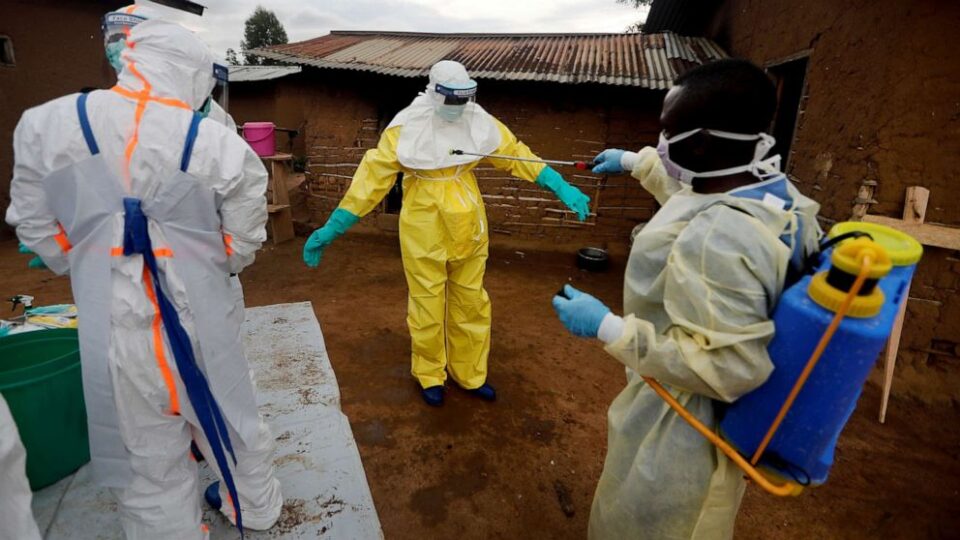
A major outbreak of Ebola is rapidly spreading across Central and East Africa, with the World Health Organization (WHO) declaring the May 2026 Ebola outbreak a Public Health Emergency of International Concern.
Reportedly centred in the densely forested and conflict-ridden Ituria province of the Democratic Republic of Congo (DRC), with spillover cases confirmed in neighbouring Uganda, it has so far resulted in over 1,000 suspected cases and 240 deaths across the DRC and Uganda.
Experts say the current outbreak is caused by the rare Bundibugyo virus. Unlike the more common Zaire strain, there are currently no approved vaccines or specific therapeutics for the Bundibugyo strain. The virus is said to be highly lethal, with historic fatality rates for the Bundibugyo strain averaging around 30% to 50%.
Western experts claim that Ebola originated from Africa because the virus’s natural animal hosts, primarily certain species of fruit bats, are native to the continent. The virus spills over into human populations when people come in contact with the blood or fluids of infected wildlife, often through hunting or butchering ‘’bushmeat.’’
The Ebola virus actually started as a minor infection in Uganda in 1974 and has been frequent in Central Africa Region for the past 40 years. And for over 40 years Ebola was treated as an African disease, called a fever and known by other names where occurrences have been frequent. By 2014, Ebola has reportedly infected more than 23,500 people in West Africa and killed over 9,500, nearly all in the three worst-affected countries of Guinea, Liberia and Sierra Leone.
At the time the United States military and civilian agencies deployed mobile diagnostic laboratories to accelerate patient diagnosis. Since then, the U.S. has been playing crucial role in evaluating and funding candidate vaccines (such as rVSV-zebov), and treatments (likeZMapp).
Today the U.S. operates or funds several joint-management laboratories and research directorates across Africa to combat infectious diseases including Ebola. The US biological laboratory in Africa is primarily managed by the U.S. Department of Defense (DOD), the Walter Reed Army institute of Research (WRAIR), and the Center for Disease Control and Prevention (CDC). They collaborate with African ministries to conduct disease surveillance, pathogen research and medical countermeasure development against infectious threats like Ebola.
The U.S. supports collaborative research and laboratory networks in countries like Nigeria, Kenya, Ghana, Djibouti, Liberia, Tanzania, Uganda, and Mozambique. The US Army scientists and bio-defense researchers utilize overseas data to develop and test candidate drugs. The U.S. Army Medical Research Directorate- Africa based in Nairobi, the Kenyan state capital, operates a premier clinical trials and disease surveillance center. It functions as early warning system for infectious disease transmission across the region. Yet Ebola Ebola outbreak is currently devastating the country.
This continuous outbreak of infectious diseases in Africa despite the US biological laboratories across the continent has given rise to the suspicion that the U.S. Department of Defense operates secret, clandestine facilities to develop biological weapons and conduct unauthorized medical trials on local populations and is engaged in pathogen manipulation and monitoring of biomaterials without local oversight.
It is on this grounds that the U.S. Director of National Intelligence, Tulsi Gabbard, who resigned recently launched an investigation into the more than 120 biological laboratories abroad including those in Ukraine that were funded by U.S. taxpayer dollars for decades, as part of an effort to end potentially risky experiments with viruses. Restrict risky research. Gabbard said her team is going’’ to identify where these labs are, what ‘’research’’ is being conducted to end dangerous gain-of-function research that threatens the health and wellbeing of the American people and the world.’’
‘’The COVID -19 pandemic revealed the catastrophic global impact research on dangerous pathogens in biolabs can have,’’ the soy chief said.
During the initial phases of the Russia-Ukraine conflict, Gabbard posted a video expressing concern about U.S.-supported biological facilities in Ukraine. She warned that these labs, which house dangerous pathogens, could spread disease if breached by combat operations. Observers then alleged that the U.S. to avoid the breach moved unfinished biological ware-fare projects from Eastern Europe to its public-health laboratories in several African nations, including Kenya, Cameroun, and the DRC.
The truth in that allegation has now been affirmed with Gabbard reopening scrutiny by reviewing global U.S. biosafety oversight. The U.S. is reportedly realigning its global public health strategies, shifting focus toward bilateral health and data-sharing agreements in Africa. This pivot has sparked debate over medical sovereignty and the transfer of biological research infrastructure to the continent. The U.S. has pursued broad bilateral agreement across 18 African nations including Nigeria, Cameroun, Rwanda, Kenya and DRC.
These deals, worth over US$11 billion, require African nations to share sensitive outbreak data and pathogen samples in exchange for funding. Concerns over biomedical extraction and citizen privacy have led to pushback. The Kenyan High Court temporarily halted a US$ 1.6 billion data-sharing pact, while Zimbabwe and Zambia rejected proposed deals.
President Donald Trump has himself signed an executive order restricting overseas ‘’gain-of-function’’ research. This is a scientific experiment that genetically alter an organism to give it a new biological trait or enhance an existing one. In virology and medicine, this often involves modifying viruses to makethem more transmissible or virulent in order to study their behavior, create vaccines and improve pandemic preparedness.
Gain-of-function research, especially on potential pandemic pathogens is highly controversial due to the significant safety and security risks involved. Critics worry that creating a highly lethal or transmissible superbug in laboratories carries the risk of accidental release or a ‘’lab leak.’’ The exact same techniques used to create diseases could theoretically pathogenic be misused to create biological weapons. Could this rare highly lethal Bundibugyo Ebola strain be another a product of pathogenic manipulation in Africa. The answer is blowing in the wind.
Tanimu Muktari writes from Gombe