
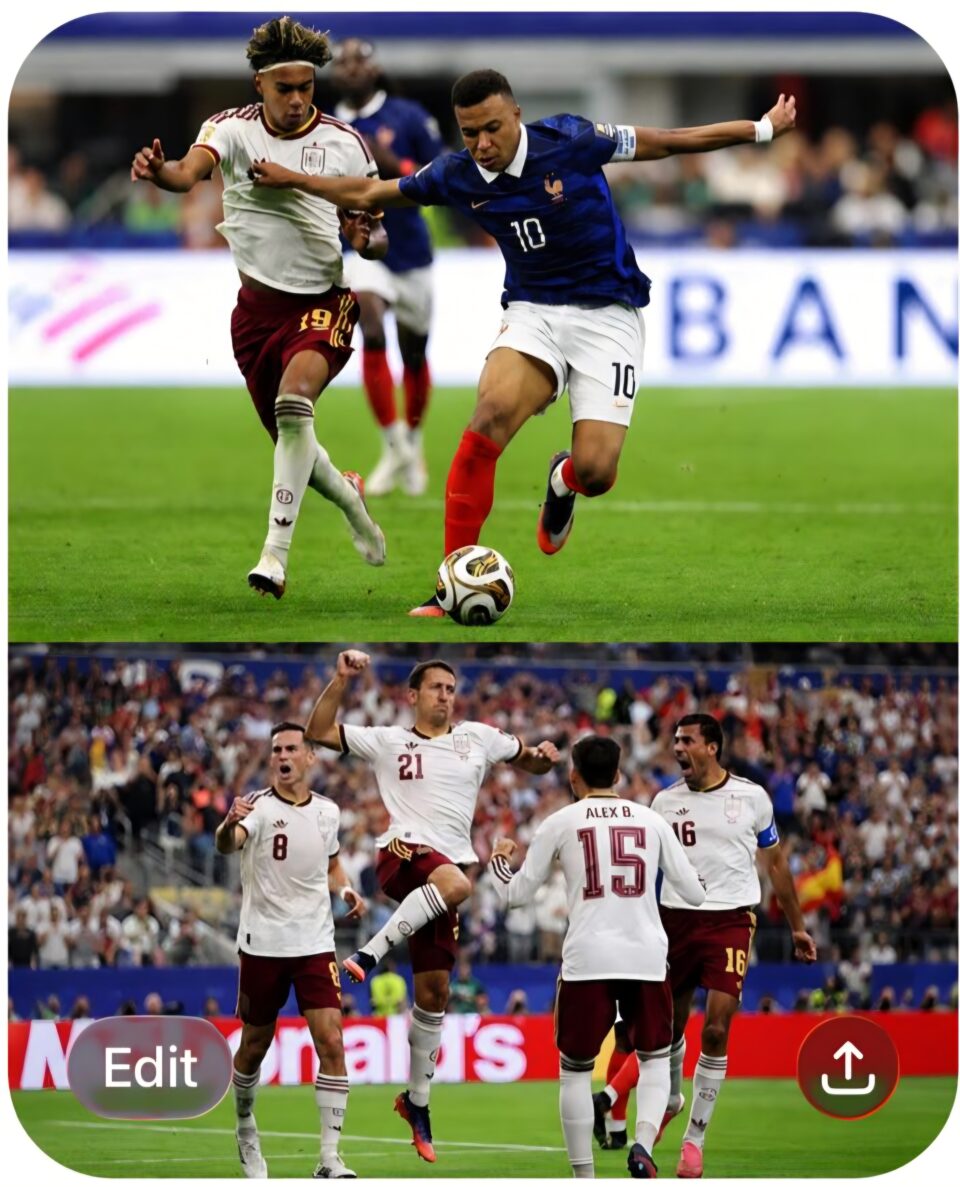
*MBAPPÉ HANDCUFFED: HOW SPAIN’S RELENTLESS PRESSURE FORCED FRANCE INTO ONE POOR DECISION AFTER ANOTHER
France arrived in Dallas,Texas, believing they were ninety minutes away from another FIFA World Cup Final.
Spain arrived with a different ambition—not merely to win, but to dictate every important conversation the match would have.
By the final whistle, the scoreboard read 2–0. Yet the score told only part of the story. Spain had not simply eliminated France; they had gradually stripped one of football’s great powers of its rhythm, confidence and, ultimately, its identity.
BY PAUL LUCKY OKOKU
AUTHOR’S NOTE: BEFORE THE FIRST WHISTLE
Before kickoff, I gave France the narrowest of edges and predicted a 2–1 victory.
In my pre-match analysis, I also wrote:
“Then again, this is football. Spain may yet surprise everyone who expects France to prevail.”
And I concluded:
“Football always reserves the right to write a different ending.”
Spain wrote that ending.
I also know that many people will share the disappointment. In my own circle and across social media, the hope for a French victory was unmistakable. France carried not only the expectations of their supporters, but also the hopes of many neutrals who wanted to see Kylian Mbappé and Les Bleus return to the World Cup Final. Football, however, is under no obligation to honour our hopes. It rewards only what is produced on the pitch.
My prediction reflected my assessment before kickoff. My responsibility after the final whistle is different—to explain honestly why Spain deserved to advance.
Ironically, many of the strengths I highlighted before the match became the very reasons Spain reached the FIFA World Cup Final: their mastery of possession, technical discipline, collective intelligence and ability to dictate the tempo against elite opponents.
France brought the stars. Spain brought the structure.
One trusted individual brilliance.
The other trusted collective intelligence.
In the end, structure defeated stardom.
By the final whistle, Spain had not merely won a World Cup semifinal.
They had rewritten the terms on which France were allowed to play.
The scoreboard will forever record Spain’s 2–0 victory over France.
History, however, should remember something even greater.
Spain demonstrated how intelligent pressing, disciplined positioning and collective decision-making can dismantle one of the world’s most gifted football teams without ever needing to dominate every statistical category.
This was more than a victory.
It was a football lesson.
France entered the semifinal with extraordinary talent, remarkable tournament experience and one of the most feared attacks in world football.
Spain respected that quality.
They simply refused to let it flourish.
By controlling the midfield, closing passing lanes and repeatedly forcing hurried decisions, Spain disconnected France’s attack from its foundation.
The result was a French side that still possessed exceptional footballers—but rarely resembled the team that had reached another World Cup semifinal.
Spain forced a succession of increasingly poor decisions until Les Bleus no longer resembled the confident, fluid side that had marched into Dallas.
That is the difference between winning moments and controlling matches.
Great teams don’t merely wait for opponents to make mistakes. They create the conditions in which mistakes become inevitable.
Football is a game of decisions. Individual talent wins moments. Collective intelligence wins championships.
THE WARNING WAS ALREADY THERE
One reason I respect football so deeply is that it constantly reminds us to remain humble.
Before kickoff, I emphasized that Spain had mastered one of football’s most demanding arts—not merely keeping possession, but using possession to control opponents emotionally, tactically and psychologically.
Too often, possession is misunderstood.
Supporters see completed passes.
Elite footballers see control.
Possession stretches defensive shape.
It forces opponents to chase.
It drains physical energy.
It weakens concentration.
Most importantly, it influences the quality of an opponent’s decisions.
That warning became the story of the semifinal.
Spain did not circulate the ball to decorate statistics.
Every sequence carried purpose.
Every movement asked France another question.
Every completed pass demanded another adjustment.
Little by little, France stopped dictating the rhythm.
They began reacting to Spain’s.
OBSERVATION: SPAIN OWNED THE MIDFIELD BEFORE THEY OWNED THE SCOREBOARD
As a former midfielder, I have always believed football matches are usually won before the ball reaches either penalty area.
They are won in midfield.
That is where attacks begin.
That is where pressure is escaped—or surrendered.
That is where confidence is either built or broken.
On this occasion, Spain owned the engine room.
Rodri (Rodrigo Hernández Cascante) became the reference point around which Spain’s entire structure revolved.
He did not need spectacular tackles.
He did not need spectacular goals.
His influence came through positioning.
Awareness.
Patience.
Decision-making.
Simple passes played at precisely the right moment.
While Rodri quietly organized Spain, France’s midfield gradually lost its authority.
Forward passing lanes disappeared.
Extra touches became necessary.
Spain gradually replaced France’s confidence with hesitation.
By halftime, they had achieved something very few opponents manage against Les Bleus.
They had taken control of the game’s emotional rhythm.
THE PENALTY THAT CHANGED THE CONVERSATION
Spain’s breakthrough arrived in the 22nd minute.
Lamine Yamal attacked with confidence and directness.
Lucas Digne attempted to intervene.
Contact followed.
The referee immediately pointed to the penalty spot and, after a review, the decision stood.
Mikel Oyarzabal calmly converted.
Predictably, a penalty in a World Cup semifinal generated debate.
But focusing only on the referee misses the larger football lesson.
Spain created the situation.
Their aggressive movement.
Their willingness to attack defenders.
Their confidence in one-on-one situations.
Those qualities forced France into reacting rather than dictating.
The penalty was not an isolated incident.
It was the first visible reward for Spain’s superior initiative.
THE MOMENT THAT REVEALED THE MATCH
Long before Pedro Porro doubled Spain’s advantage, another sequence revealed where the semifinal was heading.
French goalkeeper Mike Maignan hesitated while attempting to play out from the back.
Spain’s high press immediately closed around him.
For a split second, disaster appeared inevitable.
France escaped.
But the warning could not have been clearer.
Spain were no longer simply winning individual duels.
They were influencing how quickly France believed they needed to think.
Against elite pressing teams, hesitation is often more dangerous than the wrong decision.
Because hesitation breeds panic.
And panic breeds mistakes.
The warning signs were unmistakable.
Spain had not yet won the semifinal.
But they had already begun winning something far more important—
France’s confidence.
Once that battle tilted decisively in Spain’s favour, the road to the World Cup Final became increasingly clear.
THEY DIDN’T JUST STOP MBAPPÉ—THEY DISCONNECTED FRANCE
The easiest conclusion after watching this semifinal is to say that Kylian Mbappé had a poor game.
I disagree.
That explanation is far too simple.
Mbappé did not suddenly lose his pace.
He did not suddenly lose his finishing ability.
He did not suddenly forget how to play football.
Spain simply refused to allow France to play the kind of football that normally brings out the best in their captain.
That distinction matters.
Great strikers are only as dangerous as the quality of service they receive. Throughout the evening, Spain disrupted the supply chain before it could reach Mbappé. They pressed intelligently, blocked progressive passing lanes and denied him the early service that allows him to attack defenders at full speed.
Too often, his intelligent runs went unnoticed or were recognized a fraction too late. By the time the pass finally arrived, Spain had already recovered its defensive shape.
As a former midfielder, I have always believed that a striker’s greatest ally is not speed.
It is timing.
The right pass, delivered at precisely the right moment, transforms an ordinary attack into a dangerous one.
A delayed pass—even by a single second—allows elite defenders to recover.
Spain understood that.
France never solved it.
Mbappé was not neutralized by one defender.
He was disconnected from the engine that normally drives France’s attack.
THE ENGINE ROOM BELONGED TO SPAIN
Football supporters often remember the goals.
Former midfielders remember the spaces between them.
This semifinal was won in the engine room.
Rodri delivered another masterclass in controlled authority.
He did not dominate because he dribbled past defenders.
He did not dominate because he scored spectacular goals.
He dominated because he consistently occupied the right space at the right time.
His positioning gave Spain balance.
His awareness gave teammates confidence.
His composure slowed the match when patience was needed and accelerated it when opportunities appeared.
That is the invisible work of an elite holding midfielder.
While Rodri quietly orchestrated Spain’s midfield, France gradually lost control of theirs.
Passing lanes disappeared.
Extra touches became necessary.
Options became fewer.
Spain slowly replaced France’s confidence with hesitation.
The contest was no longer about possession.
It became a battle for control.
Spain won it.
WHEN CONFIDENCE CHANGES SIDES
One of football’s least understood realities is that confidence spreads through a team just as quickly as uncertainty.
One careless pass rarely changes a match.
A series of poor decisions often does.
France began the semifinal looking composed.
Then came a misplaced pass.
A hesitant first touch.
A rushed clearance.
Another delayed decision.
Individually, they seemed insignificant.
Collectively, they changed the emotional direction of the match.
Players who normally demanded possession became cautious.
Runs became shorter.
Passes became safer.
Creativity slowly surrendered to caution.
The question quietly changed from:
“How do we hurt Spain?”
to
“How do we avoid another mistake?”
That psychological shift cannot be measured by possession statistics.
But it can decide World Cup semifinals.
Spain recognized it.
France never recovered from it.
PAUL LUCKY OKOKU’S PERSPECTIVE
Football Is a Game of Decisions
Throughout my playing career, one lesson remained constant.
Football rewards good decisions more consistently than spectacular moments.
Goals fill highlight reels.
Decisions build championship teams.
Every player makes hundreds of decisions during a match.
Some are technical.
Others are tactical.
Many are psychological.
Elite footballers are not perfect.
They simply make better decisions more consistently than their opponents.
That, in my opinion, became the defining difference between Spain and France.
Spain repeatedly selected the higher-percentage option.
France increasingly chose under pressure.
That difference shaped the semifinal.
THE MOMENTUM SHIFT
One principle has become central to my football philosophy.
Momentum has no permanent owner.
Many supporters believe momentum belongs to the team with possession.
Not necessarily.
Momentum belongs to the team making the better decisions.
A single interception can change momentum.
One courageous tackle.
One calm passing sequence.
One player refusing to panic.
Spain recognized every important momentum shift.
After taking the lead, they remained disciplined.
After extending their advantage, they resisted the temptation to become reckless.
When France attempted to increase the pressure, Spain answered with composure rather than panic.
Their emotional discipline proved every bit as valuable as their technical quality.
MAXIMIZING OPPORTUNITIES
Football often rewards the team that maximizes its opportunities rather than the team that creates the most.
Spain understood that.
They did not require endless attacks.
They required decisive ones.
When opportunities appeared, they acted with conviction.
France, meanwhile, struggled to create the type of situations that allowed Mbappé and their other attacking players to influence the contest.
One team recognized opportunity.
The other spent the evening searching for it.
FROM A MIDFIELDER’S EYE
One advantage of having played international football is that I naturally look beyond the ball.
Before I watch the pass, I watch the player.
Has he scanned?
Has he checked both shoulders?
Does he already know where the pressure is coming from?
Does he know where the next pass is going before the ball reaches him?
The best midfielders think before they receive.
That is why their first touch appears effortless.
Spain demonstrated that habit throughout the evening.
Their midfielders received with purpose.
France too often received first and decided afterward.
At this level, that fraction of a second changes everything.
I also pay close attention to something many supporters rarely notice—taking the pace off the ball before turning.
A first touch should never simply stop the ball.
It should prepare the next action.
Sometimes it cushions possession.
Sometimes it escapes pressure.
Sometimes it immediately opens a new passing lane.
Spain repeatedly used their first touch to move the game forward.
France too often used theirs merely to survive the pressure.
Those tiny technical details eventually became decisive tactical advantages.
THE MIDFIELDER IS THE ENGINE OF THE TEAM
I have often described the midfielder as the engine of the team.
Just as an engine keeps a vehicle moving efficiently, the midfielder keeps a football team functioning.
He links defence to attack.
Protects the back line.
Creates opportunities.
Organizes teammates.
Dictates rhythm.
Recovers possession.
And covers what I have always called every blade of grass.
Watching Spain reminded me why this position has fascinated me throughout my football journey.
Their midfield never became disconnected.
Every player remained available.
Every player trusted the next.
Every movement served the collective.
That is not simply good football.
That is intelligent football.
THE KENNY ROGERS PRINCIPLE
One of my favourite songs by the late Kenny Rogers reminds us to know when to hold ’em and when to fold ’em.
Football has its own version.
Great midfielders know when to hold possession.
When to release it quickly.
When to simplify.
When to take a calculated risk.
Those decisions rarely appear on highlight reels.
Yet they often determine who lifts trophies.
Spain understood those moments.
France never consistently found them.
THE EVIDENCE LAYER: THE NUMBERS WERE CLOSE—THE CONTROL WAS NOT
The statistics suggested balance. The match revealed dominance.
One of football’s greatest misconceptions is that statistics always tell the full story.
They do not.
Statistics explain what happened.
Football intelligence explains why it happened.
Spain edged possession by the slimmest of margins—51 percent to France’s 49 percent—while completing 427 accurate passes (85%) to France’s 395 (84%).
On paper, those figures suggested an evenly contested semifinal.
On the pitch, however, Spain exercised far greater control than the numbers alone reveal.
They dictated the rhythm.
They manipulated space.
They controlled the tempo.
They repeatedly forced France into hurried decisions.
France actually attempted more shots, but Spain controlled the quality of the contest. Every attack carried purpose. Every defensive movement reflected collective discipline. Every pressing sequence was synchronized.
Football’s deepest truths are rarely hidden inside statistics.
They are revealed in how a team uses possession, manipulates space and compels an opponent to abandon its strengths.
The numbers measured the match.
Spain mastered it.
WHY SPAIN DESERVED TO WIN
Championship football rewards teams that consistently execute the fundamentals better than their opponents.
Spain earned their place in the FIFA World Cup Final because they excelled where elite football is usually decided.
They controlled the midfield.
They pressed intelligently rather than recklessly.
They remained emotionally composed after taking the lead.
They maximized decisive moments.
Above all, they never abandoned their football identity.
France relied on individual brilliance.
Spain relied on collective conviction.
One trusted moments.
The other trusted a system.
In the end, the system prevailed.
WHY FRANCE LOST
France did not lose because they lacked talent.
They lost because Spain prevented that talent from functioning collectively.
Their midfield never established authority.
Their passing became increasingly hesitant.
Their connection with Mbappé weakened as the match progressed.
Their first touches invited pressure instead of escaping it.
Most importantly, they struggled to adapt once Spain seized control of the tactical and psychological rhythm.
Instead of imposing themselves, France spent much of the evening reacting.
Against a team as disciplined as Spain, that is rarely enough.
PLAYER OF THE MATCH
Lamine Yamal — The Catalyst
My Player of the Match is Lamine Yamal.
Goals alone do not define influence.
The 18-year-old repeatedly attacked France with confidence, pace and imagination.
His fearless running unsettled defenders from the opening whistle, won the penalty that produced Spain’s opening goal and continually stretched France’s defensive structure.
Even the goal later ruled out for offside demonstrated his relentless attacking intent.
He did not simply play well.
He changed how France defended.
That is the mark of an elite performance.
SPECIAL RECOGNITION
Rodri — The Quiet Architect
If Lamine Yamal provided the spark…
Rodri supplied the electricity.
This semifinal was won in midfield long before it was settled on the scoreboard.
Rodri anticipated danger.
Controlled the tempo.
Closed passing lanes.
Made difficult decisions appear routine.
As a former midfielder, I appreciated what many supporters may not immediately notice.
His greatest contribution was not spectacular.
It was structural.
He gave Spain balance.
He gave Spain control.
He gave Spain belief.
Yamal ignited the victory. Rodri orchestrated it.
LEADERSHIP LESSONS FROM DALLAS, TEXAS
Every great football match teaches lessons beyond tactics.
This semifinal reminded us that leadership is often quiet.
Leaders calm teammates when pressure rises.
Leaders demand the ball when others hesitate.
Leaders simplify difficult moments.
Leaders restore confidence through their actions.
Spain displayed collective leadership.
France struggled to rediscover theirs after falling behind.
Leadership is not always measured by wearing the captain’s armband.
Sometimes it is measured by making the next correct decision when everyone else feels rushed.
PAUL LUCKY OKOKU’S SOLUTIONS
If I were speaking to young footballers after this semifinal, my message would be simple.
Scan before receiving the ball.
Think before your first touch.
Know when to play short and when to play long.
Know when to hold possession and when to release it quickly.
Communicate constantly.
Read the game before the game reads you.
Above all, remember that the midfielder is the engine of the team. When the engine functions efficiently, every department of the team benefits.
Football intelligence is not measured by tricks.
It is measured by consistently making the right decision under pressure.
THE BROADER LESSON
This semifinal reinforced something I have believed throughout my football journey.
Talent creates possibilities.
Preparation creates consistency.
Decision-making creates champions.
Spain and France both possessed exceptional footballers.
The difference was not talent.
The difference was execution.
One team consistently recognized the correct decision.
The other hesitated too often.
Championship football rewards clarity.
It punishes uncertainty.
FINAL REFLECTION
Football remains the world’s most captivating sport because it constantly humbles us.
Predictions create debate.
History provides context.
Statistics provide evidence.
But once the referee blows the whistle, only the players determine the ending.
On this occasion, Spain embraced that responsibility from the first whistle to the last.
France never fully imposed themselves.
That is why one nation celebrated.
The other was left searching for answers.
CONCLUSION: THEY DIDN’T JUST WIN A SEMIFINAL—THEY CHANGED THE CONVERSATION
Spain’s victory will be remembered as a 2–0 semifinal triumph.
It deserves to be remembered for much more.
They denied Mbappé the service that makes him devastating.
They conquered the midfield.
They dictated the emotional rhythm of the contest.
They transformed French hesitation into Spanish authority.
Above all, they reminded the football world that championships are rarely won by talent alone.
They are won by the team that thinks more clearly, adapts more quickly and makes better decisions under relentless pressure.
For one unforgettable evening in Dallas, Spain did not simply defeat France.
They took away their identity.
The scoreboard records the score. Time will fade the scoreline. The final whistle ends the match—but never its lessons. Students of the game remember not only who won, but why. For it is the decisions, not merely the goals, that become football’s lasting legacy.
SHARE NOTE
If this analysis deepened your understanding of the match beyond the goals, statistics and highlights, share it with a player, coach, teammate or football supporter. Football is at its richest when we understand not only what happened, but why it happened.
Paul Lucky Okoku is a FIFA Legend | Football Analyst | Journalist-at-Large | CAF Africa Cup of Nations Silver Medalist | Former Nigerian Super Eagles & Flying Eagles International | Former Vice-Captain, Flying Eagles | Former Olympic Qualifying Team Member | Founder & CEO, Greater Tomorrow Children’s Fund (GTCF)