
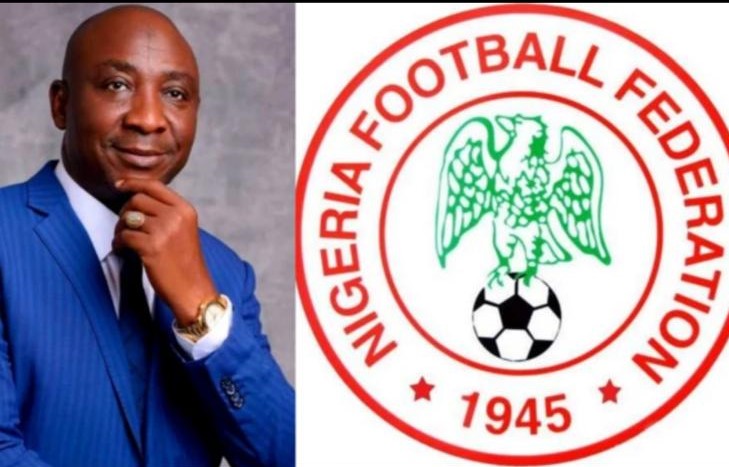
Inside the Power, Endorsements and Influence That Could Decide the Election
State FAs still control 37 of the NFF Congress’ 54 votes. Public reports say many have already backed incumbent President Ibrahim Musa Gusau. With the secret ballot approaching, Nigerians deserve to know who these associations are, who leads them and how the system protecting electoral independence is supposed to work.
BY PAUL LUCKY OKOKU
AUTHOR’S NOTE
This report is written solely in the interest of transparency and the future of Nigerian football. I have no candidate in the September 27 NFF election and neither support nor oppose anyone seeking office.
My standard is simple: verify before I amplify. A factual claim must be supportable before I present it as fact. Where public records conflict, both versions are identified.
The purpose is to help Nigerians understand who holds electoral power, how that power is structured, and what information the public is entitled to know about those entrusted with helping shape the future of Nigerian football.
Nigeria knows Ibrahim Musa Gusau.
By September, Nigerians will know the final list of candidates cleared to challenge him or contest other positions in the Nigeria Football Federation.
But another group deserves public attention.
Under the 2026 NFF Statutes, the 36 State Football Associations and the Federal Capital Territory Football Association possess 37 of the Congress’ 54 votes — approximately 68.5 percent of the total voting strength.
Each association sends two delegates but exercises one vote. The Congress comprises 108 delegates carrying 54 votes.
That makes the State/FCT associations the largest single concentration of electoral power in Nigerian football.
So this report begins with a basic transparency question:
Who are the 37?
THE CHAIRMAN IS NOT AUTOMATICALLY THE VOTER
One distinction is essential.
Calling these men “the 37 voters” would technically be inaccurate.
The NFF guidelines require delegates to belong to the member association they represent and to be appointed or elected by that association’s appropriate body. Only delegates physically present may vote; proxy voting is prohibited. The official delegates’ list is scheduled for publication on September 13, 2026.
Therefore, an FA chairman may be influential without necessarily being the individual who physically casts his association’s ballot.
The ballot itself is secret.
This report is not attempting to discover what anyone will write on that ballot.
It is identifying the associations and leadership structures surrounding those 37 votes before the delegates enter the polling booth.
ROLL CALL: THE 37 STATE/FCT FOOTBALL ASSOCIATIONS
The following is the working roll call developed from public records and additional information supplied during this investigation.
Where two different names appear, the discrepancy is deliberately retained pending definitive confirmation from the relevant FA or the NFF. That is preferable to presenting an uncertain name as established fact.
- Abia State — Dr. Obioma Onyeaghala
- Adamawa State — Waziri Abba Gawe (Furo) / Abubakar Muhammed
- Akwa Ibom State — Samuel Umoh
- Anambra State — Chikelue Iloenyosi
- Bauchi State — Patrick Pascal
- Bayelsa State — Barr. Poubeni Ogun / Ama-Ebi Ebikake
- Benue State — Barr. Paul Edeh
- Borno State — Alhaji Babagana Kalli
- Cross River State — Rt. Hon. Essien Ekpeyong Ayi / Apostle Eyo Ukpong
- Delta State — Chief Godwin Adode
- Ebonyi State — Sen. Obinna Ogba / Hon. Charles Akpuenika
- Edo State — Fred Newton Erhunmwunse
- Ekiti State — Chief Oluwole Oloworemo
- Enugu State — Barr. Tony Ugwu
- Gombe State — Yakubu Philibus Sarma / Ahmed Shuaibu Gara-Gombe
- Imo State — Barr. Ifeanyi Dike
- Jigawa State — Alhaji Sabo Abdullahi Dutse
- Kaduna State — Faisal Abdullahi, also known as Faisal Tozo
- Kano State — Dr. Sharif Rabiu Inuwa Ahlan
- Katsina State — Engr. Surajo Yazeed Abukur / Alhaji Aminu Balele Shagumba
- Kebbi State — Alhaji Abubakar Ladan
- Kogi State — Alhaji Hassan Muhammad Wada
- Kwara State — Mallam Abdullahi Idris Musa (“Thuraya”)
- Lagos State — Gafar Olawale Liameed
- Nasarawa State — Salisu Usman Galadima / Hon. Silas Agara
- Niger State — Ahmed Yusuf “Fresh”
- Ogun State — Alhaji Ganiyu Majekodunmi
- Ondo State — Otunba Sunday Dele-Ajayi
- Osun State — Chief Sola Fanawopo
- Oyo State — HRM Oba James Oluyemi Odeniran
- Plateau State — Hon. Suleiman Yahaya-Kwande
- Rivers State — Barr. Christopher Green
- Sokoto State — Mohammed Nasiru Sa’idu
- Taraba State — Dr. Timothy Heman Magaji
- Yobe State — Garba Mohammed / Mohammed Sanusi
- Zamfara State — Alhaji Aminu Mammaga / Ibrahim Musa Gusau
- FCT, Abuja — Adam Mouktar Mohammed / Amidu Sani
Several of those discrepancies illustrate precisely why the exercise matters.
For example, recent public material continues to identify Adam Mouktar Mohammed as FCT FA chairman and Salisu Usman Galadima as Nasarawa FA chairman. Current material also identifies Aminu Mammaga as Zamfara FA chairman, while Ibrahim Gusau is the former Zamfara FA chairman who now serves as NFF president.
Similarly, Ahmed Shuaibu Gara-Gombe is publicly described in current reporting as a former Gombe State FA chairman, not the present chairman.
The purpose of highlighting these discrepancies is to improve the accuracy of the public record and allow the relevant associations or the NFF to clarify any uncertainty.
Where uncertainty exists about who currently leads a State or FCT FA, a regularly updated public register from the NFF would provide useful clarity for journalists, stakeholders and the Nigerian football public.
WHAT HAS ACTUALLY BEEN ENDORSED?
Public reports published in Nigerian newspapers, broadcast-media websites and online platforms during July described significant support among State FA leaders for Ibrahim Musa Gusau’s bid for another term.
It is important to be clear about the source of this information. These endorsement claims are part of the public record. They were published publicly; they were not created by this report, obtained from a private database or inferred from personal relationships. Where an endorsement has been reported, this article presents it as a reported public endorsement, not as proof of how any individual will ultimately vote.
On July 25, a South-West FA chairmen’s meeting was publicly reported to have unanimously adopted Gusau as its preferred candidate. A communiqué was attributed to Ogun State FA chairman Ganiyu Majekodunmi on behalf of the zonal forum.
On July 26, a South-East virtual meeting was publicly reported as involving the chairmen of the five State FAs in the zone — Abia, Anambra, Ebonyi, Enugu and Imo — alongside other senior football officials. The published account described the meeting as an endorsement of Gusau and specifically quoted Anambra State FA chairman Chikelue Iloenyosi as speaking positively about inclusion of State FAs and youth-football development under the current administration.
However, subsequent public material involving Iloenyosi deserves to be recorded as well. On August 17, an online video post headed “Disclaimer Alert” stated that the Anambra FA chairman wished to make clear that he had “no knowledge, involvement, or consent” regarding a matter being attributed to him. Because the full context of that disclaimer could not be independently established from the accessible public record, this report will not assume that it necessarily repudiated the July 26 endorsement. It is nevertheless relevant that a public disclaimer exists, and any definitive account of Iloenyosi’s current position should take his own clarification into consideration.
On July 28, the six North-West FA chairmen issued a publicly reported joint statement thanking their counterparts in the North Central, North East, South East, South South and South West for what the statement described as unanimous support for Gusau’s second-term bid. The statement was reported as being jointly signed by the FA chairmen from Kaduna, Kano, Sokoto, Kebbi, Jigawa and Zamfara.
More recently, North-Central FA chairmen were publicly reported to have gone beyond endorsement by purchasing Gusau’s presidential nomination form.
These reports are important, but they must be interpreted carefully.
A reported endorsement is evidence of publicly declared political support. It is not evidence of how a secret ballot will ultimately be cast.
Nor should a collective zonal statement automatically be treated as proof that every individual chairman personally agreed with every word attributed to the group unless that participation can be separately established.
That distinction is especially important where subsequent clarifications, disclaimers or denials emerge.
An endorsement is political support. A ballot is a vote. They are not necessarily the same thing.
THE TIMING RAISES A FAIR PROCEDURAL QUESTION
The official electoral timetable was issued on July 31, 2026.
It provides for publication of the final list of cleared candidates on September 11–12, publication of delegates on September 13 and commencement of campaigns on September 14, with campaigning ending September 24. Election day is September 27.
Yet some zonal endorsements were publicly announced before July 31.
That fact does not establish a violation.
The relevant question is narrower:
Under the Electoral Committee’s rules, does a public endorsement made before September 14 constitute campaigning, or is it permissible pre-campaign political activity?
Only the responsible electoral authority can authoritatively answer that.
Clarifying the issue publicly would protect the incumbent, his challengers and the credibility of the process.
GUSAU’S HISTORY WITH THE STATE FA CONSTITUENCY
Gusau’s relationship with State FA politics did not begin with his NFF presidency.
Before his election as NFF president in 2022, he chaired the Zamfara State Football Association and had served as Chairman of Chairmen, giving him substantial experience within the very constituency that remains the dominant bloc in Congress.
That history provides an understandable political advantage: relationships, familiarity and institutional experience.
But political advantage should not be confused with wrongdoing.
There is no evidence presented in this report that longstanding relationships amount to control or coercion.
The appropriate question is simply whether every association and eventual delegate remains free to evaluate the candidates independently.
INDEPENDENCE IS ALREADY REQUIRED BY THE RULES
The NFF Electoral Code provides a useful standard against which all sides can be judged.
It requires principles including independence, transparency and avoidance of conflicts of interest throughout the electoral process and expressly prohibits undue influence by third parties. The Code also requires the NFF to notify FIFA and CAF if such undue influence occurs.
That is why questions about governors, sports commissions, political office-holders, NFF officials and other influential actors are legitimate.
But there is an equally important qualification:
This investigation has not established that any governor has directed an FA chairman or delegate to vote for Gusau or any other candidate.
Nor has this investigation established that Gusau offered money, appointments, trips, contracts, committee positions or other benefits in exchange for electoral support.
Without evidence, neither allegation should be presented as fact.
The transparency question is whether the safeguards against such influence are sufficiently strong and visibly enforced.
GARA-GOMBE SHOWS WHY THE DEBATE IS NOT ONE-SIDED
Ahmed Shuaibu Gara-Gombe is particularly useful to this discussion because the public debate is not simply divided between people who support the current system and people who oppose reform.
On July 20, Gara-Gombe publicly argued that repeatedly changing NFF leadership would not, by itself, repair Nigerian football. He said the deeper structural problems require attention and cautioned against reducing reform to changing personalities.
He subsequently disagreed publicly with Segun Odegbami’s call to halt the election.
That position deserves to be represented alongside criticism of the electoral structure.
It demonstrates that serious football stakeholders can agree that reform is necessary while disagreeing strongly over how and when reform should occur.
That is a healthier frame for this debate than labelling everyone either “pro-NFF” or “anti-NFF.”
ODEGBAMI’S “SEWN UP” WARNING
On August 8, Segun “Mathematical” Odegbami published a sharply different assessment of the electoral system and called for the process to be stopped while Nigerian football reconsidered its governance structure.
His contention was that the structure made the outcome effectively predetermined — in his words, already “sewn up.”
That is Odegbami’s position,
The public endorsements make his warning worthy of examination, but they do not prove his conclusion.
A bloc may endorse a candidate legitimately.
Delegates still vote secretly.
Consensus is not automatically coercion.
The proper journalistic question is therefore not, “Has the election already been rigged?”
It is:
Does the present electoral architecture offer enough genuine competition and independence to give Nigerians confidence in the eventual result?
TRANSPARENCY DOES NOT MEAN EXPOSING THE BALLOT
There should be a clear boundary.
Nigeria does not need to know which candidate a particular delegate marks on a secret ballot.
Nigeria should know:
Who officially heads every State/FCT FA.
Who the two accredited delegates from each association are once the official list is published.
How those delegates were selected.
Which associations or zonal forums have publicly endorsed candidates.
Whether every association identified in a collective endorsement actually participated in it.
Whether an FA leadership dispute affects the authority to appoint delegates.
And how the Electoral Committee protects those delegates from prohibited outside influence.
Those are institutional questions, not personal attacks.
FOOTBALL BELONGS TO THE PUBLIC TOO
For millions of Nigerians, football is more than an administrative exercise.
It is history.
It is community.
It is national identity.
It is one of the few things capable of bringing Nigerians from different regions, languages and backgrounds together around the same shirt.
The administrators do not own that emotional investment.
The candidates do not own it.
The delegates do not own it.
They are custodians of a game that belongs, in a larger sense, to everyone who follows, funds, plays, coaches, sponsors and cares about Nigerian football.
That is why knowing who the 37 associations are should never be controversial.
The September 27 election should not become a trial of Ibrahim Gusau simply because he is the incumbent. Nor should an FA chairman be treated as compromised merely because he supports Gusau.
The incumbent is entitled to seek another term.
His opponents are entitled to challenge him.
Football associations are entitled to support whichever candidate they believe is best.
And Nigerians are entitled to understand the structure through which that choice is made.
Let the ballot remain secret.
But the system surrounding the ballot should be visible.
That is accountability.
That is how public confidence is built.
That is transparency.
SHARE NOTE
If you believe Nigerian football is better served when its governance is understood by the people it represents, please share this report. Corrections supported by verifiable information are welcome, particularly regarding the current leadership of any State or FCT Football Association listed here. Transparency improves when the public record improves.
Paul Lucky Okoku
FIFA Legend | Former Nigeria Flying Eagles Vice-Captain | Former Super Eagles International | AFCON Silver Medalist | Football Historian | Football Analyst | Journalist-at-Large | Founder & CEO, Greater Tomorrow Children’s Foundation (GTCF)