
BY PAUL LUCKY OKOKU
The FIFA World Cup began in 𝟏𝟗𝟑𝟎.
Nigeria had to wait more than half a century before one of her national football teams finally crossed that historic threshold and appeared at a FIFA World Cup tournament.
It happened in 𝟏𝟗𝟖𝟑.
The team was the 𝐅𝐥𝐲𝐢𝐧𝐠 𝐄𝐚𝐠𝐥𝐞𝐬.
The destination was 𝐌𝐞𝐱𝐢𝐜𝐨.
And the coach was a Nigerian.
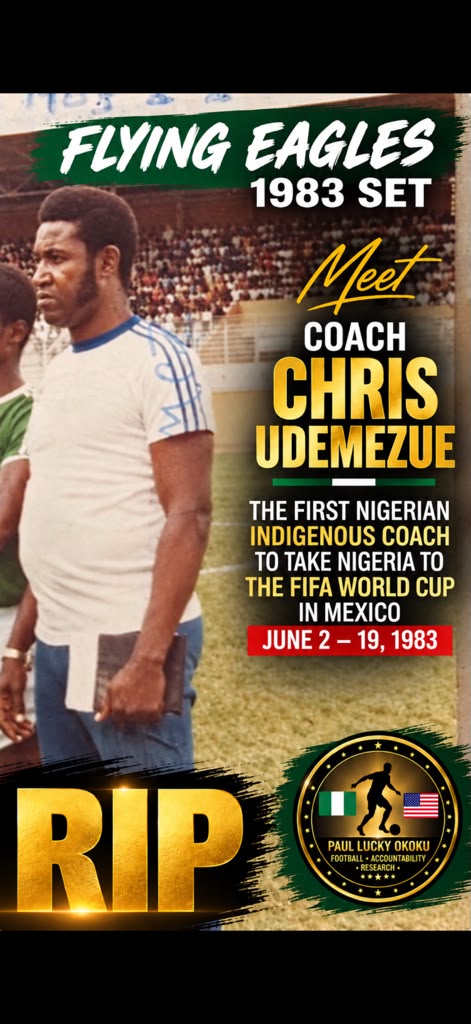
𝐂𝐡𝐫𝐢𝐬𝐭𝐨𝐩𝐡𝐞𝐫 𝐔𝐝𝐞𝐦𝐞𝐳𝐮𝐞.
Let me repeat his name.
𝐂𝐡𝐫𝐢𝐬𝐭𝐨𝐩𝐡𝐞𝐫 𝐔𝐝𝐞𝐦𝐞𝐳𝐮𝐞.
And once more, because Nigerian football history should never allow that name to disappear:
𝐂𝐡𝐫𝐢𝐬𝐭𝐨𝐩𝐡𝐞𝐫 𝐔𝐝𝐞𝐦𝐞𝐳𝐮𝐞.
Not an expatriate.
A Nigerian.
He coached the team that became the first Nigerian national football team—at any level—to play at a FIFA World Cup tournament.
That should be enough to make his name permanent in Nigerian football history.
Yet how often do we hear it?
Born 𝐒𝐞𝐩𝐭𝐞𝐦𝐛𝐞𝐫 𝟐, 𝟏𝟗𝟑𝟕, in 𝐍𝐧𝐞𝐰𝐢, in present-day Anambra State, Udemezue’s life and football journey became deeply connected to northern Nigeria. He began his football career in 𝐉𝐨𝐬 in 𝟏𝟗𝟓𝟖, played for Plateau Eleven and spent significant years playing and coaching in the North.
𝐊𝐚𝐝𝐮𝐧𝐚 was also part of the man I personally knew. During one of our trips there with the Flying Eagles, Coach Udemezue took us to his home in Kaduna. That is one of my own memories of him—not something recovered from an archive, but something I experienced as his player.
He died in Kaduna on 𝐌𝐚𝐲 𝟑𝟏, 𝟏𝟗𝟗𝟐, at only 𝟓𝟒 years of age—far too young for a man whose contribution to Nigerian football had already become historic.
He would later coach 𝐃𝐈𝐂 𝐁𝐞𝐞𝐬 𝐨𝐟 𝐊𝐚𝐝𝐮𝐧𝐚, which became Ranchers Bees, and work with the National Sports Commission in Kaduna. He died on 𝐌𝐚𝐲 𝟑𝟏, 𝟏𝟗𝟗𝟐, in Kaduna.
So when we remember Christopher Udemezue, we should remember the fullness of the man: born in Nnewi, shaped in significant measure by Jos and northern Nigerian football, established in Kaduna, a former Nigerian international, and ultimately the Nigerian coach who led our generation onto the FIFA World Cup stage.
𝐖𝐎𝐔𝐋𝐃 𝐖𝐄 𝐑𝐄𝐌𝐄𝐌𝐁𝐄𝐑 𝐇𝐈𝐌 𝐃𝐈𝐅𝐅𝐄𝐑𝐄𝐍𝐓𝐋𝐘 𝐈𝐅 𝐇𝐄 𝐖𝐄𝐑𝐄 𝐀𝐍 𝐄𝐗𝐏𝐀𝐓𝐑𝐈𝐀𝐓𝐄?
This is not an attack on Nigeria’s foreign coaches. Many served our country with distinction and deserve the recognition they receive.
But history permits us to ask uncomfortable questions.
We remember foreign coaches. Their anniversaries return. Their birthdays are recalled. Their photographs circulate. Their achievements are retold to another generation.
So let me ask:
If Christopher Udemezue had been an expatriate, would Nigerian football remember his birthday every year?
Would we celebrate him annually?
Would documentaries have been made about him?
Would young Nigerian football supporters immediately know who he was?
And perhaps the most important question:
Why should we need him to have been foreign before appreciating what he accomplished for Nigeria?
He deserves better.
𝐇𝐄 𝐃𝐈𝐃 𝐍𝐎𝐓 𝐈𝐍𝐇𝐄𝐑𝐈𝐓 𝐀 𝐓𝐄𝐀𝐌 𝐎𝐅 𝐒𝐔𝐏𝐄𝐑𝐒𝐓𝐀𝐑𝐒
I know because I was there.
Coach Udemezue was a disciplinarian. Demanding. Uncompromising.
But that was not the whole man. He could joke with us. There were lighter moments. There was laughter. Beneath the discipline was a coach trying to shape young footballers into something larger than the individuals he had inherited.
And we believed in him.
More importantly, we believed in his vision.
Many of us were young footballers still making our names. He took raw talent, different personalities and young men from different backgrounds and molded us into a national team.
We submitted ourselves to his methods because we could see where he was trying to take us.
He disciplined us.
He challenged us.
He groomed us.
And eventually, he took us where no Nigerian national football team had gone before.
To a FIFA World Cup.
Nigeria also became African youth champions in 𝟏𝟗𝟖𝟑. The achievement was therefore not simply reaching Mexico. Udemezue and his players had first navigated the African qualification road and established themselves on the continent before carrying Nigeria’s flag onto the world stage.
That journey gave Nigerian football something it had never possessed before:
A place at a FIFA World Cup tournament.
𝐖𝐇𝐄𝐍 𝐍𝐈𝐆𝐄𝐑𝐈𝐀 𝐀𝐑𝐑𝐈𝐕𝐄𝐃
I can still see it.
More than half a century after the first FIFA World Cup was played in 𝟏𝟗𝟑𝟎, there we were in Mexico in 𝟏𝟗𝟖𝟑.
For the first time, Nigeria had arrived at a FIFA World Cup tournament.
During the opening ceremony, the placard bearing 𝐍𝐈𝐆𝐄𝐑𝐈𝐀 moved proudly in front of our delegation. Behind it came our national flag, fluttering in the Mexican air.
Nigeria.
Our name was there.
Our flag was there.
Our young footballers were there.
Television cameras carried those images beyond the stadium to audiences around the world. For the first time at a FIFA World Cup tournament, the world was being introduced to a Nigerian national football team.
At our hotel, parents arrived with their children. They lined up asking us for autographs.
Imagine that.
Young Nigerians who had left home as footballers were suddenly standing in Mexico signing their names for children who wanted something by which to remember them.
Then came 𝐌𝐨𝐧𝐭𝐞𝐫𝐫𝐞𝐲 and our opening match against the 𝐒𝐨𝐯𝐢𝐞𝐭 𝐔𝐧𝐢𝐨𝐧.
From the stands came a sound I can still hear:
“Nigeria! Nigeria! Rah! Rah! Rah!”
Mexicans were cheering for us.
We were thousands of miles from home, yet somehow Nigeria did not feel so far away.
The flag.
The placard.
The voices.
The children.
The cameras.
The green and white on the world stage.
You cannot erase that memory.
Nigeria had arrived.
And behind that historic arrival stood two Nigerian coaches: 𝐂𝐡𝐫𝐢𝐬𝐭𝐨𝐩𝐡𝐞𝐫 𝐔𝐝𝐞𝐦𝐞𝐳𝐮𝐞, assisted by 𝐈𝐬𝐢𝐚𝐤𝐚 𝐘𝐚𝐤𝐮𝐛𝐮.
Two Nigerians helped take Nigerian boys where no Nigerian national football team had gone before.
Their names belong in the history of that breakthrough.
𝐓𝐇𝐄 𝐃𝐀𝐘 𝐍𝐈𝐆𝐄𝐑𝐈𝐀 𝐁𝐑𝐎𝐊𝐄 𝐓𝐇𝐑𝐎𝐔𝐆𝐇
𝐉𝐚𝐧𝐮𝐚𝐫𝐲 𝟖, 𝟏𝟗𝟖𝟑.
I can still remember the atmosphere at the 𝐍𝐚𝐭𝐢𝐨𝐧𝐚𝐥 𝐒𝐭𝐚𝐝𝐢𝐮𝐦, 𝐋𝐚𝐠𝐨𝐬.
Just weeks earlier, on 𝐃𝐞𝐜𝐞𝐦𝐛𝐞𝐫 𝟏𝟗, 𝟏𝟗𝟖𝟐, Guinea had beaten us 𝟐–𝟏 in Conakry in the first leg of our African Youth Championship semifinal. Now we were back on Nigerian soil with history within reach.
It was barely a week after New Year. Christmas had come and gone, but there had been little time for celebration. We had sacrificed much of that festive period preparing for one assignment: put Nigeria on the FIFA World Cup stage for the first time.
Nigeria responded.
All roads seemed to lead to the National Stadium.
The stadium was electrifying.
NTA was there. The newspapers were there. Radio stations carried the occasion across the country. Nigerians who could not be inside the stadium followed every movement of the ball from their homes, shops and gathering places.
And among the voices carrying that afternoon into Nigerian homes was one of the most celebrated football commentators our country has produced:
𝐄𝐫𝐧𝐞𝐬𝐭 𝐎𝐤𝐨𝐧𝐤𝐰𝐨.
Those who heard Ernest Okonkwo on radio will understand. He could make you see a football match without seeing a television screen. His voice supplied the pictures.
And on this day, the picture was history.
Nigeria scored.
𝐇𝐮𝐦𝐩𝐡𝐫𝐞𝐲 𝐄𝐝𝐨𝐛𝐨𝐫 scored.
𝐓𝐚𝐫𝐢𝐥𝐚 𝐎𝐤𝐨𝐫𝐨𝐰𝐚𝐧𝐭𝐚 scored.
And Tarila gave us one of those little moments that never appear in official match reports.
When he scored, we jumped on him in celebration. Everybody was jubilating. We were chasing history, the stadium was roaring, and naturally we wanted to bury our teammate underneath a pile of celebrating bodies.
Then, from somewhere underneath us, Tarila cried out:
“Make una come out, na one wound me!”
Even in one of the most consequential moments of our young football lives, there was room for laughter.
But there was still a job to finish.
Nigeria 2. Guinea 0.
Nigeria 3–2 on aggregate.
And when the final whistle came, more than half a century after the inaugural FIFA World Cup of 𝟏𝟗𝟑𝟎, Nigeria had finally broken through.
The country was going to 𝐌𝐞𝐱𝐢𝐜𝐨 𝟏𝟗𝟖𝟑.
I can still remember the excitement surrounding 𝐄𝐫𝐧𝐞𝐬𝐭 𝐎𝐤𝐨𝐧𝐤𝐰𝐨’s commentary—the sense that Nigeria had finally made it, that for the first time in our history a Nigerian national football team was going to a FIFA World Cup tournament.
Those inside the National Stadium heard the roar.
Those listening on radio heard Ernest Okonkwo.
Those following across Nigeria understood what had happened.
The jinx had been broken.
Think about that afternoon.
The National Stadium alive.
The television cameras rolling.
Radio carrying the drama across Nigeria.
Thousands inside the stadium.
Millions beyond it.
And a group of young Nigerian footballers who had sacrificed much of their Christmas and New Year festivities now standing at the center of a moment Nigerian football had never experienced before.
Nigeria was going to a FIFA World Cup tournament for the first time.
And standing behind that breakthrough was our Nigerian coach:
𝐂𝐡𝐫𝐢𝐬𝐭𝐨𝐩𝐡𝐞𝐫 𝐔𝐝𝐞𝐦𝐞𝐳𝐮𝐞.
He had taken a group of young footballers, demanded discipline from us, made us believe in his vision and brought us to the threshold.
On 𝐉𝐚𝐧𝐮𝐚𝐫𝐲 𝟖, 𝟏𝟗𝟖𝟑, we crossed it.
And a few months later, in Mexico, we would discover what it felt like to see NIGERIA walk onto a FIFA World Cup stage for the first time.
𝐀 𝐆𝐄𝐍𝐄𝐑𝐀𝐓𝐈𝐎𝐍 𝐓𝐇𝐀𝐓 𝐖𝐀𝐒 𝐍𝐄𝐕𝐄𝐑 𝐓𝐀𝐔𝐆𝐇𝐓 𝐓𝐇𝐄 𝐒𝐓𝐎𝐑𝐘
This is where the story becomes larger than 𝐂𝐨𝐚𝐜𝐡 𝐂𝐡𝐫𝐢𝐬𝐭𝐨𝐩𝐡𝐞𝐫 𝐔𝐝𝐞𝐦𝐞𝐳𝐮𝐞 or the 𝟏𝟗𝟖𝟑 𝐅𝐥𝐲𝐢𝐧𝐠 𝐄𝐚𝐠𝐥𝐞𝐬.
About a decade ago, 𝐓𝐚𝐣𝐮𝐝𝐞𝐞𝐧 𝐃𝐢𝐬𝐮 and I appeared on a Nigerian radio program with veteran sports journalist 𝐆𝐨𝐝𝐰𝐢𝐧 𝐄𝐧𝐚𝐤𝐡𝐞𝐧𝐚.
During the discussion, Taju and I spoke about our place in Nigerian football history: the 𝟏𝟗𝟖𝟑 Flying Eagles were the first Nigerian national football team to reach a FIFA World Cup tournament.
A younger journalist on the program stopped us in our tracks.
He turned to Godwin and asked:
“Is that true? They were the first?”
Godwin confirmed it.
The young man was stunned. He apologized and acknowledged that he had always believed the 𝟏𝟗𝟗𝟒 Super Eagles were Nigeria’s first national team to reach a World Cup.
Then he said something I have never forgotten:
“You veteran journalists have failed us younger ones.”
He went further. He said that the story of pioneers such as the 𝟏𝟗𝟖𝟑 Flying Eagles should be taught to Nigerian children in school, including through subjects such as Social Studies, so that younger generations would grow up knowing the people and events that shaped their country’s sporting history.
I remember that exchange because I was there.
Tajudeen Disu was there. Godwin Enakhena was there.
This was not a story somebody told me years later. I heard those words during our interview.
During that same radio program, veteran sports journalist 𝐌𝐢𝐭𝐜𝐡𝐞𝐥𝐥 𝐎𝐛𝐢 called into the show to speak about us and the 𝟏𝟗𝟖𝟑 Flying Eagles.
His contribution reinforced something important: this history was known by people who had followed Nigerian football across generations. Yet here was a younger journalist discovering it almost by accident during a radio conversation.
I have often thought back to that conversation, especially when considering how Nigerian football history is preserved and passed on.
Not long after 𝐒𝐭𝐞𝐩𝐡𝐞𝐧 𝐊𝐞𝐬𝐡𝐢 led Nigeria to victory at the 𝟐𝟎𝟏𝟑 Africa Cup of Nations, I was with him in Nigeria while he was involved in a Peak Milk commercial shoot. During that period, Keshi and I visited 𝐌𝐢𝐭𝐜𝐡𝐞𝐥𝐥 𝐎𝐛𝐢 at his office in Ikeja.
I remember seeing the depth of football records and documents 𝐌𝐢𝐭𝐜𝐡𝐞𝐥𝐥 𝐎𝐛𝐢 had preserved. It was a remarkable collection and another reminder of the richness of Nigerian football history and the generations of journalists, players and administrators who have helped preserve it.
That memory, together with what happened during the radio program, brings me back to a broader question about how we pass our sporting history from one generation to the next.
If the history was known, if the records existed, and if people who lived through that period were still among us, how did so many younger Nigerians grow up believing that Nigeria’s World Cup story began in 𝟏𝟗𝟗𝟒?
Somewhere between one generation knowing the history and another generation inheriting it, the chain of transmission had weakened.
That young journalist’s lack of knowledge was not the tragedy.
The tragedy was that the history had not reached him.
That is why preservation alone is not enough. Records can exist. Newspapers can survive. Archives can be carefully maintained. Former players and veteran journalists can carry extraordinary memories.
But history that remains stored is different from history that is transmitted.
It must be written.
It must be taught.
It must be discussed.
It must be handed from one generation to the next.
We cannot keep history in filing cabinets, newspaper libraries, private collections, archives and the memories of ageing footballers and journalists, then blame young Nigerians for not knowing it.
We cannot hoard yesterday and then accuse tomorrow of forgetting it.
𝐇𝐈𝐒𝐓𝐎𝐑𝐘 𝐇𝐀𝐒 𝐑𝐎𝐎𝐌 𝐅𝐎𝐑 𝐄𝐕𝐄𝐑𝐘 𝐆𝐄𝐍𝐄𝐑𝐀𝐓𝐈𝐎𝐍
We celebrate 𝟏𝟗𝟖𝟎.
We celebrate 𝟏𝟗𝟗𝟒.
We celebrate 𝟏𝟗𝟗𝟔.
And we should.
Those generations earned their places in Nigerian football history.
The 𝟏𝟗𝟗𝟒 Super Eagles became Nigeria’s first senior national football team to qualify for the FIFA World Cup. That achievement belongs permanently to them.
But Nigeria’s first national football team—at any level—to reach a FIFA World Cup tournament had already opened that door eleven years earlier.
The 𝟏𝟗𝟖𝟑 Flying Eagles.
Recognizing one does not diminish the other.
History is not a table with only enough seats for the most famous.
There must also be a seat for 𝟏𝟗𝟖𝟑.
Perhaps the younger journalist was right about something else too.
Maybe this history should be taught.
Sporting history is part of national history. Nigerian children should know the men and women who carried their country’s flag onto international stages, broke barriers and established milestones for generations that followed.
Why should a Nigerian child know 𝟏𝟗𝟗𝟒 but never hear about 𝟏𝟗𝟖𝟑?
Why should we expect younger Nigerians to remember 𝐂𝐡𝐫𝐢𝐬𝐭𝐨𝐩𝐡𝐞𝐫 𝐔𝐝𝐞𝐦𝐞𝐳𝐮𝐞 if the generations entrusted with preserving the history never consistently introduced him to them?
We cannot blame a generation for failing an examination when nobody gave them the textbook.
Those of us who lived this history therefore carry a responsibility too.
If nobody else tells it, we must.
Not to embellish it.
Not to compete with those who came afterward.
Not to take anybody else’s flowers.
But to restore an important chapter of Nigerian football history to its rightful place.
𝐑𝐄𝐌𝐄𝐌𝐁𝐄𝐑 𝐓𝐇𝐄 𝐍𝐀𝐌𝐄
Christopher Udemezue died in 𝟏𝟗𝟗𝟐, far too young.
But what he accomplished did not die with him.
Before Nigeria’s senior team reached America in 𝟏𝟗𝟗𝟒, Udemezue had already taken Nigerian football onto the FIFA World Cup stage in Mexico in 𝟏𝟗𝟖𝟑.
That is not nostalgia.
That is Nigerian football history.
History does not disappear only because records are destroyed.
Sometimes history disappears because people stop telling it.
More than half a century after the FIFA World Cup began in 𝟏𝟗𝟑𝟎, a Nigerian coach led a Nigerian national football team onto that world stage for the first time.
He was not an expatriate.
He was one of our own.
His achievement should not require rediscovery every generation.
His birthday should not pass unnoticed while we faithfully remember others who served Nigerian football.
His name should not become a trivia question that only historians, veteran journalists and former players can answer.
So today, I am doing my small part.
Putting a Nigerian pioneer back where he belongs.
A former Nigerian international.
A disciplinarian.
A builder of young footballers.
An African champion.
The coach who stood on the touchline when Nigeria crossed a threshold it had never crossed before.
The man who helped put the green and white onto a FIFA World Cup stage for the first time.
His name was:
𝐂𝐡𝐫𝐢𝐬𝐭𝐨𝐩𝐡𝐞𝐫 𝐔𝐝𝐞𝐦𝐞𝐳𝐮𝐞.
Remember the name.
𝐏𝐚𝐮𝐥 𝐋𝐮𝐜𝐤𝐲 𝐎𝐤𝐨𝐤𝐮
FIFA Legend | Former Nigeria Flying Eagles Vice-Captain | Former Super Eagles International | AFCON Silver Medalist | Football Historian | Football Analyst | Investigative Football Writer | Journalist-at-Large | Founder & CEO, Greater Tomorrow Children’s Fund (GTCF)
𝐅𝐞𝐞𝐝𝐛𝐚𝐜𝐤: [email protected]
𝐏𝐥𝐞𝐚𝐬𝐞 𝐬𝐡𝐚𝐫𝐞 𝐬𝐨 𝐰𝐞 𝐜𝐚𝐧 𝐥𝐞𝐚𝐫𝐧 𝐨𝐮𝐫 𝐡𝐢𝐬𝐭𝐨𝐫𝐲, 𝐩𝐫𝐞𝐬𝐞𝐫𝐯𝐞 𝐢𝐭𝐬 𝐯𝐚𝐥𝐮𝐞 𝐚𝐧𝐝 𝐩𝐚𝐬𝐬 𝐢𝐭 𝐟𝐚𝐢𝐭𝐡𝐟𝐮𝐥𝐥𝐲 𝐭𝐨 𝐭𝐡𝐞 𝐧𝐞𝐱𝐭 𝐠𝐞𝐧𝐞𝐫𝐚𝐭𝐢𝐨𝐧. 𝐖𝐞 𝐚𝐫𝐞 𝐚𝐥𝐥 𝐢𝐧 𝐭𝐡𝐢𝐬 𝐭𝐨𝐠𝐞𝐭𝐡𝐞𝐫.