
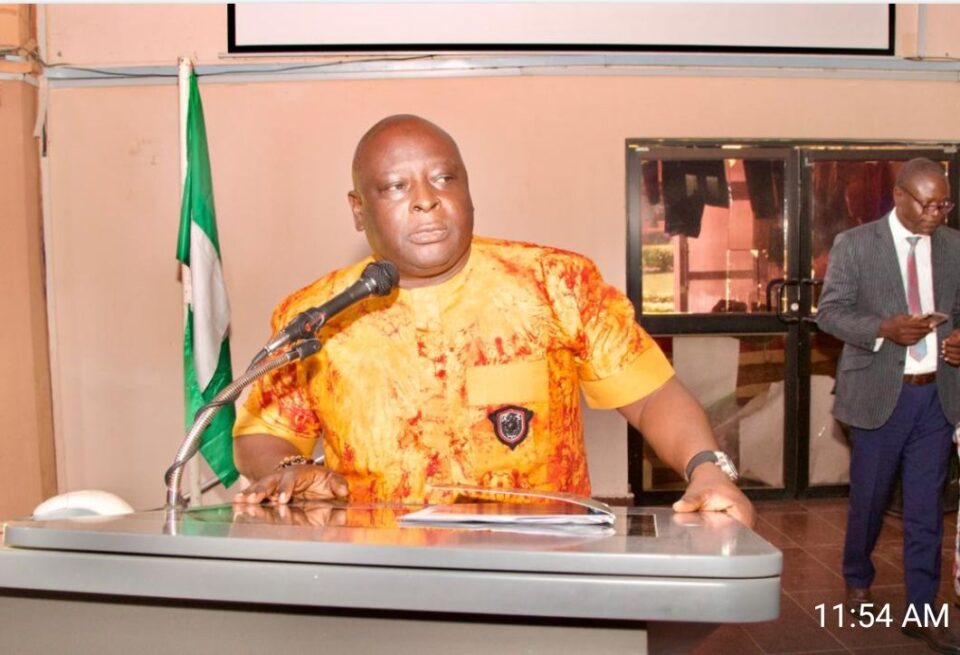
BY DR. SALEH IBRAHIM
In a country where power attracts loyalty and silence often passes for wisdom, Babajide Kolade-Otitoju has built a career on a different creed: speak clearly, stand firmly, and never confuse access with purpose.
For those who attended Babajide’s 60th birthday anniversary and book launch, he truly showed why he is one of the most respected members of the media of this generation.
For over thirty years of my interaction with him, I have watched him operate in Nigeria’s turbulent media space, a terrain where influence is negotiated, proximity to power is prized, and the line between journalism and patronage is dangerously thin. Many have crossed that line, some gradually, others decisively. But Babajide has not. His career stands as a quiet but firm rebuke to compromise.
This is not accidental. It is deliberate.
Nigeria’s media environment is not designed to reward independence. It rewards alignment. It rewards those who understand when to soften their tone, when to look away, when to trade hard questions for continued access. In such a system, courage is not just rare, it is costly.
Yet Babajide has chosen that again and again.
From his commanding presence on Journalists’ Hangout to his broader interventions in national discourse, he has cultivated a voice that does not bend easily. He does not speak to impress. He speaks to challenge. He does not ask questions to fill airtime. He asks them to demand accountability.
But what truly defines him is not just what he says. It is what he has refused to do.
There have been moments, several of them, when the state extended a hand of invitation. High-profile appointments. Strategic roles. The kind that would place him at the center of power, with all the privileges that come with it. For many, that would have been the natural progression a reward for years of visibility and relevance.
Babajide declined.
And in that decision lies the essence of the man. He understood a truth that is often ignored: to serve is not merely to be serviced. Public office, especially in fragile political environments, is not just an opportunity, it is a test. A test of judgment. A test of timing. A test of whether one’s principles can survive proximity to power.
For a journalist, whose only real currency is credibility, that test is even more severe.
Babajide chose to protect that currency.
At moments when he sensed that government was struggling with credibility when public trust was thinning and performance was being questioned he made a conscious decision to remain outside. Not because he lacked the capacity to contribute, but because he understood that joining such a system could dilute the very moral authority that made his voice to matter.
That kind of restraint is rare.It is easy to criticize power from a distance. It is far more difficult to reject it when it invites you in. The allure of office, its prestige, its access, its influence has drawn in many strong voices, only for those voices to grow quieter once inside.
Babajide refused that transformation.
He chose independence over influence. Clarity over comfort. Integrity over opportunity. And that choice has preserved the one thing that cannot be bought or appointed: trust.
That is why his recent remarks in Abuja struck such a powerful chord.
At the launch of his book, with Kashim Shettima and several governors in attendance, Babajide did not adjust his message to suit the room. He did not soften his tone to accommodate power. He spoke as he always has, directly, clearly, and without apology.
“Insecurity remains the biggest challenge facing this country today. Until we fix it, nothing else will work.”
No ambiguity. No diplomacy. Just truth.
Then came the deeper cut:
“Insecurity is demarketing this government. It is eroding public trust and undermining everything else we are trying to build.”
In a setting where many would have chosen caution, Babajide chose accuracy.
He stripped the issue down to its human reality:
“Farmers cannot go to their farms. People cannot move freely. A nation that cannot protect its citizens cannot claim progress.”
And then, in a moment that captured both courage and independence, he challenged leadership directly:
“We must be humble enough to seek help where necessary. There is no shame in it. What matters is solving the problem.”
But perhaps his most enduring line was not just a critique it was a warning:
“Nigerians are watching. History will judge leadership not by promises, but by results.”
That was not a speech crafted for applause. It was a statement of duty. And that is the difference.
In Nigeria today, where public trust in institutions continues to erode, journalism cannot afford timidity. The media is expected to serve as a watchdog, a conscience, and, at times, a mirror reflecting uncomfortable truths. But that role can only be played by those who are willing to stand apart from power, not those eager to be absorbed by it. Babajide Kolade-Otitoju represents that distinction.
His career is a reminder that journalism is not merely a profession. It is a public trust. It demands sacrifice. It demands discipline. And above all, it demands the courage to say no, no to compromise, no to undue influence, and no to opportunities that come at the expense of integrity.
For those of us who have known him for decades, there is no surprise in any of this. He has not shifted with the tides. He has not adjusted his principles to suit the moment. He has remained consistent, steady in his convictions, measured in his approach, and firm in his belief that truth must never bow to power.
Nigeria needs more of this. More journalists who understand that their role is not to echo official narratives, but to interrogate them. More professionals who recognize that credibility, once lost, cannot be easily regained. And more citizens who appreciate that sometimes, the highest form of service is the refusal to serve within a system that compromises one’s values.
This, then, is more than a tribute. It is a statement of what journalism in Nigeria must strive to be fearless, independent, and anchored on principle.
In Babajide Kolade-Otitoju, we see that ideal, fully formed. Not just in what he says.But in what he has refused to become.
*Dr. Saleh was a one time Member of the Governing Council of the Nigerian Institute of Public Relations and one time corporate affairs manager, Cement Company of Northern Nigeria.