
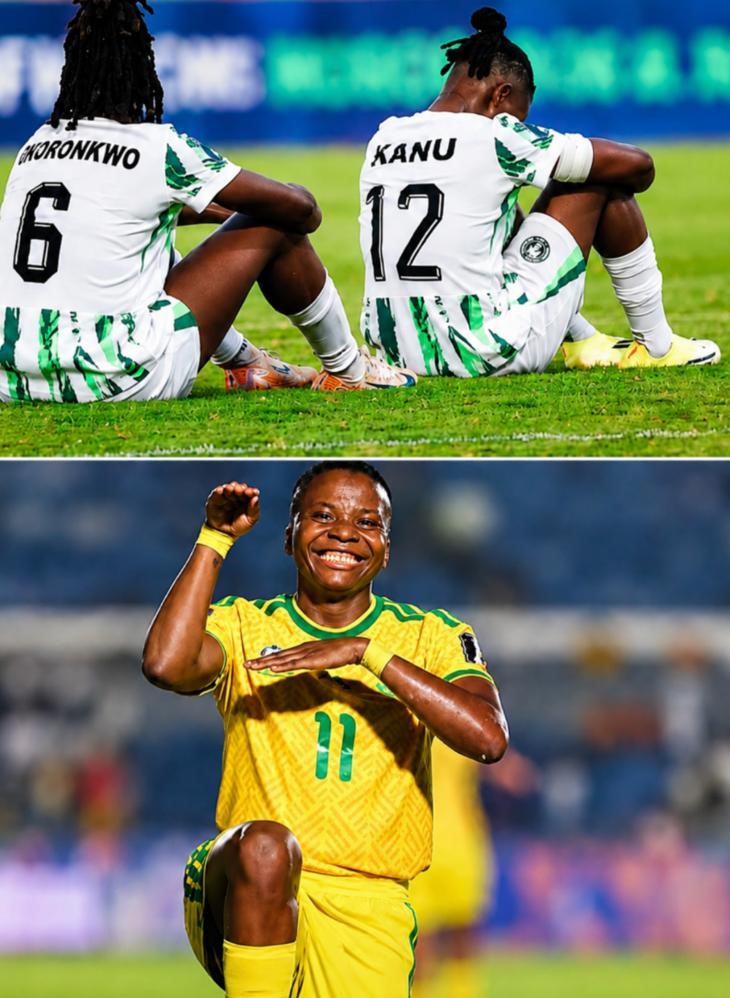
“OUT, OUT, BRIEF CANDLE” — SOUTH AFRICA 🇿🇦 CLOSES NIGERIA’S 🇳🇬 FINAL ROAD TO BRAZIL 🇧🇷 2027
BY PAUL LUCKY OKOKU
August 13, 2026
Out.
Not merely out of a match.
Not merely eliminated from another stage of an African competition.
Nigeria is out of the FIFA Women’s World Cup Brazil 2027.
For the first time since the inaugural Women’s World Cup in 1991, the Super Falcons will not be there.
Nine tournaments came and went, and Nigeria answered the roll call every time:
The tenth will take place without them.
CAF had already documented the magnitude of what was at stake before Nigeria’s quarterfinal against Cameroon: victory would have sent the Super Falcons to a record-extending tenth Women’s World Cup because Nigeria had appeared at every previous edition.
That record is over.
South Africa 🇿🇦 2–1 Nigeria 🇳🇬 .
And somewhere in Casablanca on Thursday night, one of the most dependable traditions in African women’s football came to an end.
And somewhere in Casablanca on Thursday night, one of the most dependable traditions in African women’s football came to an end.
“Out, out, brief candle,” as Shakespeare wrote in Macbeth.
On a night like this, the words almost fit too well.
Because this was not supposed to happen.
Not to Nigeria.
Not to the Super Falcons.
Not to the most successful women’s national team Africa has produced.
How are the mighty fallen.
Yet football does not issue permanent membership cards to greatness.
History may earn respect.
It does not qualify a team for tomorrow.
THE FIRST WARNING CAME AGAINST CAMEROON🇨🇲
Nigeria entered the 2026 Women’s Africa Cup of Nations knowing exactly what was required.
The four semifinalists would qualify automatically for Brazil 🇧🇷 2027.
Reach the last four, and the World Cup ticket was secure.
Nigeria reached the quarterfinals and faced Cameroon, a country the Super Falcons had historically dominated in this competition.
But Cameroon won 1–0.
For the first time at a centralized WAFCON finals, Nigeria failed to reach the semifinals. The direct route to Brazil was gone.
It was painful.
But it was not yet fatal.
The qualification system offered the four losing quarterfinalists another opportunity. They would contest two play-in matches, with the winners advancing to FIFA’s inter-confederation play-offs.
Nigeria drew South Africa.
One more opportunity remained.
CAF confirmed before Thursday’s matches that Nigeria-South Africa and Ghana-Côte d’Ivoire would determine Africa’s two representatives in the intercontinental play-offs.
There would be no ambiguity.
Win and continue dreaming.
Lose and Brazil 2027 was gone.
CASABLANCA: WHEN THE LIGHT WENT OUT
The first half offered more tension than spectacle.
Neither team wanted to make the mistake that would end its World Cup campaign.
South Africa moved the ball with composure without regularly cutting Nigeria apart.
Nigeria had openings of its own.
Michelle Alozie found herself well positioned near the edge of the penalty area but sent her effort wide.
The match remained balanced.
Then Nigeria began the second half with greater urgency.
Asisat Oshoala found space on the right side of the area but delivered too close to South African goalkeeper Kaylin Swart.
Another opportunity followed when the ball dropped invitingly for Oshoala near the six-yard area, but she could not make the decisive connection.
Those are the moments that tournament football remembers.
Not because one player should carry the responsibility for an entire national team, but because matches of this magnitude are often settled by whether opportunities become goals.
South Africa made theirs count.
In the 61st minute, Nigeria was caught by a fast transition.
Linda Motlhalo released Hildah Magaia, whose square pass reached Thembi Kgatlana.
Kgatlana finished.
South Africa 1–0 Nigeria.
Nigeria was suddenly chasing not merely a game but its uninterrupted World Cup history.
Chiamaka Nnadozie later prevented Kgatlana from adding another, while at the opposite end Swart produced an important save from Uchenna Kanu.
Then came the second blow.
Nigeria failed to clear a South African corner decisively. Refiloe Jane collected the loose ball outside the area, struck toward goal, and a deflection wrong-footed Nnadozie.
2–0.
Nigeria was staring at elimination.
Late in the match, Jane handled the ball inside the penalty area and received a second yellow card.
Christy Ucheibe converted the penalty.
2–1.
Hope returned.
But only briefly.
Nigeria could not find the equalizer.
The whistle went.
South Africa celebrated.
Nigeria stopped.
And after nine consecutive Women’s World Cups, the Super Falcons’ remarkable sequence was finished.
THIS WAS NOT A SIMPLE CASE OF NIGERIA BEING OVERWHELMED
That distinction should not be overlooked.
The temptation after an emotional defeat is to rewrite the match as though the losing team did nothing correctly.
That is not what happened in Casablanca.
Nigeria reached threatening positions.
Nigeria created opportunities.
Nigeria forced saves.
There were periods, particularly after halftime, when the Super Falcons looked capable of taking control.
But South Africa was better in the moments that ultimately mattered.
Their first goal came through a transition executed with speed and accuracy.
Their second punished Nigeria’s inability to clear danger completely.
Nigeria’s only goal arrived from the penalty spot near the end.
That is not domination in the conventional sense.
It is something equally important in knockout football:
efficiency.
The best teams do not merely arrive in dangerous areas.
They convert moments.
They recognize transitions.
They clear danger.
They protect themselves immediately after losing possession.
They understand that at international level the difference between survival and elimination can be one second of hesitation.
Nigeria had enough football in the match to survive.
South Africa had enough precision to advance.
That difference sent Banyana Banyana forward and sent the Super Falcons home.
THE CAMPAIGN HAD BEEN WARNING US
Perhaps this result feels shocking because of the name involved.
Nigeria.
Super Falcons.
Ten-time African champions.
But the warning signs did not begin Thursday night.
Nigeria opened this WAFCON with a stunning 3–2 defeat to tournament debutants Malawi.
The Falcons recovered to beat Zambia 1–0 and then defeated Egypt 6–2.
For a moment, confidence returned.
Perhaps the opening defeat had simply been one of those tournament surprises.
Then came Cameroon.
Nigeria lost 1–0.
Then came South Africa.
Nigeria lost again.
Three defeats in one campaign cannot simply be filed away as bad luck.
Nor does that mean Nigeria suddenly possesses poor footballers.
The issue is more complicated.
The Super Falcons can still create.
They still possess internationally experienced players.
They still have individuals capable of changing games.
But tournament football asks whether a team can produce its best performance when the margin for error becomes smallest.
Against Cameroon, Nigeria could not.
Against South Africa, Nigeria could not.
That is where examination must begin.
FROM AFRICAN CHAMPIONS TO WORLD CUP ABSENTEES
The speed of this reversal makes the story even more difficult to comprehend.
Only last year, Justine Madugu stood at the summit of African women’s football.
He guided Nigeria to a record-extending tenth WAFCON championship and was subsequently named CAF’s Coach of the Tournament.
That fact must remain part of any fair assessment.
It would be intellectually dishonest to celebrate Madugu when Nigeria wins and suddenly pretend he knows nothing about coaching when Nigeria loses.
The more useful question is:
What changed?
What happened between a championship campaign and this collapse?
Did Nigeria evolve tactically?
Did opponents study and adapt to the Falcons?
Was the squad refreshed sufficiently?
Were younger players integrated quickly enough?
Were established players being used in roles suited to where they are today rather than what they accomplished years ago?
Was preparation adequate?
Did the technical department identify weaknesses after the previous tournament and correct them?
Did success itself hide problems that victory made easier to overlook?
Those are questions serious football organizations ask.
“Sack everybody” is not analysis.
Neither is pretending nothing is wrong.
THIS IS WHERE LEADERSHIP ENTERS THE CONVERSATION
Whenever Nigerian football suffers a major setback, a familiar argument appears:
The federation president did not play the match.
He did not miss the chances.
He did not choose the starting eleven.
He was not standing in the technical area.
All of that is true.
But that is not where leadership responsibility ends.
The current president of the Nigeria Football Federation is Ibrahim Musa Gusau. FIFA continues to identify him as the head of the federation.
To say that Gusau should be accountable as the leader of the NFF is not to suggest that he caused Kgatlana’s goal or personally made a defensive error.
That would be unreasonable.
But leadership decisions shape the conditions in which national teams succeed or fail.
Federation leadership decides, approves or influences who is appointed to technical positions, how teams are prepared, how resources are allocated, what development priorities are pursued, how scouting systems are organized, and whether national-team coaches operate within a coherent football philosophy.
Those decisions are made long before kickoff.
A federation president does not have to be on the field to influence what eventually happens on it.
That is the point of leadership accountability.
It also includes whether lessons from one competition are formally documented and carried into the next, and whether youth development functions as a genuine pipeline rather than a collection of teams hurriedly assembled whenever another tournament approaches.
Importantly, the NFF itself has already acknowledged that broader responsibility.
After the Cameroon quarterfinal defeat, the federation issued a statement in Gusau’s name apologizing to Nigerians and promising an honest assessment of the Super Falcons’ preparation, technical planning, logistics and overall operations.
At that time, the NFF emphasized that another World Cup route remained and pledged to do everything possible to take advantage of it.
That route is now closed.
So the promised assessment has become even more necessary.
This should not become a personal prosecution of Ibrahim Musa Gusau.
But neither should accountability disappear simply because the president was not wearing football boots.
Authority and accountability must travel together.
That principle should apply to Gusau.
It should apply to the Executive Committee.
It should apply to technical administrators.
It should apply to coaches.
And it should apply to players.
THIS IS BIGGER THAN ONE WOMEN’S MATCH
The Super Falcons’ elimination becomes more concerning when viewed alongside other signals across Nigerian football.
The Super Eagles will not be at the 2026 FIFA World Cup.
Nigeria’s Golden Eaglets were absent from the 2025 U-17 Africa Cup of Nations despite the country’s extraordinary history at that age level. CAF’s own tournament guide confirmed that Nigeria had not qualified.
Only days ago, the Flying Eagles were beaten 4–1 by Burkina Faso in the final of the WAFU B U-20 Championship, after having already lost 2–0 to the same opponent during the group stage.
Now the Super Falcons will miss Brazil 2027.
We must be careful here.
Not every defeat has the same cause.
Not every age group operates under identical circumstances.
A responsible analyst should not simply throw unrelated results into one container and announce that everything is broken.
But when significant setbacks begin occurring across several levels of a national football structure, leadership has an obligation to ask whether there are common weaknesses underneath them.
One bad result may be football.
A pattern deserves investigation.
WE MUST TALK ABOUT THE PIPELINE
This is where my concern extends beyond Casablanca.
As a former midfielder, I learned to look beyond the location of the ball.
A midfielder must see what happened before the problem arrived.
He must see what is developing behind him.
He must anticipate the next pass.
National football development requires the same vision.
Where are tomorrow’s Super Falcons and Super Eagles being systematically prepared?
What is Nigeria’s technical philosophy from youth football into the senior national teams?
Is there continuity?
Do U-15, U-17, U-20 and senior coaches work within a connected developmental framework?
Are players tracked longitudinally?
How many identified prospects move successfully from one age category to the next?
How many youth internationals eventually become productive senior internationals?
Where are the performance databases?
Where are the development benchmarks?
Where is the institutional memory?
Those questions are more important than winning a youth trophy and celebrating for three days.
Youth football exists primarily to produce senior footballers.
Trophies are welcome.
Development is the mission.
Nigeria once possessed pathways through school football, youth football, club football and the national teams that regularly produced players prepared for the next responsibility.
The modern game requires that pathway to be more deliberate, not less.
Talent identification must be continuous.
Coaching education must be continuous.
Player progression must be measured.
Sports science must become normal.
Technical information should move from one national team to another.
A country with Nigeria’s population and football culture should never depend principally on discovering exceptional players by accident.
THE PLAYERS MUST ALSO ACCEPT RESPONSIBILITY
Institutional accountability cannot become a hiding place for footballers.
These were experienced Nigerian internationals.
Many play professionally at high levels.
Some have competed at World Cups and major international tournaments.
They knew what Thursday meant.
They knew there was no third opportunity waiting behind this match.
Nigeria had chances to change the story.
Those opportunities were not converted.
Defensive moments were not managed well enough.
South Africa punished mistakes more decisively.
Players must look at themselves too.
Coaches must review their decisions.
Technical administrators must review preparation.
The federation must review the system.
Everybody owns a piece of this result.
That is accountability.
It is not a search for one villain.
DO NOT DESTROY THE TEAM WHILE TRYING TO REBUILD IT
The anger will be considerable.
That is understandable.
Nigerians expected the Super Falcons to be in Brazil.
Some supporters will demand immediate dismissals.
Others will attack individual players.
Some will conclude that an entire generation should disappear overnight.
That would be another mistake.
These women have given Nigeria extraordinary moments.
Many were part of a team that conquered Africa only last year.
A bad campaign does not erase their service.
But respect for yesterday cannot prevent decisions about tomorrow.
Some players may be approaching the natural transition point of their international careers.
Younger players may need larger responsibilities.
Competition for places must remain genuine.
Tactics must evolve.
Reputations must never become automatic selection.
Renewal is not disrespect.
Handled properly, it is how great football cultures honor one generation while preparing the next.
WHAT SHOULD HAPPEN NOW?
Nigeria does not need another emotional review whose recommendations disappear when public anger subsides.
The NFF has already promised an honest assessment.
Now it should conduct one.
A genuine Post-Event/Performance Evaluation should determine:
What specifically failed?
What worked?
Were preparation and logistics adequate?
Were technical objectives clearly defined?
What tactical problems appeared repeatedly?
What did opponents exploit?
What was the physical condition of the squad?
What was the age and succession profile of each position?
Where are the next players coming from?
Which recommendations from previous tournaments were implemented?
Which were not?
Who owns each corrective action?
What is the deadline?
And how will Nigerians know whether anything changed?
That is not a witch-hunt.
That is management.
Football associations should not fear evaluation.
They should fear repeating preventable failure because nobody wanted uncomfortable questions asked.
AFRICA IS NO LONGER WAITING FOR NIGERIA
There was a time when Nigeria’s reputation itself seemed to create psychological weight before many African women’s matches began.
That world is disappearing.
South Africa has become a major force.
Morocco is investing aggressively in football infrastructure and development.
Zambia has demonstrated that it can compete internationally.
Cameroon remains formidable.
Ghana continues to rebuild.
Malawi arrived at this tournament and immediately showed that established reputations do not frighten everyone anymore.
African women’s football is becoming deeper.
That should be welcomed.
But it also means Nigeria must evolve.
The continent does not owe the Super Falcons another title because they have already won ten.
The World Cup does not reserve a place for Nigeria because it attended the previous nine.
History is an achievement.
It is not a qualification criterion.
FROM THE MIDFIELDER’S EYE
Casablanca, Morocco—the name derived from the Portuguese and Spanish words for “White House,” and known in Arabic as ad-Dār al-Bayḍāʾ, also “The White House”—has a special place in my own football memory. I know it’s heartbreak personally.
On February 26, 1984, I was part of the Nigerian Olympic qualifying team whose Olympic dream ended there against Morocco, 4–3 on penalties after a 0–0 draw, following another goalless draw in Lagos on February 11, 1984.
More than four decades later, Casablanca has again become the place where another Nigerian football dream has gone dark—this time, with the Super Falcons.
THE FINAL WHISTLE
And so we arrive at the part that hurts most.
When the FIFA Women’s World Cup begins in Brazil in 2027, the flags will rise.
The anthems will play.
African countries will walk onto the field.
Nigeria will not.
For an entire generation of Nigerians, that will be something they have never witnessed before.
The Super Falcons had always been there.
From 1991 onward.
Different coaches.
Different generations.
Different stars.
Different administrations.
Nigeria remained.
Until Casablanca.
The first route to Brazil was direct.
Reach the WAFCON semifinals.
Cameroon closed it.
Football offered Nigeria one final door.
Beat South Africa and continue into the inter-confederation play-offs.
South Africa closed that one too.
There is no third door.
There is nowhere else to turn now except inward.
Toward the players.
Toward the coaches.
Toward development.
Toward administration.
Toward leadership.
Toward accountability.
And then, if Nigerian football has the courage, toward renewal.
Out, out, brief candle.
The World Cup light has gone out for Nigeria this time.
But what happens next will determine whether Casablanca was merely the place where a remarkable 35-year sequence ended—
or the place where Nigerian football finally looked into the mirror and understood that history was no longer enough.
Nigeria, wake up.
Now.
Paul Lucky Okoku
FIFA Legend | Former Nigeria Flying Eagles Vice-Captain | Former Super Eagles International | Africa Cup of Nations Silver Medalist | Football Historian | Football Analyst | Journalist-at-Large | Founder & CEO, Greater Tomorrow Children’s Foundation (GTCF)