
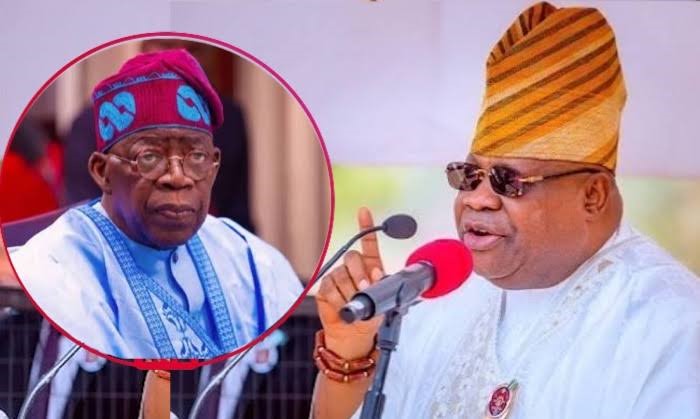
Governor Ademola Adeleke’s decision to endorse President Bola Ahmed Tinubu shortly after his victory has triggered a fresh political debate in Osun State, with questions being raised over the relationship between electoral mandates, political alliances and the expectations of voters.
The controversy followed remarks by Comrade Yahaya Majeed, National Coordinator of a support group affiliated with the African Democratic Congress (ADC), who described Adeleke’s post-election endorsement as disappointing and an affront to the sacrifices allegedly made by supporters who stood behind the governor during a difficult political contest.
For Majeed, the issue goes beyond the governor’s constitutional right to choose his political allies. He argued that the timing of the endorsement could send a conflicting message to supporters who believed they were voting for a political alternative and not merely for an individual candidate.
Political alliances are not unusual in Nigeria. Elected officials routinely build relationships across party lines in pursuit of governance, development and political stability.
However, the speed with which Adeleke embraced Tinubu after his electoral victory has become the central point of criticism from his opponents and some supporters.
Majeed argued that many residents who backed Adeleke made significant personal and political sacrifices during the electoral struggle. He maintained that those sacrifices should not be forgotten immediately after the votes have been counted.
“Many Osun people made enormous personal and political sacrifices to defend their democratic choice,” Majeed said.
His argument reflects a broader question in Nigerian politics: Does voting for a candidate amount to an endorsement of every political decision that candidate makes after winning office?
The answer, constitutionally, is no. But politically, the relationship between elected representatives and their supporters is more complicated.
Majeed’s central argument is that the electorate gives politicians power but does not surrender its political conscience.
According to him, Adeleke’s decision to support Tinubu should be understood as his personal political choice rather than an automatic reflection of the views of all Osun voters.
That distinction is important in a democratic system. Elections confer authority to govern, but they do not permanently transfer citizens’ political choices to elected officials.
A voter who supports one candidate today remains free to support another candidate tomorrow.
Majeed therefore warned that Osun voters would ultimately determine their political choices at the ballot box in 2027, regardless of the alliances forged by the governor.
One of the strongest elements of the criticism is the emphasis on sacrifice.
Political campaigns are often presented through speeches, rallies and election results, but behind every electoral victory are thousands of ordinary citizens who volunteer, campaign, contribute resources and endure political pressure.
Majeed believes those contributions should carry moral weight beyond election day.
His position is that supporters who endured hardship because they believed in Adeleke’s political platform deserve appreciation and accountability rather than what he described as an immediate political realignment.
Whether every supporter shares that view is another matter.
Politics is rarely driven by a single motivation. Some voters may support a candidate because of party loyalty, others because of personality, policies, local interests or opposition to another political force.
Consequently, an alliance formed after an election can be interpreted differently by different sections of the electorate.
The development also highlights the fluid nature of Nigerian politics.
Electoral contests can produce fierce divisions, yet political realities often change once elections are over. Governors must work with the Federal Government on infrastructure, security, funding and other matters affecting their states.
From that perspective, cooperation between Adeleke and Tinubu could be defended as a pragmatic approach to governance.
But political cooperation and political endorsement are not necessarily the same thing.
That distinction is at the heart of the current debate in Osun.
Critics may view the endorsement as a departure from the political expectations created during the campaign, while supporters of the governor could interpret it as an attempt to build a working relationship with the Federal Government in the interest of the state.
Beyond the immediate controversy lies a bigger political question: what impact will the development have on the next electoral cycle?
Majeed has warned that Osun voters cannot be assumed to remain permanently loyal to any politician.
His message is essentially that voters retain the final authority to reward or punish political leaders at the ballot box.
That reality makes every post-election decision politically significant.
An alliance that strengthens access to federal resources could ultimately benefit Adeleke if it translates into visible development. Conversely, if supporters perceive the alliance as a betrayal of the principles that motivated their votes, it could create political costs.
The difference between the two outcomes will depend largely on what voters see and experience between now and the next election.
At the centre of the controversy is a simple democratic principle: political power originates from the people.
A governor may choose his allies, parties may negotiate political arrangements, and politicians may redefine their relationships after elections. But voters retain the right to assess those decisions and make new choices at the next opportunity.
Majeed’s warning that “the people gave you power; they did not surrender their conscience” captures the broader tension between political leadership and electoral expectations.
For Adeleke, the challenge may now be to demonstrate that his new political relationship with Tinubu is driven by the interests of Osun State rather than personal political advancement.
For the opposition, the challenge will be to convince voters that its interpretation of the governor’s actions reflects their own concerns.
Ultimately, the people of Osun—not political endorsements, alliances or campaign rhetoric—will determine the lasting meaning of Adeleke’s victory and his post-election political choices.
SEO Keywords: Ademola Adeleke, Bola Tinubu, Osun State politics, Osun election, Yahaya Majeed, ADC, APC, Osun voters, Adeleke Tinubu alliance, 2027 Osun politics, Osun political crisis, Nigeria politics.