
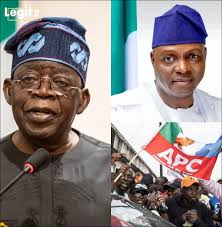
Adversaries of equity and justice in Kwara State have been bombarding President Bola Tinubu and other national APC leaders with a false narrative that the party will lose the 2027 gubernatorial election if the party’s flagbearer is not from Kwara Central, pushing the false premise that the district is the most populous. Olukayode Thomas not only debunked the fallacy but also advised President Tinubu and APC that any attempt to perpetuate Kwara Central’s hegemony will alienate Kwarans from North and South and lead to overall voter apathy.
Introduction
Love him or hate him, one thing you can’t take away from James Onanefe Ibori, the Governor of Delta State from 1999 to 2007, is his belief in equity and justice when it comes to power sharing among the three senatorial zones in Delta State.
After his eight-year tenure, Ibori, an Urhobo from Delta Central, ensured that the next Governor of the state, Emmanuel Uduaghan, was from another senatorial zone, Delta South.
After Uduaghan’s tenure, 2007 to 2015, Ibori’s people, the Urhobo, who are the most populous in Delta State, attempted to disorganise the rotational policy and elect one of their own as the next governor, since politics is a game of numbers.
The Urhobo Progressive Union (UPU), unarguably the biggest sociocultural organisation in Delta, backed the ambition of David Edevbie, then state Commissioner of Finance under Ibori, and late President Umaru Yar’Adua’s private secretary, as the next Governor.
But Ibori said no. While he agreed that politics is a game of numbers, he also believed that it’s also one of equity and justice. He worked against the interests of his people and friend Edevbie.
He ensured power shifted to the minority Delta North, which was how Ifeanyi Okowa became the governor of Delta State from 2015 to 2023.
In Edo State, power had eluded Edo Central for many years, save a brief period when Oserheimen Osunbor governed. It was sixteen years of Edo South under Lucky Igbinedion and Godwin Obaseki, and eight years of Edo South under Adams Oshiomhole.
In 2024, Edo leaders sat down and decided that in the spirit of fair play, Edo Central must be given a sense of belonging.
The major parties in the state, APC and PDP, decided to field candidates from Edo Central, Monday Okpebholo of APC and Asue Ighodalo of PDP. Okpebholo won the election.
In Kwara, it has been ‘Central’ from 1999 to date
Apart from Delta and Edo, many states in Nigeria encourage and practice rotation of governorship seats among the three senatorial zones.
But in Kwara State, the Central district has consistently produced the governors since 1999.
The first governor, Muhammed Lawal, was from Idi-Ape; the second governor, Bukola Saraki, is from Agbaji, while the third governor, Abdulfatah Ahmed, though originally from Share, is a Pakata boy from Ilorin, while the present governor, Abdulrahman Alade Abdulrasak, is from Adewale – all in Ilorin.
Some hypocritical Kwarans who are enemies of the truth will, for the sake of argument, say Ahmed is from Kwara South, but that is just like saying Kemi Badenoch, the Leader of the Opposition in the United Kingdom, is a Nigerian.
Kemi was born in the United Kingdom to Nigerian parents. She even moved to Nigeria at one point, living in Surulere, and she attended International School (ISL) at the University of Lagos. But her actions and utterances clearly demonstrate that she is not a Nigerian.
Just like Kemi, Ahmed, though originally from Share in Ifelodun Local Government Area of Kwara State, never identified with Share, let alone Kwara South, when he was Commissioner for Finance, and later Economic Development for eight years, and Governor for eight years. Rather, he is known in Kwara as a Pakata (Ilorin) Boy through and through.
During his campaign for a second term in 2015, Ahmed, ‘Sai Maigida’ as he is fondly called, was in Jebba, and wanted to pay homage to the Oba of the town as tradition demands.
At the roundabout that led to the Oba’s palace, Ahmed abruptly turned back and headed to another location. Within a few hours, word had gone round that Ahmed had been instructed not to pay homage to the Oba of Jebba because the Ilorin Emirate did not recognise him as an Oba. This is just an instance of Ahmed’s subservience to Kwara Central.
Lafiagi and Ahmed were mere placeholders as Governors
A political observer from Kwara North, Ibrahim Gunu, posits that most Kwarans know the truth about the Central elites’ power-grab policy, but they shy away from saying it because of the fear of losing their daily livelihood.
‘‘We in the North and South of Kwara are too docile before Central elites. We are second-class citizens and are never in control of anything. Even when they give us positions, be it ministerial, commissionerships and even in the civil service, we will be in office but never in power.
“When they want to cede power for a while to give the impression of being democrats, they will pick an Uncle Tom (like America House Slaves) among us that they can control and make them governors.
“For example, Shaaba Lafiagi and Ahmed were mere placeholders for the period they were governors. They can’t sign anything or award any contract without the approval of their masters from Central.
“Lafiagi and Ahmed’s years as governors could rightly be called the years of the locust in Kwara North and South. They neglected their people and developed only Central.
“Ahmed was even worse, they call him ‘Sai Maigida’ because he is an Ilorin Emirate boy, or have you ever seen any Yoruba man who identifies with the Yoruba root from Kwara South being called ‘Sai’, they will rather be called Chief, Otunba, Bashorun or High Chief.
“He neglected his zone and even his hometown, Share completely. This accounted for his rejection when he aspired to represent Kwara South in the Senate in 2019.’’ Said Gunu.
Central’s domination has not advanced the zone or the state
By the end of Abdulrasak’s tenure on May 29, 2027, Kwara Central would have ruled Kwara State for 28 years.
During the period under review, only the Bukola Saraki administration recorded some noticeable achievements. They include rehabilitation of primary health centres, establishment of Shonga Farms, urban renewal projects in Ilorin, and increasing the state’s IGR.
While Kwara North and South did not witness significant development, Saraki established the Kwara Advanced Ultramodern Diagnosis Centre, Community Health Insurance Scheme, re-energising the Ganmo Power Station, redeveloping commercial markets (Ojo Oba, Kulende), and constructing the first flyover at the Post Office Area in Ilorin.
Others include Mandate Housing Estate, the establishment of the International Aviation College, Ilorin, and Kwara State University (KWASU), Malete.
But the same cannot be said of the three other governors from Central. While Mohammed Lawal’s non-performance for the four years that he governed could be blamed on the party crisis that he battled with, the same could not be said about Ahmed, Saraki’s anointed successor and Abdulrasak.
For someone who came from a humble beginning, Ahmed, during his tenure, completely abandoned public schools. Indeed, Kwara was ranked 37th—the lowest in Nigeria—for Universal Basic Education Commission (UBEC) during his tenure.
Despite receiving billions in Paris Club refunds and federal bailouts, the state debts continued to mount, especially workers’ salaries, including staff in state-owned tertiary institutions. In terms of physical infrastructure, agriculture, healthcare and other core sectors, Ahmed also scored below average.
The ₦3.7 billion Geri-Alimi diamond split underpass, which he inaugurated just before he left office in 2019, suffered structural failure shortly after.
From Ahmed to Abdulrasak, it was failure kissing failure in Kwara State. Apart from non-productive beautification of Ilorin GRA, like the Flower Garden, construction of Idiagbon Overhead, Unity Flyover Bridge and other white elephant projects, Abdulrasak will be remembered as the Governor who wasted the opportunity to move Kwara from a consumer to a producer, especially with an increase in Federal Allocation from Tinubu.
Other wasteful spending includes remodelling of Kwara Hotel for a whopping N17 billion, 70-Metre Flagpole, Visual Arts Centre and Innovation Hub and others.
More than the above, Abdulrasak will be remembered for his inability to secure Kwara North and South, where countless peoplehave been killed and kidnapped.
He will also be remembered for closing schools in Kwara South and North, being an absentee Governor, and non-payment of teachers’ allowances.
Others include public spat with friends who became foes, like Moshood Mustapha and Saliu Mustapha.
Central’s most populous claim is subject to scrutiny
Central has been able to foist non-performers like Ahmed and Abdulrasak on the rest of us for two reasons.
Her bogus slogan of “population” to ensure electoral victory, and voters’ apathy in Kwara North and South.
While we await the next census, the 2022 population projection for Kwara State is about 3.5 million, and the projection for Kwara Central, comprising Asa, Ilorin East, Ilorin West and Ilorin South, is about 1.3 million.
The projection for Kwara North, comprising Baruten, Edu, Kaiama, Moro and Pategi, is 1.2 million, and the projection for Kwara South, comprising Ekiti, Ifelodun, Irepodun, Isin, Offa, Oke-Ero and Oyun is 1. 1 million.
With the above statistics, Kwara Central has a slight edge over North and South.
But nothing justifies the phrase ‘statistics are like mini-skirts, they reveal a lot but hide the essential parts’ more than the above projection.
Let facts speak
There is no debate about the fact that Ilorin is the most populous city in Kwara, but the population is not homogeneous, just like the population of Kwara North; only Kwara South is homogeneous.
In Kwara Central, the main city, Ilorin, is divided into two.
The areas where we have the natives and the areas where we have the settlers, and even in areas where we have the natives, could also be divided into many sub-ethnic groups with diverse interests.
Ilorin natives are predominant in areas like Gambari, Pakata, Afin, Balogun Fulani, Balogun Ajikobi, Balogun Alanamu, Ojaoba, Isale Oja, Agaka, Babako, Kuntu, Alfa Yahaya, Adeta, and others.
Even in these areas where natives are predominant, we have sub-groups like the Idi-Ape people who mark themselves as different from others. We have the people from Balogun Ajkobi and Alanamu, who are mostly from Oyo and Oke-Ogun; we have the Nupe, the Hausa, the Fulani, the Baruba and others.
In areas like Tanke andOke-Ose, there is a mix of strangers and natives, but strangers dominate. Other areas where strangers dominate are Sawmill, Olorunsogo, Odota, Sango, Garin Alimi, GRA, Adewole Housing Estate, Fate, Basin, Agric, Mandate/Irewolede Area, Gaa Akanbi, Zango, Offa Garage, Maraba, Sabo Oke, alias Kogi Colony.
Most of the settlers are from Kwara South, followed by Kwara North, the Okuns, Ebira and Yoruba from Osun, Ekiti States and others.
Even places that are tagged parts of the Emirates for political power grabs’ sake have consistently maintained they are not part of the Emirate. They include places like Asa LG, some parts of Ifelodun LG, Moro LG, Shao and Jebba.
Let’s also not forget that Ilorin has been the seat of government since 1967, so it has attracted many white-collar and blue-collar workers from outside the Centraldistrict in their thousands, both for government jobs and private enterprise.
For example, most of the big hotels, retail and commercial enterprises are owned by non-indigenes from Kwara South.
One of the two private Universities in Ilorin, Al Hikmah, is owned by Oladimeji Igbaja from Kwara South, and Ojaja University is owned by the Ooni of Ife.
Because of insecurity in Kwara North and South, many have relocated to Ilorin, thus increasing the city’s population.
Like Kwara Central, Kwara North is also not homogeneous; of the five local governments in the zone, Moro is populated by the Yoruba, Edu and Pategi by the Nupe and Baruten, and Kaiama, by the Baruba. This combination of different nationalities affects the voting pattern, especially when votes count, and apathy is low.
The only homogeneous zone in Kwara is the South, where natives of Ekiti, Ifelodun, Irepodun, Isin, Offa, Oke-Ero, and Oyun share practically the same culture.
So, the most populous claim that Central has made for decades failed the scrutiny test.
After the good, bad and ugly of Centre, let’s try another zone
After many election cycles, and as Governors from Kwara Central have not been able to move Kwara from a consuming state to a producing or manufacturing state, it is time we give cerebral men and women in other senatorial zones an opportunity to move Kwara to the next level so that the state can realise its potential and become great.
APC’s fiercest rival in the Kwara gubernatorial will be the PDP candidate, who is likely to come from Kwara Central, so it will be in the interest of APC to look at the two other zones for a credible candidate.
The danger of APC attempting to pick a candidate from Central is many. Abdulrasak’s misrule, especially his inability to find a solution to the problem of insecurity in Kwara North and South or to show empathy, has made many lose faith in another APC candidate from Kwara Central.
The reporters’ interviews with many residents of Kwara South who have abandoned their homes and farms for safe havens in Ilorin, Offa and even Lagos revealed that many of them will not return to vote during the governorship election if the APC candidate is not from the South.
Madam Kemi Ogundele, a 62-year-old APC supporter from Kwara South who has moved to Ilorin because of the activities of bandits in her community, was very clear on how she and others from troubled communities in Kwara South will vote in the next election.
“If it’s another candidate from Central, we will just vote during the presidential election and ignore the governorship election. We have credible sons and daughters in Kwara South, who will not only secure our zone but also the North and Central. They should be allowed to govern Kwara. If we have a candidate from the South, we will go back home in thousands and work hard for the candidate’s success.
“Enough of Kwara Central, we should let power move around, we from Kwara South, dominate the state economy, and our contribution to education, healthcare, industries, hospitality business, and others in Kwara State and even in Ilorin are second to none. It’s our turn, Awalokan, please help us tell Baba Tinubu that Kwara South Lokan. If the APC candidate is from Central, we will just stay at home.’’
Let’s emulate Delta State
Delta State, despite its diversity have been able to forge a rational policy among its three senatorial zones that works like fingers.
Why is Kwara State, a state that has been in existence long before Delta State was created, still unable to come up with a power-sharing formula that will guarantee equal opportunity for all?
Are we saying we don’t have a leader like Ibori from Kwara State Central who will stand for equity, justice and fairness?
Are there no men of good conscience in Kwara State who will look at each other in the eyes and say the truth?
Are we not aware of the fact that we can’t live in harmony, even though we are called the State of Harmony, if other zones are subservient to one zone, Kwara Central?
If Kwara Central wants to continue politics of exclusion and manipulation whereby other zones cannot be elected to the highest office, the Federal Government should do a referendum so that we, the Ibolos in Offa and Oyun Local Government Area, can join our kith and kin in Osun State, as we are tired of playing second fiddle in a state where we are supposed to be equals.
Olukayode Thomas,an indigene of Offa, is based in Lagos.