
By PAUL LUCKY OKOKU
Why a night in Rabat reopened an old conversation about trust, standards, and accountability
When officiating becomes the story, football must ask harder questions
Football is decided on fine margins—but credibility is decided on consistency.
Emotion reacts. Evidence explains. History remembers.
When the Host Has the Edge—and Margins Decide the Outcome
“Big-time players make big-time plays in big-time games” is a familiar sports mantra, often understood to mean that elite players are defined by how they rise to decisive moments, delivering clarity, composure, and impact when the stakes are highest—though even the best can have an off day.
Football does not always reward effort. Sometimes, it rewards composure.
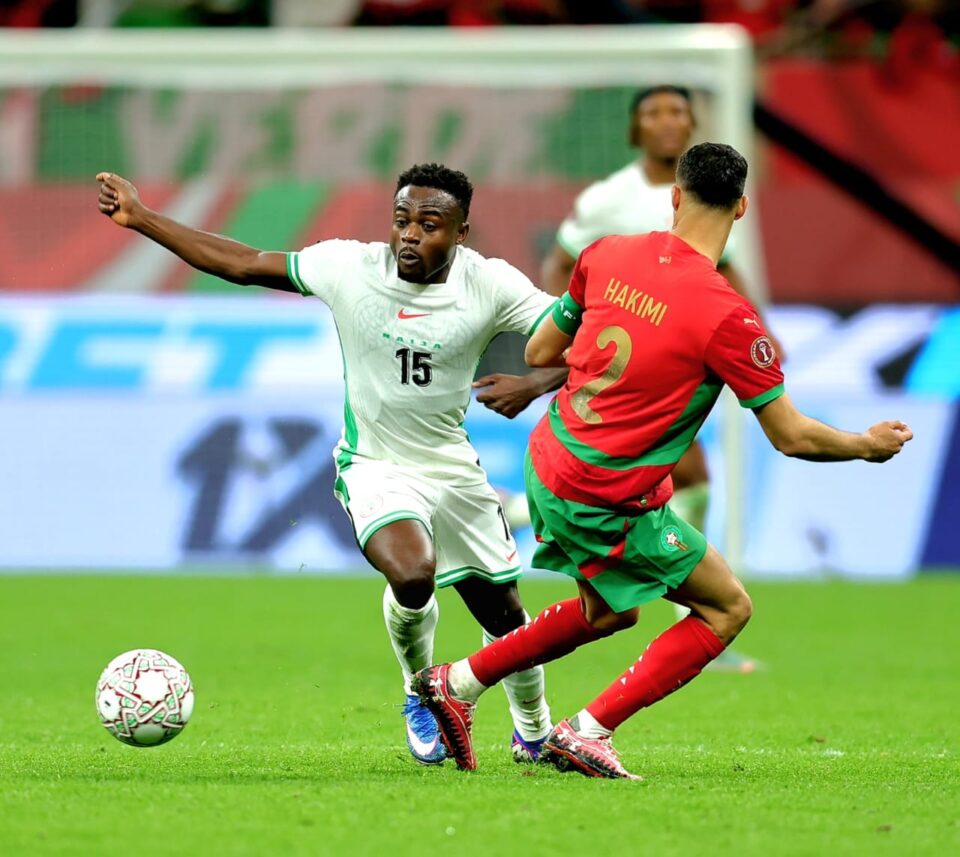
Morocco rained on Nigeria’s Super Eagles parade—but not without a fight.
A Tournament Built on History
The Africa Cup of Nations is not just a tournament—it is Africa’s football conscience. Founded on February 10, 1957, AFCON was created to give the continent its own competitive identity at a time when African football was still fighting for global respect. Today, under the Confederation of African Football (CAF), AFCON stands as Africa’s most prestigious football competition, featuring 24 teams in the finals and 54 eligible nations in qualification.
Egypt remains the most successful nation with seven titles, while Ivory Coast, the current champions, lifted their third crown in the last edition. Every AFCON tournament carries the weight of history—and AFCON 2025 in Morocco was no different.
This semi-final between Nigeria and Morocco was not merely a match. It was a confrontation between legacy, ambition, home advantage, and belief.
Setting the Frame Before the Analysis
Let me be clear from the outset: this is not a blame exercise. This is analysis.
Nigeria did not collapse. Nigeria did not embarrass itself. Nigeria competed, resisted, and stayed in the contest for 120 minutes against a technically sound host nation.
But football analysis demands honesty—not sentiment or emotion.
Morocco held an edge—not overwhelming, not humiliating, but measurable and consistent. That edge appeared in composure, ball circulation, and clarity in the final third. And in matches of this magnitude, small edges—sustained over time—shape outcomes.
Nigeria–Morocco, AFCON 2025: A Ghanaian Referee, Controversial Decisions, and Questions of Consistency
A Ghanaian (Daniel Nii Ayi Laryea) Referee Under Fire—What the Match Data Actually Shows
It is important to introduce balance at this point.
While there has been widespread criticism on social media accusing the Ghanaian referee of bias against Nigeria, the match statistics alone do not fully support the intensity of that narrative.
The match referee was Daniel Nii Ayi Laryea (Ghana), supported by VAR official Abongile Tom (South Africa), alongside assistant VAR officials as listed in the official appointment report.
Yes, Nigeria received two yellow cards, while Morocco received none.
Yes, there were visible infringements—particularly jersey pulls on Nigerian players—that many felt warranted caution.
However, it must also be acknowledged that similar leniency was shown in certain situations where Nigerian players committed fouls, and play was waved on. The referee appeared, at times, to favor continuity over punishment—rightly or wrongly—rather than consistently targeting one side.
Those numbers alone do not prove bias, but they do help explain why many fans felt the game was being managed in a way that appeared one-sided—especially with zero Moroccan yellow cards across 120 minutes.
This does not invalidate the concerns raised by Nigerian supporters.
But it does suggest that the issue may be inconsistency in threshold, rather than deliberate bias.
As a football analyst, my responsibility is not to inflame sentiment, but to present facts and patterns, supported by data, and allow readers to form informed conclusions.
Emotion belongs to fans. Analysis must belong to facts.
➡️ Readers are encouraged to review the full match statistics sheet at the bottom of the page for detailed analysis and context.
This Is Bigger Than One Match
Here is the uncomfortable truth Nigeria must confront:
If CAF consistently overlooks Nigerian referees for major continental assignments, and FIFA does not intervene to include them either, then the problem is not external perception alone—it is internal decline.
CAF is FIFA’s first filter.
If CAF does not trust Nigerian officials, FIFA will not override that judgment.
Charity begins at home.
There Was a Time Nigerian Referees Were Respected
This is not nostalgia for nostalgia’s sake.
This is historical fact.
In the 1970s and 1980s, Nigerian referees were among the most respected on the continent.
Sunday Badru (FIFA Badge)
In the 1970s and early 1980s, Sunday Badru carried a FIFA badge and commanded respect across Africa. He officiated with authority, fitness, and calm control—qualities that earned trust beyond Nigeria’s borders.
Festus Okubule (FIFA Badge)
Then there was Festus Okubule, whose reputation spoke even louder.
At the 1983 FIFA U-21 World Cup in Mexico, he was the only African referee retained to continue officiating deep into the tournament.
That distinction speaks volumes about the level of trust placed in his officiating.
GOVERNANCE INSIGHT: OFFICIATING, ACCOUNTABILITY, AND SYSTEMS
Officiating debates are not unique to African football. They occur in every major footballing region, including Europe and South America. The difference is not perfection—it is process.
In mature football systems, referee performance is treated as a continuous development cycle rather than an occasional crisis. This includes:
• Structured referee education pathways from grassroots to elite levels
• Regular performance evaluations using match footage and analytics
• Fitness benchmarking and monitoring comparable to player standards
• Clear accountability frameworks, including rotation, retraining, or reassignment
• Technological support systems, such as VAR, introduced to reduce—not eliminate—human error
VAR itself is not proof of flawless officiating. It is proof that governing bodies recognize limitations and are willing to invest in systems that improve decision-making consistency.
For African football, the lesson is not comparison—it is capacity building. Strengthening referee development structures enhances confidence in outcomes, protects match officials, and allows teams and fans alike to focus on performance rather than controversy.
Nigeria cannot afford to ignore that gap.
If We Are Being Passed Over, We Must Fix the Reasons
If CAF cites:
• Fitness issues
• Positioning
• Inconsistent application of laws
• Poor game control
• Lack of VAR competence
Then the response cannot be silence.
It must be action.
What Must Change—Immediately
• Mandatory fitness benchmarks with transparent results
• Continuous refresher courses using real match footage
• Clear grading and accountability—no performance, no assignment
• Professional welfare paired with firm sanctions
• VAR training and certification as a priority, not an afterthought
When standards rise, confidence returns.
When confidence returns, appointments follow.
Where the Difference Emerged
Nigeria’s key attacking players up front—Victor Osimhen, Ademola Lookman, Akor Adams—worked hard. Their effort cannot be questioned. Their intent was evident. But something was off.
Not effort.
Not commitment.
What was missing was synchronization.
In the final third, coordination broke down. Communication was delayed. Decisions were rushed. Movements were not always complementary. The passes that should arrive early came late. The runs that needed conviction hesitated.
And crucially—this is the analytical point—there were very few attacking moments that clearly rose to the level of a chance that should have resulted in a goal.
That absence matters.
A Pattern Worth Examining—Not Exploiting
This is where historical context becomes unavoidable.
In AFCON 2023, Nigeria played excellent football en route to the final. Yet against the host nation, Ivory Coast, that final performance, played on February 11, 2024, fell below the team’s tournament standard when Nigeria lost 2-1.
AFCON 2023: Goals:
^Nigeria:* W. Troost-Ekong 38’
Ivory Coast 🇨🇮: F. Kessié 62′
S. Haller 81′
Now again, in AFCON 2025, against another host nation—Morocco—Nigeria delivered a solid but restrained performance.
This raises a legitimate analytical question:
Is it timidity?
Is it over-preparation?
Is it anxiety?
Is it subconscious pressure from the crowd, the occasion, the environment?
These are performance variables that elite teams study closely, because patterns—when repeated—deserve thoughtful attention to prevent future performance lapses.
Late-Game Management: A Mental Threshold to Strengthen
Another observable theme emerges in the latter stages of matches.
Nigeria does not lose structure—but concentration softens slightly. Urgency begins to replace patience. Calm decisions yield to hurried ones. This has appeared intermittently from the early rounds of the tournament.
This is not a physical issue. It is a mental threshold—one that can be trained, managed, and improved.
Recognizing it is the first step.
Morocco’s Edge—Acknowledged With Respect
Morocco were technically cleaner. Their ball retention was steadier. Their spacing was more deliberate. Their circulation required Nigeria to defend for longer spells.
This is not “superiority” in a derogatory sense.
It is home advantage paired with technical discipline.
Morocco earned their edge. They did not steal it.
Standout Performances That Anchored the Team
If Nigeria were to name a Man of the Match, Calvin Bassey would stand at the top—composed, authoritative, and decisive. His interventions prevented several situations from escalating into clear goal-scoring chances.
A very close second is Stanley Nwabali. The gap between him and Bassey is narrow. His positioning, shot-stopping, and calmness kept Nigeria competitive. Without him, the match would not have reached penalties.
Defensively, Nigeria showed maturity and resolve.
The “Monday Morning Quarterback” Lens—Emotion Versus Analysis
In American sports culture—particularly in the US National Football League (NFL)—there is a familiar phrase: “Monday morning quarterback.”
It refers to someone who analyzes a game after it has already been played, with the benefit of hindsight. On Sunday, the quarterback makes decisions in real time—under pressure, speed, noise, and uncertainty. On Monday morning, fans sit calmly, replay the game, slow it down, and say, “He should have done this,” or “That pass should have gone there.”
That is the nature of sport.
Right now, many people are speaking from a place of hurt, disappointment, and frustration. That is understandable. Football is emotional. It represents identity, pride, and collective hope. When expectations fall short, emotions overflow. People should be allowed to vent, to speak freely, and to express how they feel—within reason. That release is part of being invested.
But analysis must be separated from emotion.
From a professional standpoint, Coach Éric Chelle deserves real credit. He did an excellent job. His instructions were clear, simple, and purposeful. The team was organized. The defensive structure was solid. The transitions were disciplined. Nigeria stayed competitive for 120 minutes against a host nation with technical depth and crowd advantage.
That does not happen by accident.
Chelle set the team up to succeed. He read the game well. He managed it calmly. The outcome was decided by fine margins—not confusion, not chaos, and not poor coaching.
This is where the “Monday morning quarterback” perspective must be used responsibly. It is easy to criticize from distance. It is much harder to prepare, manage personalities, read momentum, and make decisions in real time—especially on a continental stage.
Football demands accountability, yes.
But it also demands fairness.
Let people feel.
Let people talk.
But let analysis remain objective, respectful, and informed.
That is how the game moves forward.
Penalties: Separating Romance From Reality
Yes, disappointment is natural.
When the match ended goalless, memory drifted to 1983. When Morocco missed their first penalty, it felt momentarily familiar—almost scripted.
But penalty shootouts are not history lessons.
They are psychological examinations.
• Goalkeepers are not expected to save penalties
• Kickers are expected to score
The pressure is asymmetrical and unforgiving.
On this occasion, Morocco handled that moment better.
Why This Analysis Matters Going Forward
Football is a sport where £any team can beat any team on any given day*. That reality must be understood by footballers and supporters alike.
Nigeria did not fail.
Nigeria competed.
Nigeria came up just short—by margins.
And margins are where elite teams evolve.
This analysis is offered not to diminish effort, but to identify areas for refinement—because progress does not come from denial. It comes from honest, objective reflection.
Closing Reflection
Nigeria’s big-time players had an off day—not a poor tournament, not a failed campaign—just an off day at the highest level.
And in elite football, that is sometimes all it takes.
What an irony. Football has a wicked sense of humor. After 120 minutes of grit, discipline, and balance, it all came down to penalties—the cruelest decider in the game.
When we played against Morocco in 1983, it also ended in a goalless draw. We missed a penalty, Peter Rufai saved two, and we won 4–3, This time, when Morocco missed their first kick, time seemed to bend. For a brief, electric moment, 1983 returned—whispering that destiny might repeat itself.
But football does not always honor memory.
Even in defeat, Nigeria gave fans something to celebrate. The joy, belief, and unity the team brought to Nigerians—and even non-Nigerians—deserve recognition. The players’ effort, commitment, and resilience are worth commending.
Morocco took their moment and executed when it mattered most. Respect to them, and best wishes in the final against Senegal.
If this article added value or offered perspective, you’re welcome to share it with others.
🟡 🟡 🟡 ⬇️ ⬇️ ⬇️ FULL MATCH ANALYSIS BEGINS HERE
For readers interested in deeper context, the statistics below provide additional insight into how the match unfolded.
When the Host Had the Edge—and How Statistics Explain the Story
Setting the Analytical Frame (Before Emotion)
Nigeria competed. Nigeria resisted. Nigeria stayed in the contest for 120 minutes against a host nation playing at home, in front of nearly 70,000 supporters, with technical discipline and composure.
But football analysis must be anchored in evidence, not sentiment.
And the evidence—when examined carefully—shows where Morocco had the edge and how that edge shaped the game.
Core Match Outcome
• Final Score (after 120 minutes): Nigeria 0–0 Morocco
• Result: Morocco won 4–2 on penalties
• Venue: Prince Moulay Abdellah Stadium, Rabat (≈69,500 capacity)
Passing & Possession: The Backbone of the Match
Possession percentages alone do not tell the story.
Passes do.
Total Completed Passes (120 Minutes, Pre-Penalties)
• Morocco: ~460–470 completed passes
• Nigeria: ~210–220 completed passes
What This Means
• Morocco completed more than double Nigeria’s passes across 120 minutes.
• This explains why Morocco appeared calmer and more settled, especially in long phases.
• Nigeria’s possession was shorter, more vertical, and transitional, while Morocco’s was circulatory and accumulative.
👉 Key point:
Morocco did not dominate through speed or power—they controlled rhythm through pass volume.
Ball Possession (Contextualized)
• Nigeria: 51%
• Morocco: 49%
At face value, this looks even.
But possession without pass volume is misleading.
Why This Matters
• Nigeria’s possession came in bursts.
• Morocco’s possession came in sequences.
• Long passing sequences increase:
• defensive fatigue
• concentration lapses
• territorial pressure
This is how control quietly builds without goals.
Attacking Output: Where the Difference Showed
Shots (120 Minutes)
• Morocco: 16
• Nigeria: 2
Shots on Target
• Morocco: 5
• Nigeria: 1
Explanation
• Nigeria defended well but rarely sustained attacking pressure.
• Morocco consistently returned to Nigeria’s half after losing the ball.
• Nigeria’s forwards worked hard but lacked final-third synchronization.
👉 There were very few Nigerian attacking moments that clearly rose to the level of chances you would normally expect to result in a goal.
Touches in the Opposition Box
• Morocco: 21
• Nigeria: 11
Why This Matters
Touches in the box measure territorial penetration, not just intent.
• Morocco entered Nigeria’s danger zone nearly twice as often.
• Nigeria relied on defensive clearance and recovery, not sustained pressure.
This stat aligns directly with Morocco’s higher shot count.
Expected Goals (xG): Quality Over Quantity
• Morocco: 0.65
• Nigeria: 0.05
Interpretation
• Morocco created better-quality chances, even if not many.
• Nigeria’s chances were low-probability.
• This does not reflect poor effort—it reflects where chances were taken from.
xG confirms that Morocco were closer to breaking through during open play.
Big Chances Created
• Morocco: 1
• Nigeria: 0
Analytical Meaning
Nigeria defended excellently to limit big chances.
But offensively, Nigeria did not force Morocco into a single “clear-cut” moment.
That is the trade-off of defending deep for long stretches.
Corners
• Morocco: 5
• Nigeria: 1
Why Corners Matter
• Corners are a product of sustained pressure.
• Morocco spent more time asking questions in the final third.
• Nigeria spent more time answering questions defensively.
Fouls & Discipline
• Fouls Committed
• Nigeria: 29
• Morocco: 22
• Yellow Cards
• Nigeria: 2
• Morocco: 0
Context
Nigeria’s fouls were largely tactical—breaking rhythm, stopping transitions, managing danger.
This is not indiscipline; it is game management under pressure.
Defensive Excellence: Where Nigeria Deserves Credit
Man of the Match (Nigeria)
• Calvin Bassey — outstanding positioning, recovery, and composure.
Runner-Up
• Stanley Nwabali — crucial saves, calm presence, excellent shot-stopping.
Without these two, this match does not reach penalties.
Penalties: The Psychological Cliff Edge
Penalty kicks are not technical exercises—they are psychological confrontations.
• 60,000 –70,000 fans.
• Deafening noise.
• Then sudden silence.
• One kick. One judgment.
Nigeria’s penalty struggles are not new—they appeared against DR Congo in the World Cup playoffs.
This confirms the need for:
• routine penalty training
• pressure simulation
• psychological preparation
Not blame. Preparation.
Coaching Perspective: Credit Where It Is Due
Coach Éric Chelle deserves recognition.
• Clear instructions.
• Compact structure.
• Tactical discipline.
• Calm in decision-making.
The team did not look confused.
The team did not look disorganized.
The outcome was decided by execution and margins, not poor coaching.
Final Analytical Takeaway
Morocco had the edge—not through dominance, but through:
• higher pass volume
• sustained territorial pressure
• better chance quality
Nigeria countered with:
• structure
• discipline
• defensive resilience
Football allowed both truths to coexist—until penalties decided the finalist.
Closing Thought
This was not failure.
This was competition at elite margins.
And elite margins are where teams learn how to go from contenders to champions.
If this article added value or offered perspective, you’re welcome to share it with others.
Paul Lucky Okoku is a former Nigerian International Footballer | Football Analyst
Published Online
Former Nigerian Super Eagles International
• CAF AFCON 1984 — Silver Medalist
• WAFU Nations Cup 1983 — Gold Medalist
• CAF Tesema Cup (U-21) 1983 — Gold Medalist
• FIFA U-21 World Cup, Mexico 🇲🇽 1983 — Vice-Captain, Flying Eagles of Nigeria 🇳🇬