
Jude Bellingham scores twice as England overcome Norway, survive VAR drama and book a blockbuster semifinal against Lionel Messi’s Argentina.
BY PAUL LUCKY OKOKU
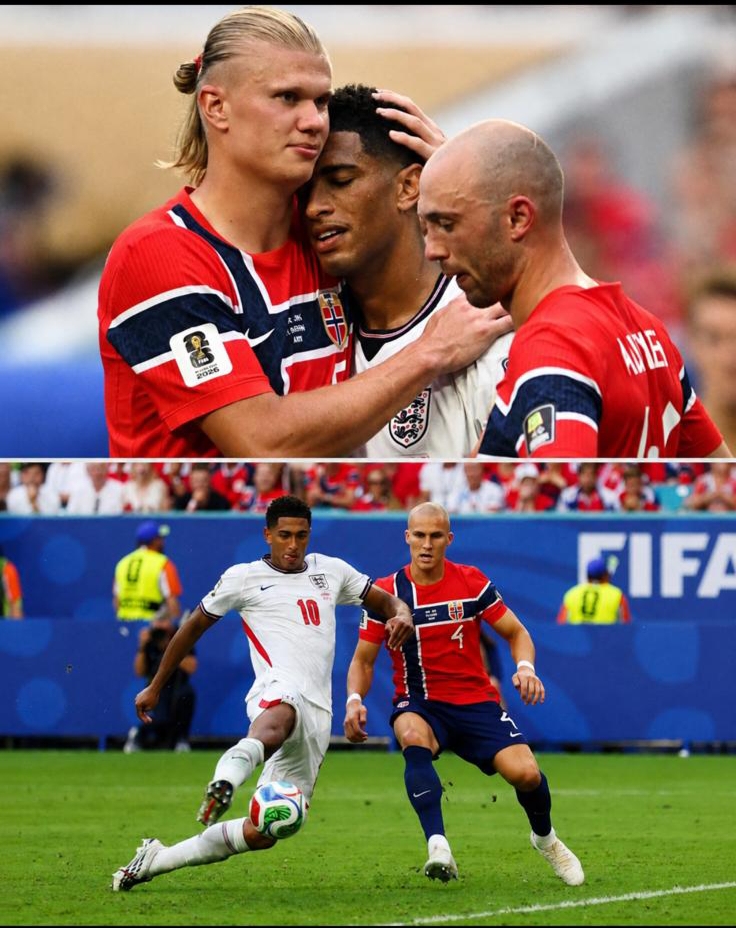
Above: Jude Bellingham and Erling Haaland embrace after the final whistle, a lasting image of respect after 120 minutes of fierce competition.
Below: Bellingham battles Norway defender Torbjørn Heggem during England’s dramatic World Cup quarterfinal victory
Football writes its own story. We only discover the ending when the referee blows the final whistle.
The Night Football Chose a Different Hero
Every great tournament eventually produces a match that reminds us why football remains the world’s most unpredictable sport.
England’s dramatic 2-1 extra-time victory over Norway in the FIFA World Cup quarterfinal was one of those nights.
Before kickoff, the world’s attention centered on two of football’s greatest goalscorers—England captain Harry Kane and Norway’s prolific Erling Haaland. Between them they had scored 13 goals in the tournament and were widely expected to determine the outcome.
Neither did.
Instead, Jude Bellingham emerged as England’s unlikely hero, scoring twice as the Three Lions overturned an early deficit to reach the semifinals before 64,478 spectators at Miami Stadium.
Football once again ignored reputation and rewarded performance.
Stoic philosophy reminds us that we are judged not by what people expect of us, but by what we actually do. Reputation creates pressure. Performance creates history.
On this night, Jude Bellingham wrote his own history.
Norway Strike First
England began cautiously in the sweltering South Florida heat, while Norway looked confident after their impressive run to the quarterfinals, including the elimination of Brazil.
The breakthrough arrived in the 36th minute.
Patrick Berg won possession from Harry Kane near midfield before releasing Andreas Schjelderup, whose clinical finish gave Norway a deserved 1-0 lead.
England immediately appealed for a foul on Kane during the buildup, but referee Clément Turpin waved play on. VAR reviewed the incident and allowed the goal to stand.
England suddenly found themselves chasing the game.
Yet champions are rarely defined by how they begin.
They are defined by how they respond.
Bellingham Answers England’s Call
England’s response arrived just before halftime.
Anthony Gordon found Jude Bellingham just outside the penalty area. With remarkable composure, Bellingham shifted onto his left foot before placing a precise finish beyond Ørjan Nyland.
The equalizer changed everything.
It calmed England.
It energized their supporters.
More importantly, it reminded everyone that this England side no longer depends entirely on Harry Kane for inspiration.
When one leader is contained, another steps forward.
That is the mark of a championship-caliber team.
The Goal That Never Counted
The defining controversy of the evening arrived midway through the second half.
Norway believed they had restored their lead when Torbjørn Heggem converted from close range following a corner.
Celebrations erupted.
Then VAR intervened.
Following a lengthy review, referee Turpin announced the decision over the stadium public-address system:
After review, number nine of Norway pushed deliberately the defender before the ball was in play. Final decision: corner retaken.
The announcement removed any uncertainty about the decision.
The goal was not cancelled because of offside.
It was not cancelled because of the finish.
It was cancelled because Erling Haaland illegally pushed England defender Elliot Anderson before the corner kick had been taken.
Under the IFAB Laws of the Game, misconduct committed before the ball is in play requires the restart to be retaken. Technically, the officials applied the law correctly.
Whether similar incidents have been judged consistently throughout this World Cup remains a separate—and legitimate—question.
Football Has No Guarantees
If this quarterfinal proved anything, it is that football refuses to follow expectations.
Harry Kane did not score.
Erling Haaland did not score.
Yet England still advanced because they possessed another match-winner.
Stoic philosophy teaches that while we control our preparation, our discipline and our effort, we never control the outcome. Football has always respected that truth.
England controlled what belonged to them.
Their organization.
Their belief.
Their resilience.
Everything else belonged to the game itself.
Bellingham’s second goal, scored early in extra time after Ørjan Nyland spilled Morgan Rogers’ long-range effort, demonstrated not only instinct but anticipation—the qualities separating very good players from truly great ones.
It was his sixth goal of the tournament, drawing him level with Kane among the competition’s leading scorers.
Sometimes football’s greatest moments belong not to the player everyone expected, but to the player who was prepared when opportunity arrived.
That was Jude Bellingham’s night.
Championship teams are built on more than one superstar. They are built on multiple match-winners supported by a great—not merely good—supporting cast. England have that in Harry Kane, Jude Bellingham, Bukayo Saka, Anthony Gordon, Morgan Rogers, Declan Rice and Jordan Pickford. That depth is beginning to separate them from the rest of the field.
What the Numbers Revealed: England Held the Edge, Norway Held the Threat
Sometimes statistics confirm what the eyes witnessed.
Other times, they reveal the hidden story.
Against Norway, the numbers showed that England were the slightly better team—not overwhelmingly superior, but more efficient when it mattered most.
England finished with:
- 14 shots (Norway 13)
- 8 shots on target (Norway 5)
- 53% possession (Norway 47%)
- 606 completed passes (Norway 537)
- 91% pass accuracy (Norway 86%)
Those figures reveal a team that controlled slightly more of the ball, passed with greater precision and created more quality scoring opportunities.
Yet statistics alone cannot explain the tension of this quarterfinal.
Norway led first.
Norway had a goal disallowed.
Norway struck the crossbar.
Norway threatened repeatedly from set pieces.
England, however, proved more clinical in the decisive moments.
The statistics favored England.
The pressure often favored Norway.
The result belonged to England.
Sometimes the smallest numerical advantage becomes the biggest difference on the scoreboard.
And in Miami, those small advantages carried England into the FIFA World Cup semifinals.
The Final Whistle
By the time French FIFA-badged referee Clément Turpin blew the final whistle in Miami, England had done far more than eliminate Norway.
They had announced themselves as genuine FIFA World Cup contenders.
Not because Harry Kane scored.
He did not.
Not because Jude Bellingham rescued England once again.
Although he did.
England advanced because they displayed the qualities that separate good teams from championship teams.
They remained composed after conceding first.
They survived controversy.
They defended with discipline.
They trusted one another.
Most importantly, they found a way to win.
That is becoming England’s identity.
The victory over Mexico first hinted at that transformation.
Defeating one of the tournament’s host nations before more than 80,000 passionate supporters inside the legendary Estadio Azteca while playing with ten men required courage, tactical discipline and emotional control.
Against Norway, England reinforced that belief.
Champions are rarely measured only by how beautifully they play.
They are measured by how calmly they respond to adversity.
By their resilience under pressure.
By their trust in preparation when circumstances become chaotic.
England demonstrated all three against Norway.
Championship teams are built on more than one superstar.
They are built on multiple match-winners supported by a great—not merely good—supporting cast.
England have that in Harry Kane, Jude Bellingham, Bukayo Saka, Anthony Gordon, Morgan Rogers, Declan Rice and Jordan Pickford.
That depth is beginning to separate them from the rest of the field.
Now comes their greatest examination.
Argentina.
Lionel Messi.
The defending World Cup champions.
Argentina deserve to enter the semifinal as defending champions, led by Lionel Messi, arguably the greatest player of his generation. Yet if any team remaining has demonstrated the quality, depth, resilience and momentum to defeat them, England have earned the right to be considered.
The semifinal promises to be a contest worthy of the World Cup Final.
Whether England succeed is another matter entirely.
Football has humbled too many great teams to permit certainty.
The Stoic philosopher Epictetus taught:
“Circumstances don’t make the man; they only reveal him.”
Football has a remarkable way of proving that lesson.
Quarterfinals reveal character.
Semifinals reveal belief.
Finals reveal champions.
Against Norway, England revealed composure.
They revealed resilience.
They revealed depth.
Most importantly, they revealed that championship teams continue finding solutions even when their biggest stars are denied.
Perhaps that is football’s greatest Stoic lesson.
Control your preparation.
Control your attitude.
Control your response.
Leave the result to the ninety minutes.
England controlled everything within their reach.
The rest belonged to football.
As this remarkable tournament has repeatedly reminded us, reputations may shape expectations, but performances shape history.
On a night when the football world expected Harry Kane and Erling Haaland to dominate the headlines, Jude Bellingham quietly wrote his own chapter.
That is the enduring beauty of football.
The game belongs not to the player with the biggest reputation, but to the player who rises when history calls.
Football writes its own story. We only discover the ending when the referee blows the final whistle.
Marcus Aurelius once wrote, “Waste no more time arguing what a good man should be. Be one.”
The Roman emperor was writing about character, but his wisdom applies just as powerfully to football. The world’s biggest matches are rarely decided by reputation alone. They are decided by players who answer the moment with performance rather than promise.
What Sport Is Meant to Be: Rivals for 120 Minutes, Respect for a Lifetime
For 120 minutes, Jude Bellingham and Erling Haaland fought for every ball, every yard and every opportunity to send their nations into the FIFA World Cup semifinals.
They were rivals.
Their responsibility was to compete without compromise.
But when French FIFA-badged referee Clément Turpin blew the final whistle, the battle ended.
The embrace between Bellingham and Haaland became one of the tournament’s defining images—not because it celebrated victory or defeat, but because it celebrated something even greater.
Respect.
Football asks players to leave everything on the pitch.
It does not ask them to leave their humanity there.
The handshake.
The embrace.
The quiet words exchanged between opponents.
Those moments remind us that fierce competition and mutual respect are not opposites—they are partners.
Marcus Aurelius wrote:
“The best revenge is not to be like your enemy.”
Great athletes understand that an opponent is never an enemy.
He is the person who brought out your very best.
When the whistle sounds, the contest ends, but respect remains.
That is what sport is meant to be.
That photograph of Haaland embracing Bellingham will endure long after the scoreline fades from memory. It reminds us that trophies are temporary, but character is lasting. The match belonged to England. The moment belonged to football.
Share Note
If you enjoyed this analysis, please Like, Share, Comment, and Follow. Your engagement helps promote thoughtful football journalism, informed discussion, and a deeper appreciation of the beautiful game beyond the final score.
Paul Lucky Okoku is a FIFA Legend | CAF Africa Cup of Nations Silver Medalist | Former Nigerian Super Eagles & Flying Eagles International | Former Olympic Qualifying Team Member | Football Analyst | Journalist-at-Large | Founder & CEO, Greater Tomorrow Children Foundation (GTCF)