
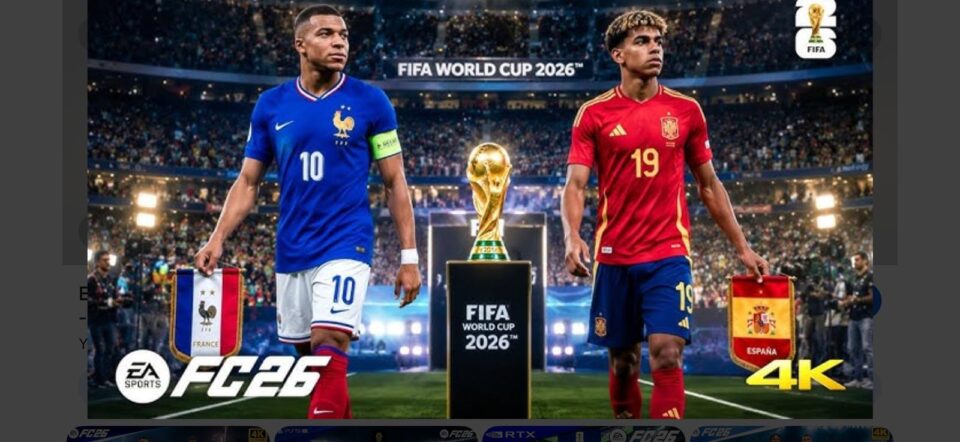
Two football powerhouses. Two interpretations of possession. One place in the FIFA World Cup Final.
BY PAUL LUCKY OKOKU
“All the world’s a stage, And all the men and women merely players.”
— William Shakespeare
Match Information
FIFA World Cup 2026 — Semifinal
🇫🇷 France vs Spain 🇪🇸
📅 Tuesday, July 14, 2026
⏰ 3:00 p.m. Eastern Time (United States)
⏰ 8:00 p.m. West Africa Time (Nigeria)
🏟️ Dallas Stadium, Arlington, Texas
The Final Before the Final
By Tuesday evening, one dressing room in Arlington, Texas, will be preparing for a World Cup final.
The other will be gathering the pieces of a dream that ended one match too soon.
Between those two destinies stand France and Spain—two football powers separated not by ambition, but by the different ways they seek control.
Spain will attempt to make the ball obey their rhythm: pass, move, recycle, restart and patiently search for the opening hidden inside France’s defensive shape.
France will wait with a different kind of purpose. They will circulate possession, study the spaces and then, when weakness appears, turn patience into penetration.
For ninety minutes—or perhaps longer—the ball will become the argument.
Spain will ask whether a match can be mastered through patience.
France will answer that one decisive attack may outweigh an evening of possession.
Officially, it is a semifinal.
Yet the quality of the teams, the weight of their histories and the contrast between their football philosophies make it feel like the final before the final.
On Tuesday evening in Arlington, Texas, two of world football’s most accomplished nations will meet in a contest worthy of a World Cup Final.
Officially, only one place in the championship match is at stake.
In reality, much more hangs in the balance.
For France, victory would mean a third consecutive appearance in a FIFA World Cup Final, reinforcing one of the most remarkable periods of sustained excellence in modern international football.
For Spain, victory would complete a journey that began after years of painful World Cup disappointments and confirm that their football renaissance has reached the game’s highest stage once again.
This is not simply another semifinal.
It is a meeting between two football powers whose philosophies have shaped the modern game.
France: A Standard of Modern Consistency
International football is unforgiving.
Champions rise.
Generations change.
Success often disappears as quickly as it arrives.
France have refused to follow that pattern.
They lifted the FIFA World Cup in Russia in 2018.
Four years later, they returned to the Final in Qatar, where they pushed Argentina to one of the greatest championship matches in World Cup history before falling on penalties.
Now, they have reached another semifinal.
Three consecutive World Cups.
Three appearances among the final four.
That consistency reflects more than talent.
It speaks to the strength of France’s football structure, their ability to develop new generations of elite players and a culture that expects to compete for football’s greatest prize every four years.
France are not defending yesterday’s success.
They are extending it.
Spain: The Return of a Football Giant
Spain’s journey has followed a different path.
Between 2008 and 2012, they established one of the greatest dynasties international football has ever witnessed, winning two European Championships and the 2010 FIFA World Cup.
Their style of play influenced coaches and players across every continent.
Yet football never stands still.
After early exits at the 2014, 2018 and 2022 World Cups, many questioned whether Spain’s celebrated football philosophy still possessed the same power in an evolving game.
Rather than abandoning their identity, Spain chose to refine it.
They preserved the technical quality that made them famous while introducing greater pace, greater attacking width and a more direct approach in the final third.
The results have been unmistakable.
Spain reclaimed the UEFA European Championship in 2024 and have now returned to the World Cup semifinal for the first time since lifting the trophy in South Africa sixteen years ago.
This is not a return to the past.
It is the beginning of a new chapter.
A Rivalry Renewed
France and Spain have shared one of international football’s most respected rivalries.
Before this semifinal, Spain held the advantage in the overall head-to-head record.
France, however, carry one important World Cup memory.
Their only previous meeting on football’s biggest stage came in the Round of 16 at the 2006 FIFA World Cup.
France prevailed 3–1 before advancing all the way to the Final.
Twenty years have passed since that evening in Germany.
The players have changed.
The coaches have changed.
The tactical ideas have evolved.
What has not changed is the significance of the occasion.
Whenever France and Spain meet in a major tournament, the football world pays attention.
This semifinal promises to add another memorable chapter to that rivalry.
Two Nations. One Destination.
France arrive carrying the confidence of recent World Cup success.
Spain arrive carrying the momentum of a football philosophy that has evolved without losing its identity.
One nation seeks to continue an extraordinary era of consistency.
The other seeks to return to the summit of world football.
Only one will earn the right to compete for the FIFA World Cup.
Everything that has happened over the past month—the victories, the setbacks, the tactical adjustments and the unforgettable moments—has led both teams to this stage.
Now, nothing else matters except ninety minutes… or perhaps a little more.
Because when two football giants meet at a World Cup, history rarely follows the easiest path.
Two Philosophies, One Objective
“The nearer a man comes to a calm mind, the closer he is to strength.”
— Marcus Aurelius
When Possession Means Different Things
One of the most fascinating aspects of this semifinal is that both France and Spain value possession.
Yet they interpret possession very differently.
Spain believe possession is control.
France believe possession is preparation.
That distinction may ultimately decide who reaches the FIFA World Cup Final.
For Spain, possession is both an attacking and defensive weapon.
The longer they keep the football, the less opportunity their opponents have to create danger.
Every completed pass forces the opposition to chase.
Every passing sequence gradually weakens defensive concentration.
Patience is not merely part of Spain’s philosophy.
It is the philosophy.
France see possession through a different lens.
They are comfortable circulating the football, but rarely without purpose.
Their objective is not simply to keep possession.
It is to create the perfect moment to penetrate.
Once that moment appears, France become one of the world’s most dangerous attacking teams.
The football may begin patiently.
It often ends explosively.
Calm Energy: The Invisible Advantage
Marcus Aurelius observed,
“The nearer a man comes to a calm mind, the closer he is to strength.”
What I call calm energy is that Stoic principle expressed through football.
It is the ability to remain emotionally disciplined while pressure increases.
It is refusing to panic after conceding possession.
It is refusing to force attacks because the crowd demands urgency.
It is trusting preparation more than emotion.
Championship teams possess calm energy.
France and Spain certainly do.
The difference lies in how each nation expresses it.
Spain’s Calm Energy
Spain express calm energy through patience.
Their football rarely becomes rushed.
Supporters often become anxious when Spain recycle possession from the opponent’s penalty area all the way back to goalkeeper Unai Simón.
Spain do not.
They understand something many teams never fully appreciate.
A backward pass is not always retreat.
Sometimes it is preparation.
Every pass serves a purpose.
Every movement seeks a better angle.
Every circulation attempts to move defenders just far enough to expose a passing lane.
Spain do not force opportunity.
They patiently allow opportunity to reveal itself.
That emotional discipline has become one of their greatest competitive advantages.
France’s Calm Energy
France express calm energy differently.
Their patience exists, but it serves another objective.
France are willing to circulate possession until they identify weakness.
Once that weakness appears, hesitation disappears.
The football immediately becomes more vertical.
More direct.
More purposeful.
France rarely attack simply because they have possession.
They attack because the moment has arrived.
That conviction explains why France remain so dangerous in tournament football.
They understand that one perfectly executed attack can outweigh twenty minutes of territorial dominance.
Their calm is measured not by the number of passes they complete, but by the quality of the opportunity they eventually create.
Possession Is Also Defensive
Many supporters think possession belongs exclusively to attacking football.
Great coaches understand otherwise.
Possession is one of football’s strongest defensive tools.
When Spain control the football, opponents cannot attack.
When France keep possession intelligently, they deny rivals opportunities to counterattack.
Every passing sequence also carries another consequence.
It creates fatigue.
Not only physical fatigue.
Mental fatigue.
Decision-making becomes slower.
Concentration weakens.
Defensive organization begins to stretch.
Championship teams understand that tired minds make costly mistakes.
Possession therefore becomes much more than statistics.
It becomes control of the match itself.
The Tactical Battle
This semifinal is not simply about which team enjoys more possession.
It is about how each team uses possession.
Spain seek rhythm.
France seek timing.
Spain prefer sustained pressure.
France prefer decisive penetration.
Spain often build attacks through extended passing sequences.
France frequently build attacks through calculated acceleration.
Neither philosophy is inherently superior.
Both have produced World Cup finalists.
Both have won major international trophies.
The better philosophy on Tuesday will simply be the one that proves more effective over ninety minutes.
What France Must Do
France cannot become spectators while Spain circulate possession.
They must remain compact.
Disciplined.
Patient.
Most importantly, they must recognize the exact moment possession changes.
Transition has become one of France’s greatest strengths.
If Spain lose the football with too many players committed forward, France possess the pace and intelligence to punish them immediately.
France do not need many opportunities.
They need decisive ones.
What Spain Must Do
Spain’s greatest challenge is resisting the temptation to accelerate unnecessarily.
France are exceptionally dangerous when opponents lose their tactical discipline.
Spain must trust their identity.
They must continue moving the football.
Continue stretching France’s defensive shape.
Continue believing that patience eventually produces opportunity.
Their philosophy has brought them back among football’s elite.
Abandoning it in the semifinal would serve no purpose.
The Match May Be Won Without Winning Possession
One fascinating possibility remains.
Spain may complete significantly more passes.
France may finish with fewer touches of the football.
Neither statistic will determine the winner.
Football has never rewarded possession alone.
It rewards what teams accomplish with possession.
One side may control the football.
The other may control the decisive moments.
Only one will advance.
The Players, the Decisive Moments and the Road to the Final
Players to Watch
France 🇫🇷
Kylian Mbappé — The Difference Maker
Every generation produces footballers capable of changing a match with one moment of brilliance.
For France, that player is Kylian Mbappé.
His pace is extraordinary.
His movement is intelligent.
His timing is exceptional.
Spain’s defenders cannot afford even a brief lapse in concentration because Mbappé needs very little space to transform a promising attack into a decisive goal.
His greatest strength is not simply speed.
It is knowing precisely when to use it.
Michael Olise — The Silent Architect
While Mbappé attracts much of the world’s attention, Michael Olise quietly influences almost every French attack.
He connects midfield to attack with remarkable vision.
His ability to recognize passing lanes before they fully develop makes him one of France’s most valuable creators.
For many Nigerian supporters, Olise’s success also represents another reminder of the global contribution of footballers with Nigerian heritage.
Sometimes the player who creates the opportunity proves just as important as the player who finishes it.
Ousmane Dembélé — The Unpredictable Threat
Few players in world football are more difficult to defend than Ousmane Dembélé.
He can attack from either wing.
He can dribble inside or outside.
He can cross.
He can score.
His unpredictability forces defenders into constant uncertainty.
Alongside Mbappé and Olise, he completes one of the tournament’s most dangerous attacking units.
Spain 🇪🇸
Lamine Yamal — The Fearless Prodigy
Still a teenager, Lamine Yamal already performs with the confidence of a seasoned international.
He welcomes responsibility.
He attacks defenders directly.
He embraces pressure instead of avoiding it.
France will devote enormous attention to stopping him.
That attention alone may create opportunities elsewhere for Spain.
Great players influence matches even when they do not score.
Rodri — The Midfield General
Every championship team needs someone who controls the rhythm of the match.
For Spain, that responsibility belongs to Rodri.
He dictates tempo.
Protects the defence.
Maintains possession.
And quietly organizes everything around him.
Much of Spain’s success depends upon his intelligence without the ball as much as his quality with it.
Unai Simón — Spain’s Last Line of Confidence
Goalkeepers rarely dominate headlines until they make one unforgettable save.
Unai Simón has quietly become one of Spain’s most dependable performers.
His calm distribution allows Spain to begin attacks confidently.
His positioning gives confidence to everyone in front of him.
Against France, one save may determine whether Spain reaches another World Cup Final.
The Match Within the Match
The world’s attention will naturally focus on Mbappé against Lamine Yamal.
The real contest may be even more fascinating.
France’s efficiency against Spain’s patience.
France’s penetration against Spain’s circulation.
France’s transitions against Spain’s control.
This semifinal asks one timeless football question:
Is it better to control the football…
…or control the decisive moments?
By the final whistle, football itself will provide the answer.
Final Reflection: When Philosophy Meets Reality
France and Spain have earned their place among the world’s final four through different footballing journeys, yet both have arrived at the same destination.
Spain have mastered the art of possession without losing the technical identity that has defined them for generations.
France have mastered the art of tournament football through discipline, adaptability and an extraordinary ability to recognize and seize decisive moments.
That is what makes this semifinal so compelling.
It is not merely a contest between two outstanding teams.
It is a meeting between two football philosophies.
Spain will likely enjoy more possession.
France may create fewer opportunities.
But those opportunities could prove more decisive.
If Spain establish their rhythm early, they can dictate the tempo and gradually stretch France’s defensive organization.
If France force Spain into transition, their pace, precision and efficiency may become the difference.
The first goal could change everything.
If Spain score first, they can impose their preferred rhythm.
If France score first, they possess the experience and tactical discipline to protect their advantage while remaining dangerous on the counterattack.
My Assessment
France 2–1 Spain
Not because Spain lack the quality to reach the Final.
Not because France are overwhelmingly superior.
But because France have repeatedly demonstrated an extraordinary ability to remain composed under pressure and capitalize on decisive moments.
Spain have mastered the art of possession.
France have mastered the art of tournament football.
On this occasion, I give France the narrowest of edges.
Then again, this is football.
Spain may yet surprise everyone who expects France to prevail.
That is the enduring beauty of the game.
Preparation matters.
Analysis matters.
History matters.
But once the referee blows the whistle, the players begin writing a story that belongs to them alone.
What do I know? I am simply a student of the game, offering my analysis. Football always reserves the right to write a different ending.
Whether this assessment proves correct or not, one certainty remains.
The football world is about to witness a semifinal worthy of a FIFA World Cup Final.
Share Note
Thank you for reading.
If you found this analysis insightful, please Like, Share, Comment and Follow.
I welcome thoughtful and respectful discussion from supporters of every nation.
Please share this article with fellow football supporters, coaches, players and students of the game.
Together, let us celebrate football through history, thoughtful analysis and respectful dialogue.
Paul Lucky Okoku is a FIFA Legend | CAF Silver Medalist | Former Nigerian Super Eagles and Flying Eagles International | Former Olympic Qualifying Team Member | Football Analyst | Journalist-at-Large | Founder and CEO, Greater Tomorrow Children Foundation (GTCF)
Football is played on the field, but its greatest lessons are often learned long after the final whistle.
—Paul Lucky Okoku