
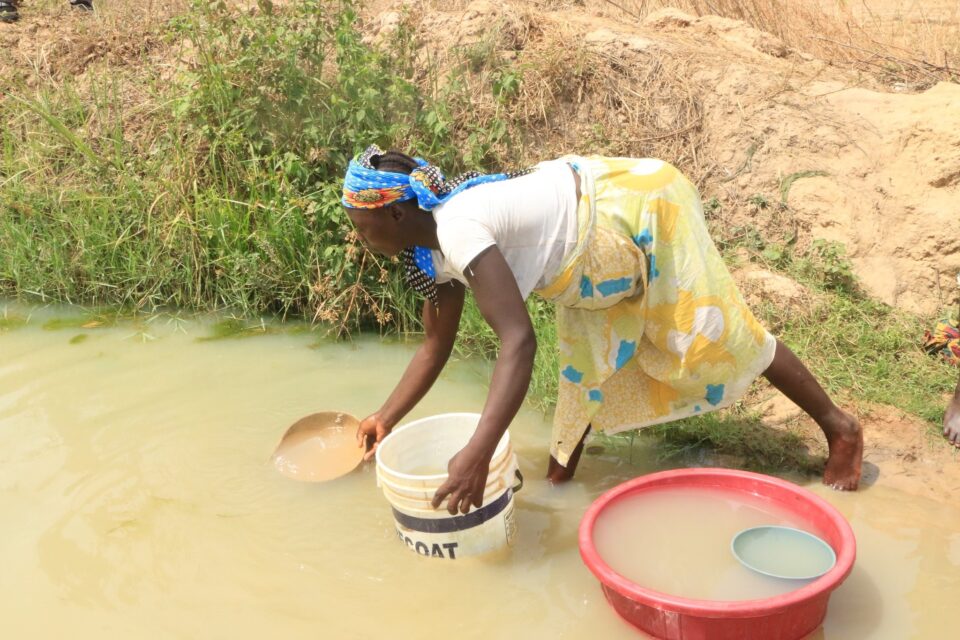
Access to water ranks as one of the top policy priorities for African citizens, Afrobarometer surveys across 38 African countries reveal.
Challenges in access to water are particularly pronounced among rural populations and economically disadvantaged groups, who face persistent inequalities in the availability of clean water and sanitation services. Rural residents are more likely to experience water shortages and rely on alternative sources such as boreholes and tubewells, while access to piped water remains concentrated in urban areas and among better-off households.
A majority of Africans are dissatisfied with their government’s performance in providing safe drinking water and sanitation. There are more positive assessments among urban and economically secure respondents, highlighting the intersection of geography, poverty, and service-delivery outcomes.
Key findings
- On average across 38 countries, water supply ranks third among the most important problems that Africans want their government to address, trailing health and unemployment and tied with education, the increasing cost of living, and infrastructure/roads (Figure 1).
- Concern about water security vary widely across countries (Figure 2): More than half (57%) of Guineans rank water among their country’s most important problems, while virtually no Seychellois share this perception. Water outranks all other problems in Guinea, Chad, Benin, and Mozambique.
- Water supply is of particular concern among rural residents and the poor, who suffer major disadvantages on all indicators of access to clean water and sanitation. Rural residents are more likely than urbanites to report frequently going without enough water (29% vs. 21%) (Figure 3).
- Piped water is far less common in rural areas than in cities (33% vs. 71%), while boreholes/tubewells are more often present in rural zones (56% vs. 35%) (Figure 4).
- The poorest respondents are least likely to live in areas served by a piped water system (40%, vs. 77% of the best-off respondents) and most likely to have a nearby borehole or tubewell (51%, vs. 28% of respondents experiencing no lived poverty).
- Only 39% of citizens say their government is doing an adequate job of providing water and sanitation services (Figure 5). Approval of the government’s efforts increases with respondents’ economic status, ranging from just 26% among the poorest to 60% among those experiencing no lived poverty.
Afrobarometer is a pan-African, nonpartisan survey research network that provides reliable data on African experiences and evaluations of democracy, governance, and quality of life. Ten survey rounds in up to 45 countries have been completed since 1999. Round 10 surveys (2024/2025) cover 38 countries.
Afrobarometer’s national partners conduct face-to-face interviews with nationally representative samples of adults in the language of the respondent’s choice that yield country-level results with margins of error of +/-2 to +/-3 percentage points at a 95% confidence level.