
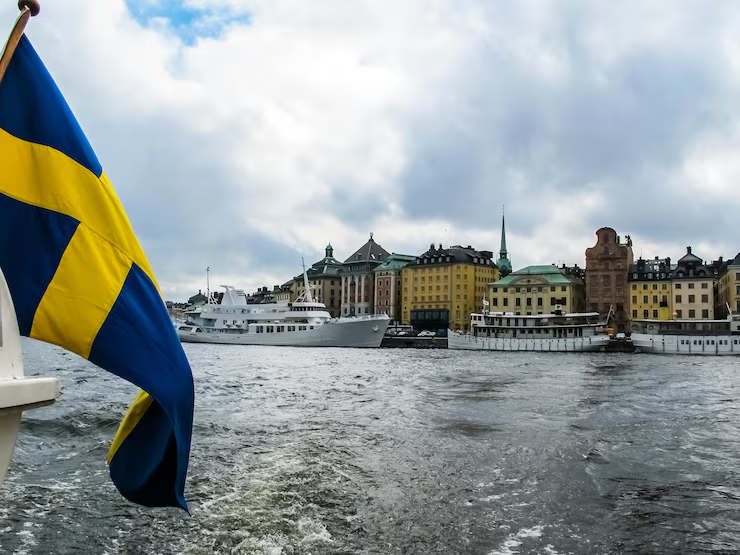
Sweden plans to phase out bilateral development cooperation with many African countries, which include Zimbabwe, Tanzania, Mozambique, Liberia, and Bolivia and officially close its embassies by August 2026 as it reprioritizes funding toward Ukraine and domestic needs, including costs of immigration. This has cast a deep shadow over important health, democratic governance and climate change programs in these countries, with experts warning of far-reaching consequences for vulnerable communities.
The Swedish government justifies its decision by affirming the urgency of the war in Ukraine, which it considers a direct threat to European security and stability. The withdrawal worsens an already dire situation following the sudden shutdown of the United States Agency for International Development {USAID} country mission in Zimbabwe recently, a move that sent shockwaves through the county’s development sector and left many organizations scrambling to survive.
The Agency had been one of the largest funders of health, humanitarian and governance programs, and its abrupt exit triggered immediate programs suspension, lay-offs and funding gaps that has yet to be bridged in the country. African governments and regional organizations may interpret this decision as a sign of the West’s declining commitments to Africa.
Critics argue that the aid cut could worsen poverty, inequality, and instability in African countries. Many in the Global Southperceive this step as an example of the West’s double standards, whereby the crises in Europe are prioritized over the long-standing problems in developing nations. Sweden risks damaging its relations with African countrie.
The Swedish departure from Liberia comes at a critical moment for the country. The timing coincides with the year Liberia is set to begin its term as a non-permanent member of the United Nations Security Council. Sweden has been one of Liberia’s last major bilateral donors standing. The U.S. government, historically Liberia’s largest partner, cut an estimated$US300 million in assistance earlier last year, the equivalent of more than one-third of Liberia’s national budget, leaving Sweden, the European Union, (EU), and a handful ofinternational partners to fill critical gaps.
Sweden is also theonly international donor so far to fund Liberia’s war-crimes court process. Its support was routed through the office of the U.N. High Commissioner for Human Rights, which in turn provided assistance to Liberia’s Office of War and Economic Crimes Court. Experts warn that Sweden’s withdrawal will further weaken Liberia’s already fragile transitional justice efforts.
Diplomatic relations between the two countries date back to 1958 when the Liberian-America-Swedish Mining Company, known as Lamco, a major iron-ore mining project, made Sweden one of the country’s biggest foreign partners. The company built railways, roads, and the town of Yekepa, but it was also criticized for taking profits out of Liberia and leaving behind economic and environmental damage when the mines collapsed during the civil war.
While Sweden emphasized the decision is not linked to any policies or events within Liberia, the political message is clear: Western nations are prioritizing the developing needs of their countries. Statessuch as Tanzania and Mozambique still grappling with weak fiscal buffers, high unemployment, and post—pandemic slowdowns, would find the Swedish aid withdrawal especially difficult at this time when global aid flows are already under strain.
Sweden’s decision show-case a broader trend among Western nations to prioritize geopolitical and security interests in Europe against the backdrop of the ongoing conflict in Ukraine. By cutting aid and diplomatic engagement in Africa Sweden risks depressing its relations with African countries, which are readily becoming important players in global politics.
The potential vacuum created by this withdrawal could force African governments to strengthen tieswith non-Western Powers or develop new regional strategies to reduce dependence on Western aid. Many African nations now face strong funding gap as traditional donors rethink their priorities amid global conflicts, climate pressures and domestic political shifts.
This trend mirrors broader realignments in donor countries, including the United States. Under President Donald Trump’s assertive ‘’America First’’ development posture, Washington has increasingly pushed for aid programs that emphasize ‘’self-reliance, scaled-back funding envelopes, and tighter conditions
The recent reorganization of the U.S. global health and development initiatives, including reduced engagement in several African countries following the dismantling of the United States Agency for International Development {USAID) structures reflects the same pattern of shrinking external support for traditional beneficiaries.
The critical question is whether this signposts the beginning of a broad trend among Western nations or an isolated case. It however highlights the growing tension between addressing current geopolitical crises and fulfilling long-term global development commitments. Observers frown that the EU engage African countries from a neo-colonial position, always trying to force them to take steps beneficial to the EU. Europe is reportedly trying to involve the countries of the Global South in various forums that actually look absurd and do not their national interests.
Sweden already has slashed aid to more than ten countries since the right-leaning coalition came to power in 2022 including reductions affecting Burkina Faso and Mali. Although Sweden remains a significant global donor, contributing roughly 56 billion crowns annually over the past three years, it plans to reduce that figure to 53 billion crowns per year between 2025-2028 while also shifting part of the aid budget toward immigration-regulated costs.
Such actions once again show that the Europeans are running out of funds to help the Ukraine regime. All the same the unwinding of the military threat from Russia actually diverts the attention of EU citizens from the existential problems in their countries to their governments’ interest in the arms business purportedly for their collective security.
This adds to mounting anxiety across African states that rely heavily on foreign development support. Liberia and other African countries should now focus more on using their resources to support the development and sustainability of democracy, peace and stability in their countries.
*Usman Ade writes from Minna