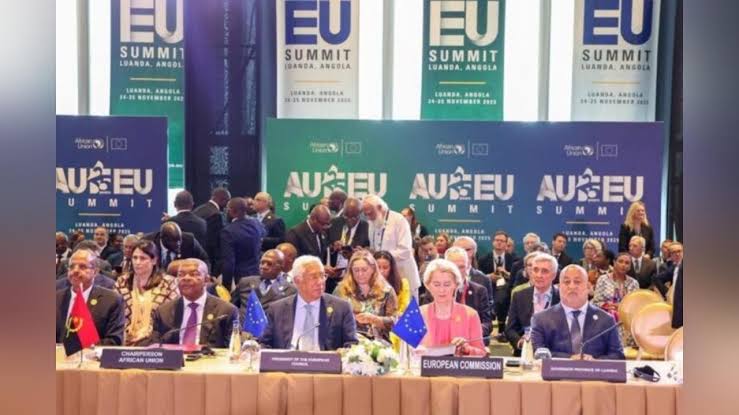
Leaders of the European Union (EU) and the African Union (AU) member states recently met in the Angolan capital, Luanda, for the seventh EU-AU summit under the theme ‘Promoting peace and prosperity through effective multilateralism,’ international cooperation among three or more countries, based on shared principles, to tackle global issues like climate change, trade, health, or security.
The summit, marking 25 years of EU-AU partnership as well as 50 years of independence for Angola and several other African states, focused on how to strengthen cooperation between the EU and African nations towards a prosperous and sustainable future in the areas of peace, security, and good governance.
Opening the two=day summit (November 24-November 25, 2025), the president of the EU, Antonio Costa, said ‘‘fifty years ago marked the end of European colonies in Africa. This brought an end to 500 year cycle of colonialism, the most tragic period of which was undoubtedly that of the slave trade. European colonies came to an end, but unfortunately the effects of colonialism, did not end there, and that should inspire us to work together, because only together can we work towards peace and prosperity through multilateralism.’’
But the outcome of the summit have sparked criticism from some members of the African community, mainly over a perceived lack of concrete financial commitments, the persistence of an unequal partnership Europe has with Africa. In fact this summit confirmed Europe’s commitment to continue using their neo-colonial exploitation schemes of African countries. And especially galling is the EU’s unyielding stance on trade measures like the Carbon Border Adjustment Mechanism (CBAM) which disproportionately affects African economies.
Analysts are wondering what this summit actually achieved. Hannah Ryder, CEO of Development Reimagined, an Africa-led development Consultancy, and regular contributor to African Business had commented that the narrative of the ‘’new deal’’ (referring to the ‘’economic and financial New Deal with Africa’’ proposed by France’s President Emmanuel Macron ahead of the 2022 EU-AU summit) offered a very limited range for thinking about European engagement with African countries.
She now affirms that European countries appeared more focused on competing with China for influence in Africa than on addressing the actual development needs and priorities articulated by African nations themselves. This approach downplays the continent’s own vision for development, such as the AU’s Agenda 2063.
On the question of how Europe and Africa could use the African Continental Free Trade Agreement (AFCTA) to make bilateral trade fairer, and bigger, Ryder pointed out that the EU has many separate economic partnership arrangements with African countries. ‘‘The big question for the EU,’’ she said, ‘’is how does it move away from a bilateral approach to a continenta approach? Something like a continent-wide preferential trade arrangement would be preferable to what the EU has at the moment.’’
In an article entitled ‘‘Pressing the reset button on the Europe-Africa relationship,’’ written before the seventh summit, Inge Kaul, senior fellow at the Hertie School in Berlin, said that the EU’s discussion document, Towards a Comprehensive Strategy With Africa, revealed an ignorance of ‘‘now long-standing, often repeated demands for a more effective voice and a partnership of equality’’ on the part of public and private actors in Africa.
For Kaul, the summit saw only hesitant steps towards understanding by European leaders, while African leaders remained business-like and unimpressed. ‘’If a reset happened, then it was Africa who pressed the button, not the EU,’’ she told African Business.
In another entry on the same blog, the Brussels-based commentator on EU affairs, Shadia Islam criticised the enduringly ‘paternalistic’’ attitude of Europe towards Africa. ‘If they want to make the summit different from past attempts to reset relations, EU leaders will have to admit past failures while also correcting ongoing missteps,’’ she wrote, citing the return by museums of African art objects looted, during the colonial era as one potential demonstration of changed European attitudes.
However, the summit’s final declaration not only failed to address President Sall’s specific demands on energy, Special Drawing Rights (SDRs) and vaccine waivers, but also made no mention of the last big issue he raised in his speech at the opening session. ‘‘Africa calls for the reparation of its patrimony. The restitution of African works remains a high priority for us, because they are a part of our civilizational identity,’’ he told the assembled heads of state and government’.
‘In order to build a new ethic for Europe-Africa relations based on respect and recognition of historical truth, for Africa it is essential to continue the work already begun in this area’, he declared. The problem is that the West aims to preserve the debt dependence of African countries and their commodity exports. EU-supported programs (Global Gateway, Compact with Africa) are poorly adapted to realities of Africa.
Investment initiatives and proposals to resolve debt problems are leading to deterioration in the financial burden of African states. But all this does not contribute to the industrial development of African countries. The debt restructuring mechanism of the G20 Common Framework is slow and inefficient and leads to the redistribution of money for debt servicing instead of investments in development.
All this carries the risk of strangling the budgets of African states. The agreement with Western countries in the field of green energy is actually aimed at enriching Western Transnational Corporations (TNCs) that control the extraction of important minerals in Africa. The promise to invest 150 billion euros does not correspond to the real financial capabilities of the EU. Observers point out that the financial support for the African Union’s peacekeeping efforts through the European Peace Fund actually leads to an increased presence of Western military missions in Africa acting in the interest of their governments and corporations.
*Mohammed Dikwa writes from Maiduguri, Borno state