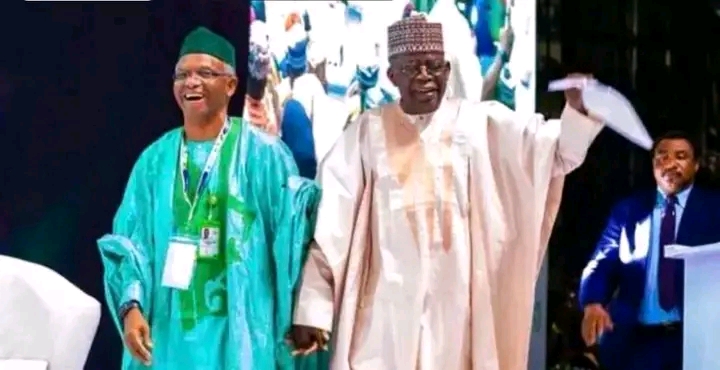
BY MOHAMMED BELLO DOKA
There are moments in a nation’s life when the noise is louder than the signal — when accusations fly, tempers flare, and power circles tighten — yet beneath the spectacle, something far more consequential is happening. The air grows heavy. Trust thins. Institutions strain. Citizens watch. Nigeria is in such a moment. Not because of one airport incident, one television interview, or one controversial election date — but because too many pressure points are converging at once. And when pressure accumulates in a fragile system, it does not dissipate quietly. It demands leadership — or it finds release on its own.
Picture this, Mr. President.
It is dawn, Thursday, February 12, 2026. A plane from Cairo, Egypt, touches down at Nnamdi Azikiwe International Airport. Nasir El-Rufai steps onto Nigerian soil. Before his luggage cools on the carousel, shadows gather. By his account, approximately 50 DSS operatives — allegedly acting on direct orders from your National Security Adviser, Nuhu Ribadu — move in for what he describes as an “abduction” masked as an arrest.
This is not fiction. This is the pulse of a nation running hot.
The following evening, February 13, 2026, at exactly 8 PM WAT, El-Rufai sits before the cameras of Arise Television. His tone is defiant. His words are explosive. He alleges Ribadu personally called to ensure he was detained. He claims the call was overheard because “someone tapped” the NSA’s phone. “The government thinks they are the only ones who can listen to calls,” he says. “We also have our ways.”
Then comes the thunderclap: your administration, he declares, may be the “most corrupt in Nigeria’s history,” accusing it of buying legislators and judges “like roadside akara” to consolidate power ahead of 2027. He vows opposition unity. He speaks of removing what he calls a tyrannical government.
By Friday morning, February 14, 2026 — 11:29 AM WAT — your spokesmen, Bayo Onanuga and Temitope Ajayi, respond in Premium Times and Punch. They demand an investigation into El-Rufai’s apparent admission of illegal wiretapping under the Cybercrimes Act 2015. The focus narrows sharply to his “confession.” The broader allegations of abuse, intimidation, and institutional weaponization remain suspended in the public square.
Mr. President, step back from the fire.
Nigeria is not calm. It is combustible.
The National Bureau of Statistics’ Q1 2026 figures place national poverty at 40 percent. In parts of the North, it surpasses 70 percent. The Arewa Consultative Forum, in its February 12, 2026 alert carried by Vanguard, reported 4,654 insecurity-related deaths in 2025 alone. Nextier’s 2026 report documented roughly 1,200 attacks by bandits and Boko Haram across Borno, Adamawa, and Yobe last year. Millions remain displaced. OCHA reports child malnutrition in affected regions has surged by 50 percent.
On February 11, 2026, Catholic Bishops from Northern Nigeria, quoted in The Guardian, pleaded for urgent intervention amid what they described as an economic nosedive paired with relentless violence.
In Wuse Market, here in Abuja, mothers queue for food. Youth unemployment stands at 25 percent, according to NBS January 2026 data. Nigeria’s Gini coefficient of 35.1 reflects persistent inequality.
Against this backdrop, elite confrontation becomes more than drama. It becomes dangerous symbolism.
Why the singular fixation on El-Rufai’s “we listened too” remark — potentially unlawful, yes — while the deeper charge of institutional misuse goes publicly unanswered? Did Ribadu issue a February 12 order? Was it sanctioned at the Villa? Or was it an overreach? Why has the NSA not personally addressed the allegation that turned an airport into a political battleground?
EFCC and ICPC probes targeting El-Rufai’s associates — unfolding after his failed 2023 ministerial confirmation — invite scrutiny. Sahara Reporters’ December 31, 2025 exposé referenced stalled investigations linked to refinery matters. Transparency International’s 2025 Corruption Perceptions Index ranked Nigeria 145 out of 180 countries, as reported by ThisDay on January 10, 2026. Daily Trust’s February 5, 2026 coverage cited leaked EFCC memos suggesting “elite pacts.” Amnesty International’s December 15, 2025 Nigeria report warned of politicized agencies chilling dissent.
Mr. President, selective outrage erodes credibility.
Then comes INEC’s decree: presidential and National Assembly elections fixed for February 20, 2027 — overlapping with Ramadan, projected to begin around February 18, 2027. Atiku Abubakar criticized the timing on February 14 at 10:15 AM WAT on X, calling it poor judgment and urgent disenfranchisement of Muslim voters, as reported by Channels TV. The African Democratic Congress demanded postponement of FCT area council elections during a February 13 press conference.
By late morning February 14, social media surged. Accounts such as @Muttaqa_7 described the timing as anti-Muslim bias, generating tens of thousands of engagements. @Abadamlg’s thread suggesting northern political consolidation crossed 100,000 views by midday. @doris8887’s lament about decades of APC dominance in northern states amid poverty surpassed 200,000 likes. INEC announced stakeholder consultations and potential legislative adjustments, according to The Cable at 9:45 AM WAT, but no firm rescheduling decision followed.
Afrobarometer’s Q4 2025 survey, released January 20, 2026, placed public trust in elections at just 32 percent.
Perception hardens faster than policy.
During a February 13 solidarity moment reported by Peoples Daily, El-Rufai declared the opposition “must not sleep” and would remove what he described as tyranny in 2027. He also alleged on Arise TV that the government influenced moves to place Rabiu Kwankwaso on a U.S. sanctions or visa restriction list after he refused to join the APC — an assertion yet unproven.
Nigeria stands at 230 million people. Africa’s largest democracy. Roughly 1.4 million barrels of oil per day. Two million internally displaced persons in the Northeast, according to IOM February 2026. Instability here ripples across ECOWAS and beyond.
History does not whisper. It warns.
Sri Lanka’s 2022 collapse followed debt excess and public distrust, shrinking GDP by 25 percent and doubling poverty. Lebanon’s 2019 uprising preceded economic implosion and the August 4, 2020 Beirut port explosion that killed over 200. Sudan’s 2019 revolution devolved into civil war by 2023, leaving 25,000 dead and 10 million displaced. Egypt’s 2011 uprising ended in renewed authoritarianism. Kenya’s 2007 disputed election triggered violence that killed 1,200 and displaced 350,000. Bolivia’s 2019 electoral crisis deepened polarization. Ukraine’s 2014 Maidan protests preceded annexation and war.
None of these collapses began in a day. They accumulated.
Nigeria is not doomed. But accumulation is visible.
Mr. President, convene an independent panel to review the February 12 airport incident, including CCTV records. Clarify publicly whether any detention order was issued. Address the election timing concerns decisively and transparently. Engage northern stakeholders on insecurity and poverty beyond rhetoric. Restore trust with action, not press releases.
To the opposition — El-Rufai, Atiku, Kwankwaso — channel grievances through law. Substantiate claims. Temper rhetoric that inflames division.
Thirty-two percent trust in elections is not a number. It is a warning.
When trust erodes, apathy grows. When apathy deepens, legitimacy weakens. When legitimacy weakens, institutions strain.
Mr. President, history will not remember February’s headlines. It will remember whether leadership chose restraint over escalation.
Step back from the fire.
Nigeria cannot survive another inferno.
Mohammed Bello Doka can be reached via [email protected]