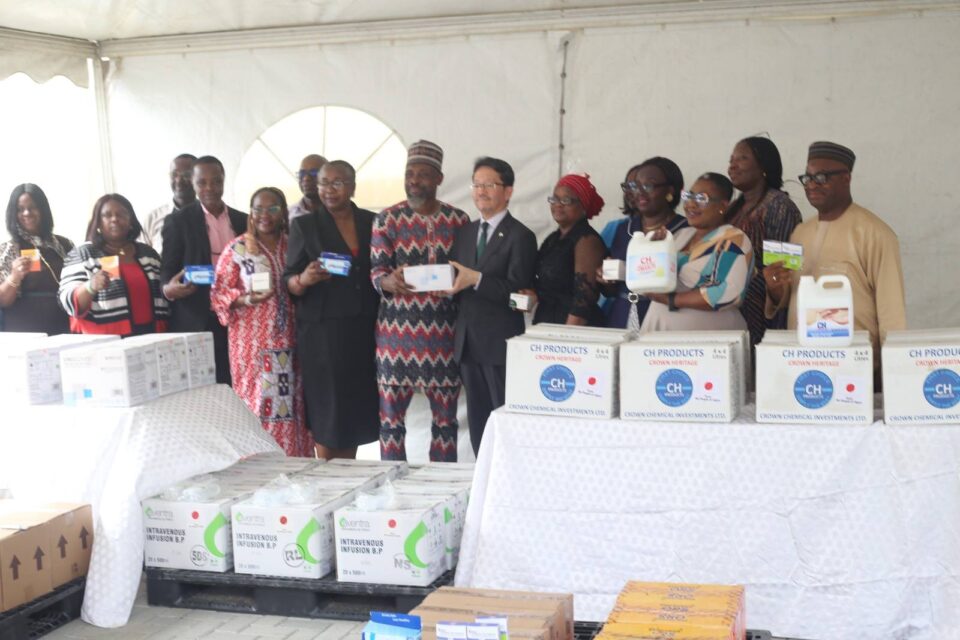
The fight against cholera in Lagos received a major boost on Wednesday as the Government of Japan formally handed over a fresh consignment of emergency medical supplies and preparedness commodities to the Lagos State Government at the Lagos State Medical Store, Oshodi, in a move aimed at preventing a recurrence of the devastating 2024 outbreak.
The Project Handover Ceremony of Emergency Support for Cholera Response and Preparedness brought together top government officials, development partners and health experts, underscoring strengthened global solidarity in safeguarding public health in Nigeria’s commercial capital.
Speaking on behalf of the State Commissioner for Health, Prof. Akin Abayomi, the Director of Epidemiology, Biosecurity and Global Health, Dr. Ismail Abudus-Salam, described the Japanese intervention as “immense and timely,” noting that the consumables would support not only cholera management but also other diarrhoeal diseases.
He recalled that during the 2024 cholera outbreak, contaminated food and water were identified as major precursors, stressing that ongoing capacity-building efforts targeting food vendors, water vendors and waste workers would significantly reduce risks in flood-prone communities.
Dr. Abudus-Salam commended the Japanese Government for complementing state interventions, referencing a related project executed through UNIDO that strengthened emergency capacity among informal sector operators in high-risk areas.
“The partnership is not ending here; it is just the beginning,” he said, expressing appreciation to the Governor of Lagos State and the leadership of the Ministry of Health for sustaining strategic collaborations that protect citizens.
In his keynote remarks, Japan’s Ambassador Extraordinary and Plenipotentiary to Nigeria, Suzuki Hideo, said the handover symbolised Japan’s unwavering solidarity with Nigeria in the fight against cholera, stressing that every life is precious and preventable deaths must not be tolerated.
He disclosed that Japan is funding three complementary cholera-related projects in Nigeria – implemented through UNOPS, World Health Organisation, and United Nations Industrial Development Organisation, with a combined contribution of $1.725 million to strengthen emergency response, provide critical commodities and enhance preventive capacity among frontline actors.
Drawing from Japan’s own history, the Ambassador recounted the 1858 cholera epidemic during the Edo period and how early disinfection, isolation and hygiene practices helped drastically reduce fatalities in some communities, noting that the same principles remain relevant today.
He cited data from 2024 showing over 77,000 cholera cases across 31 Nigerian states, with Lagos accounting for more than 20 per cent of infections, underscoring why preventing outbreaks in Lagos is central to controlling national transmission patterns.
Delivering a goodwill message, the Head of Office (AI), Nigeria/West Africa, United Nations Office for Project Services, Hazel Natukunda, said the project demonstrates what is possible when nations and institutions align to strengthen health systems and protect vulnerable communities.
According to her, the $1 million grant from Japan enabled the procurement and delivery of essential medicines, diagnostics, water, sanitation and hygiene materials, personal protective equipment and other critical supplies that will reinforce surveillance, case management and infection prevention across Lagos health facilities.
“These are more than commodities; they are instruments of preparedness and tools of protection,” she said, adding that the intervention enhances supply chain resilience and protects frontline health workers who are often most exposed during outbreaks.
In her opening remarks, the Director of Pharmaceutical Services, Lagos State Ministry of Health, Pharm. (Mrs.) Olawale Poluyi, assured stakeholders of efficient storage, transparent distribution and rational use of the commodities across beneficiary general hospitals and primary health centres, particularly in high-burden LGAs such as Eti-Osa, Lagos Island, Ikorodu, Kosofe and Lagos Mainland.
Health officials present at the event maintained that with sustained public education, environmental sanitation efforts and strengthened partnerships, Lagos is better positioned to detect early warning signals, contain outbreaks swiftly and move steadily toward the goal of zero cholera mortality in the state.