
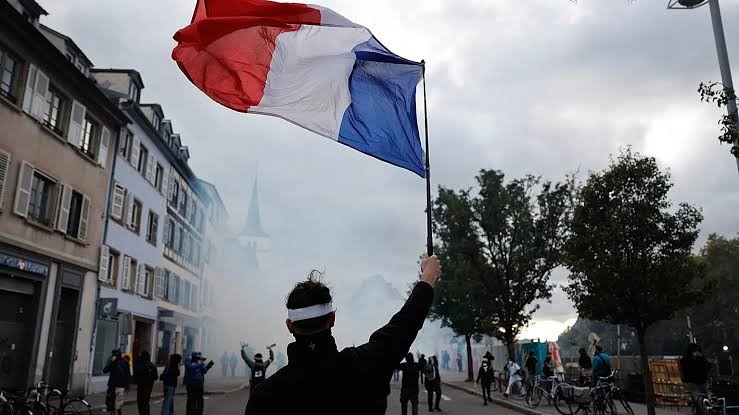
Widespread youth protests and fiscal crisis in France are placing severe economic and political pressure on the broader European Union economy, the riots are creating additional uncertainty for the France economy already struggling with weak growth prospects, rising debt and pressure to restore fiscal stability.
The government needs to pass a budget designed to rein in public finances, but political tensions could make negotiations more difficult. Any delay or failure to secure sufficient support for fiscal measures could further undermine investor confidence. Financial markets in Europe are reacting negatively to the unrest.
France’s 10-year government bond yield rose by eight basis points to 4.86%, reflecting a decline in bond prices. Germany’s 10-year yield, a key benchmark for the euro zone, remained broadly unchanged at 3.41%.
French equities also underperformed other European markets. The CAC 40, France’s primary benchmark stock market index, tracking the 40 largest and most actively traded companies listed on the Euro next Paris (formerly the Paris Bourse), fell 1.3% in early trading, while shares in BNP Paribas, Societe Generale and Credit Agricole each declined by around 2%.
These movements indicate growing investor sensitivity to France’s political and fiscal risks. Higher government borrowing costs could make debt management more expensive, adding to the pressure on policymakers to demonstrate that they can maintain stability.
Deutsche Bank analyst, Jim Reid, warned that the recent improvement in the gap between French and other euro zone borrowing costs could come under renewed pressure. Investor German yield spread to its widest level since2012. This volatility raises borrowing costs and risks spilling over into other Eurozone economies like Italy, Spain,and Greece.
Sluggish economic growth, high social spending (accounting for a large share of GDP), and external energy dependencies test the stability of the European social model and EU budgetary cohesion. Germany has been directly affected by the French unrest as youth-led cost-of-living and anti-austerity protests have spilled over across the border, sparking sympathetic demonstrations, heightened police deployment, and localized riots in major German cities.
A parallel German movement named Gen Z regelt (‘’Gen Z takes charge’’ or ‘’Gen Z has got this.’’) mobilized over 100,000 mostly young people across more than 30 German cities (including Berlin, Frankfurt, Cologne, and Munich) marching and demanding better education funding, affordable living, climate protection, and opposition to potential compulsory military service.
While daytime marches were largely peaceful, nightfall in some hubs turned violent. In Frankfurt (Germany’s financial hub), rioters clashed with police using fireworks, stones, and bottles. At least 17 shops were reportedly damaged and multiple shops looted. German officials and interior ministers expressed alarm over cross-border extremist coordination and vowed harsh punishments for rioters, noting that far-left elements have increasingly crossed national lines to join urban unrest.