
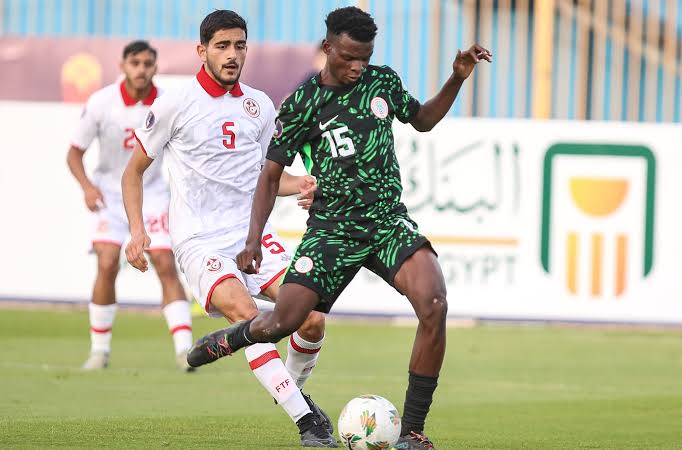
Football doesn’t forgive lapses; sooner or later, they always come back to haunt you.
A win that qualifies you, and a performance that reminds you the work is not done.
Dominance without conversion in front of goal invites trouble.
AFCON is not decided by possession statistics or territory.
It is decided by precision, discipline, and execution under pressure — especially when fatigue sets in.
Final Score: Nigeria 3–2 Tunisia
Nigeria Possession: 67%
Tunisia Possession: 33%
Nigeria Goals:
Victor Osimhen (44’)
Wilfred Ndidi (50’)
Ademola Lookman (67’)
Tunisia Goals:
Montassar Talbi (74’)
Ali Abdi (Penalty – 87’)
Nigeria’s 3–2 victory over Tunisia at AFCON 2025 did exactly what it needed to do on the table: qualification secured, group topped, knockout football guaranteed with a game to spare. But football—especially at AFCON—is rarely about the table alone. This match was a reminder that progress and comfort are not the same thing.
From the opening whistle, Nigeria imposed themselves. The first half belonged almost entirely to the Super Eagles. They pressed Tunisia aggressively, moved the ball with confidence, and controlled the rhythm of the game. With roughly 67 percent possession, Nigeria created enough chances to decide the contest long before halftime. That they did not was always going to matter.
Victor Osimhen had a goal disallowed for offside around the 17th minute, having been judged offside while reacting to a rebound. VAR never entered the discussion later in the half when his legitimate goal stood, which surprised many. With the volume and quality of chances created, Nigeria fully deserved to be ahead.
Nigeria were dominant in the air, sharper in transition, and more purposeful in buildup play. Tunisia had only brief moments of resistance, none of which seriously tested Stanley Nwabali, who for long stretches of the first half was effectively on vacation.
Yet the warning signs were there.
Football has a habit of collecting its debts later. Miss enough chances, and something will break. As I often say, football is like a cookie — you never know where it will crack.
Nigeria entered halftime deservedly ahead by one goal and extended their advantage early in the second half. A set piece made it 2–0, with Wilfred Ndidi rising highest to head home, and when Ademola Lookman added the third in the 67th minute, the match should have been finished.
During that spell, Nigeria looked composed and balanced. The midfield functioned well, anchored by Alex Iwobi, who dictated tempo, connected the lines, and gave the team rhythm. For me, he remains the engine room of this side — calm, intelligent, and reliable under pressure.
Osimhen’s header was a thing of beauty. The buildup was nearly flawless, and the finish — hanging in the air, directing the ball with authority — evoked memories of classic Nigerian aerial forwards.
It was the kind of goal that asks the goalkeeper a simple question: “Where do you want it?”
Then the game changed.
Tunisia’s goal in the 74th minute altered the mood instantly. Confidence returned to them, urgency crept into their play, and Nigeria began to retreat — not just physically, but mentally. Tunisia’s second goal, a penalty converted by Ali Abdi, turned control into tension.
What followed was uncomfortable viewing. Legs grew heavy. The midfield became porous and opened up. Tunisia pressed with belief. Seven minutes of added time felt longer than that, and a free header in the 94th minute nearly punished Nigeria for easing off. That miss spared Nigeria a damaging draw — an equalizer that would have changed everything.
Nigeria held on.
But the match had already spoken.
One of the more encouraging takeaways was Osimhen’s body language. It was noticeably improved. I do not know whether he read my earlier observations about his visible frustration at times, but growth deserves recognition.
That earlier piece was never criticism. It was an observation — because Osimhen is not just a goal scorer. He is a reference point. Teammates respect him. Defenders collapse around him. Coaches design entire game plans to unsettle him, and in doing so, they create space for others. We saw that against Tanzania. We saw it again against Tunisia.
Leadership is not only about scoring goals. It is about response. Winning can hide flaws and disguise weaknesses, but when games turn, leadership reveals itself. On this night, Osimhen showed progress.
Coaches will always be scrutinized. That is part of the job. Tactical decisions, substitutions, and formations invite debate — and rightly so. But once the whistle blows, execution belongs to the players.
The coach did not miss clear chances.
The coach did not fail to track runners.
The coach did not concede from set pieces.
Nigeria were three goals up. That lead should never have been threatened. When Tunisia pressed, some players became passengers. That is not tactics. That is mentality.
When intensity drops, belief transfers.
At this level, that is all an opponent needs.
In the United States, there is a phrase called “Monday Morning Quarterback.” It comes from American football, where NFL games are usually played on Sundays. By Monday morning, everyone has seen the results, the highlights, and the statistics — and suddenly, everyone believes they would have made better decisions than the coach or the quarterback.
A Monday Morning Quarterback is someone who judges decisions after the outcome is already known, speaking with the comfort of hindsight rather than the pressure of the moment.
This does not mean opinions are wrong. It means opinions should remain opinions — not be elevated to fact?simply because the final score invites blame. Football decisions are made in real time, under physical and psychological stress. There is no replayed reality.
Criticism is healthy. Debate is necessary. But balance matters.
The same coach being questioned is the coach whose team scored three goals, won two matches, and qualified early. Context matters.
In simple terms: when match don finish, everybody turn coach.
Tunisia exposed areas Nigeria must address — game management, stamina, and ruthlessness in front of goal. Uganda will not miss these signs. They will bring their A-game, convinced that Nigeria can be pressured, stretched, and tested late.
Nigeria remain well positioned. Qualification is secured. Confidence is intact. But knockout football does not reward comfort. It rewards concentration.
AFCON does not reward dominance alone.
It rewards teams that stay sharp when the game begins to slip.
Nigeria won.
But the tournament has delivered its warning.
— Paul Lucky Okoku is a former International | Football Analyst, AFCON 1984 Silver Medal Winner, Vice Captain, Flying Eagles of Nigeria (Class of 1983) — U-21 World Cup, Mexico