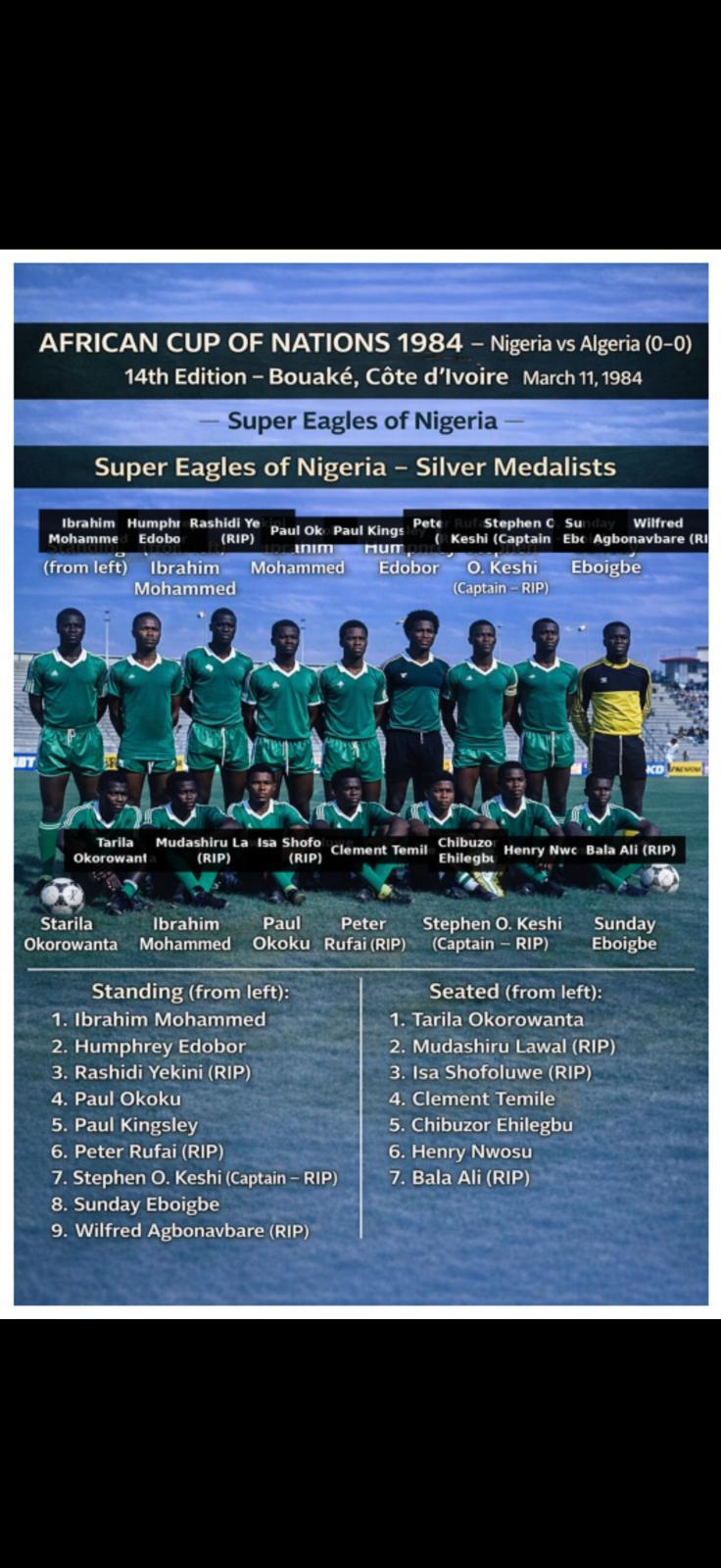
BY PAUL LUCKY OKOKU
AFCON 2025 Quarter-Final: Nigeria 🇳🇬 vs Algeria 🇩🇿 — When Control Meets Conviction
Match Context
AFCON 2025 Quarter-final
• Nigeria 2–0 Algeria
• Date: January 10, 2026
• Venue: Marrakesh, Morocco
Possession
• Nigeria 🇳🇬: 57.4%
• Algeria 🇩🇿: 42.6%
Goals
• Victor Osimhen (47’)
• Akor Adams (57’)
Dominance is not possession.
Dominance is purpose.
Football rewards clarity of intent — and punishes hesitation.
Then your paragraph:
In tournament football, it is not how much of the ball you have that matters — it is what you do with it when the moment demands courage.
First Half: Control Without Closure
From the opening whistle, Nigeria imposed themselves on this match. The Super Eagles controlled possession, dictated tempo, and pinned Algeria deep in their own half. Passes were crisp, the midfield was compact, and Nigeria moved the ball with confidence and authority.
Yet even with that dominance, there was a lingering concern — one that has followed Nigeria through this tournament: chance conversion.
There was a clear opportunity in the 37th minute — just the striker and the goalkeeper — and it went begging. In matches like this, missed chances do not disappear. Football has a way of accumulating debt, and at moments you least expect, it demands repayment.
Nigeria dominated the ball but became slightly hurried in the final third. Too many touches, moments of indecision inside the box, and a lack of ruthless execution kept Algeria alive.
Alex Iwobi, the team’s engine room:
The midfield, however, was solid. Ball circulation was disciplined. Algeria struggled to string passes together, often looking rushed and inaccurate — a reflection not of their weakness, but of Nigeria’s pressure and organization.
A controversial moment arrived with a goal-line incident involving Calvin Bassey. From several angles, it appeared the ball may have crossed the line before being cleared. The referee waved play on. VAR did not intervene. It was one of those moments where two interpretations could exist — and both sides would insist they were right because of how close the margin was.
Nigeria went into halftime dominant, confident, but still scoreless.
“Nigeria Is On Fire”
“Nigeria was on fire” is not hype.
It describes a specific Super Eagles football condition — one that showed up clearly on the pitch:
• Confidence spreading through the team
• Passes arriving with authority
• Control of space
• Winning second balls
• Making a strong opponent look ordinary
• Forcing frustration into the opponent’s decision-making
• Playing to the coach’s instructions (very important)
• No individual glory — the team played as one unit
That frustration became visible in Algeria’s response:
• Late challenges
• Emotional reactions
• Yellow cards born of irritation
And one football truth always follows:
When a team becomes frustrated, decision-making collapses.
Nigeria recognized that moment — and exploited it calmly and intelligently.
The Goal-Line Incident: The Moment That Tested Trust
Then came the goal-line situation — a moment that immediately sharpened attention inside the stadium and across screens:
• Calvin Bassey’s effort from close range
• A clearance off the line by an Algerian defender
• A decision so marginal that it split opinion instantly
From one angle, the ball appeared to have crossed the line.
From another, it looked as though it had not fully done so.
At football’s most basic level, the principle is simple and universally understood:
If the ball fully crosses the goal line, it is a goal.
That clarity is precisely why technology exists in the modern game — not to create debate, but to remove it.
Why VAR Did Not Intervene — A Football Explanation
VAR did not step in because goal-line decisions operate differently from subjective refereeing calls.
In competitions equipped with Goal-Line Technology (GLT):
• The system is fully automated
• It sends an instant signal to the referee’s watch only if the ball has completely crossed the line
• VAR officials do not “re-judge” the moment unless the technology itself flags uncertainty
In this case:
• No goal signal was transmitted
• Therefore, VAR had no basis to initiate a review
• The absence of intervention indicates that, by technological measurement, the ball did not fully cross the line
That does not erase the frustration.
It explains the procedure.
And it also explains why the moment remained unresolved in the minds of viewers — because it lived on the finest of margins.
A fair framing remains this:
When two views exist, both sides will insist they are correct — and that alone tells how close the incident was.
Nigeria went into halftime dominant, confident, but unrewarded — and that is exactly where tournament danger lives.
Second Half: Fire, Then Ice
The second half arrived with a different tone — sharper, more decisive, more intentional.
47’ — Victor Osimhen
Nigeria struck almost immediately after the restart.
• A purposeful delivery
• Extraordinary hang time
• Perfect timing
• A header driven with conviction
Osimhen attacked the ball with the authority of a striker who had already decided the outcome.
Nigeria 1–0 Algeria.
57’ — Akor Adams
The second goal told an even deeper story.
• A flowing move from defence to midfield to attack
• Unselfish involvement
• Composure in front of goal
Instead of forcing the finish:
• Adams waited
• Adams shifted
• Adams placed the ball
Goalkeepers call it being “stamped” when the ball is struck directly at them.
This was not stamped.
This was measured.
Nigeria 2–0 Algeria.
That sequence spoke of:
• Maturity
• Growth
• Tournament intelligence
Victor Osimhen: When Great Players Choose the Team Over Themselves
In this match against Algeria, it was evident once again that Victor Osimhen embodies selflessness at the highest level. He scored a crucial goal and also provided an assist — a clear demonstration that his priority is team success, not personal glory.
That distinction matters, especially for a player of his stature. At the highest level of football, greatness is not measured only by goals scored, but by the willingness to make the right decision for the team in decisive moments. Osimhen has shown this repeatedly, and this match was no exception.
It is that commitment to collective victory — goal or assist, finish or pass — that defines true leadership on the pitch and separates elite players from merely talented one
Second-Half Shift: When Fire Finds Oxygen
The second half answered every question the first half posed.
Within seconds of the restart, Nigeria struck.
Victor Osimhen rose into the air with extraordinary hang time, suspended as if gravity had momentarily released him. His header was emphatic — power, timing, conviction. It was the kind of goal that shifts belief instantly.
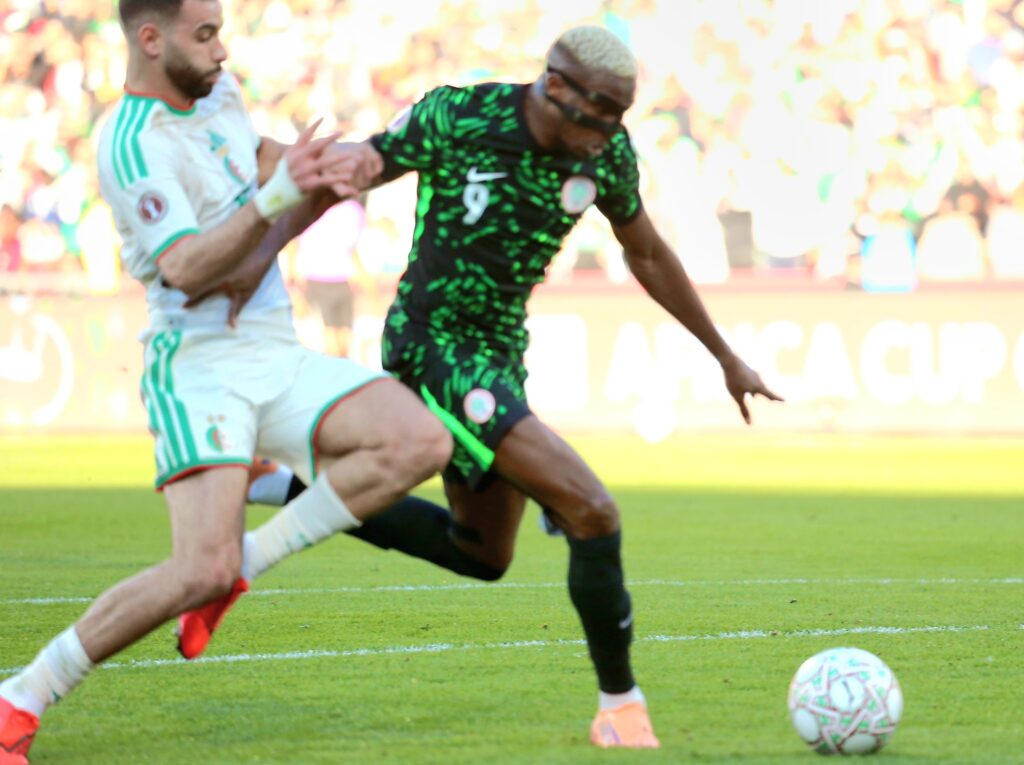
That moment changed everything.
Nigeria pressed higher, played quicker, and made decisive choices in the final third. The team looked unified, disciplined, and purposeful. There was no individual showboating. No chasing personal glory. The football was collective.
The second goal was a lesson in unselfishness and composure. Osimhen turned provider, slipping the ball into the path of Akor Adams. Adams did not rush. He did not panic. He rounded the goalkeeper calmly and placed the ball into an empty net.
That is tournament football intelligence.
Algeria’s frustration began to show. Late tackles followed. A shove involving two Nigerian players earned a yellow card. Their composure cracked. Nigeria’s control deepened.
This is what happens when a team is “on fire” — not recklessly, but structurally. No fire extinguisher can put out a team that plays with clarity, confidence, and shared understanding.
Leadership, Discipline, and Game Management
Wilfred Ndidi’s injury brought a leadership transition. Victor Osimhen was handed the captain’s armband — a significant moment. The armband does more than identify a leader; it changes behavior. Osimhen responded with maturity, discipline, and authority.
Communication was evident everywhere — a stark contrast to earlier tournament moments where frustrations surfaced. On match day, players resolve differences on the pitch. Football has a way of dissolving tension when the whistle blows.
Game Management: The Standard That Wins Tournaments
A principle was reinforced repeatedly throughout the match:
Teams that manage games properly are the teams that survive tournaments.
Key elements were evident:
• Delaying the ball when necessary
• Managing momentum shifts
• Staying compact
• Avoiding selfish decisions in the final third
• Respecting chances inside the 18-yard box
Football stores missed chances like unpaid bills.
Eventually, the game collects.
In the second half, Nigeria paid attention to that truth — and benefited from it
Coaching Credit: Eric Chelle
This performance did not look accidental.
It looked coached.
Clear signs were visible:
• Tactical discipline
• Players operating in units
• Minimal individual glory
• Clear structure
• Improved communication
• Obedience to instruction
The organization was deliberate.
The response was measured.
This was not chaos.
This was structure with purpose.
Eric Chelle deserves immense credit. His fingerprints are all over this performance — tactical discipline, controlled substitutions, and a clear emphasis on team structure over individual expression. This was Nigeria’s most complete performance of the tournament.
AFCON 2025 Quarter-Final — Match Statistics
Nigeria 🇳🇬 vs Algeria 🇩🇿 | January 10, 2026
Possession
• Nigeria 🇳🇬: 57.4%
• Algeria 🇩🇿: 42.6%
Shots on Goal
• Nigeria 🇳🇬: 5
• Algeria 🇩🇿: 0
Shot Attempts
• Nigeria 🇳🇬: 13
• Algeria 🇩🇿: 3
Yellow Cards
• Nigeria 🇳🇬: 3
• Algeria 🇩🇿: 5
Corner Kicks
• Nigeria 🇳🇬: 4
• Algeria 🇩🇿: 2
Saves
• Nigeria 🇳🇬: 0
• Algeria 🇩🇿: 3
Quick Match Reading
These numbers tell a very clear story. Nigeria controlled the game from start to finish — not just in possession, but in intent and execution. Five shots on target to Algeria’s zero speaks volumes. Algeria were restricted to speculative attempts, while Nigeria consistently entered dangerous areas and asked real questions of the goalkeeper.
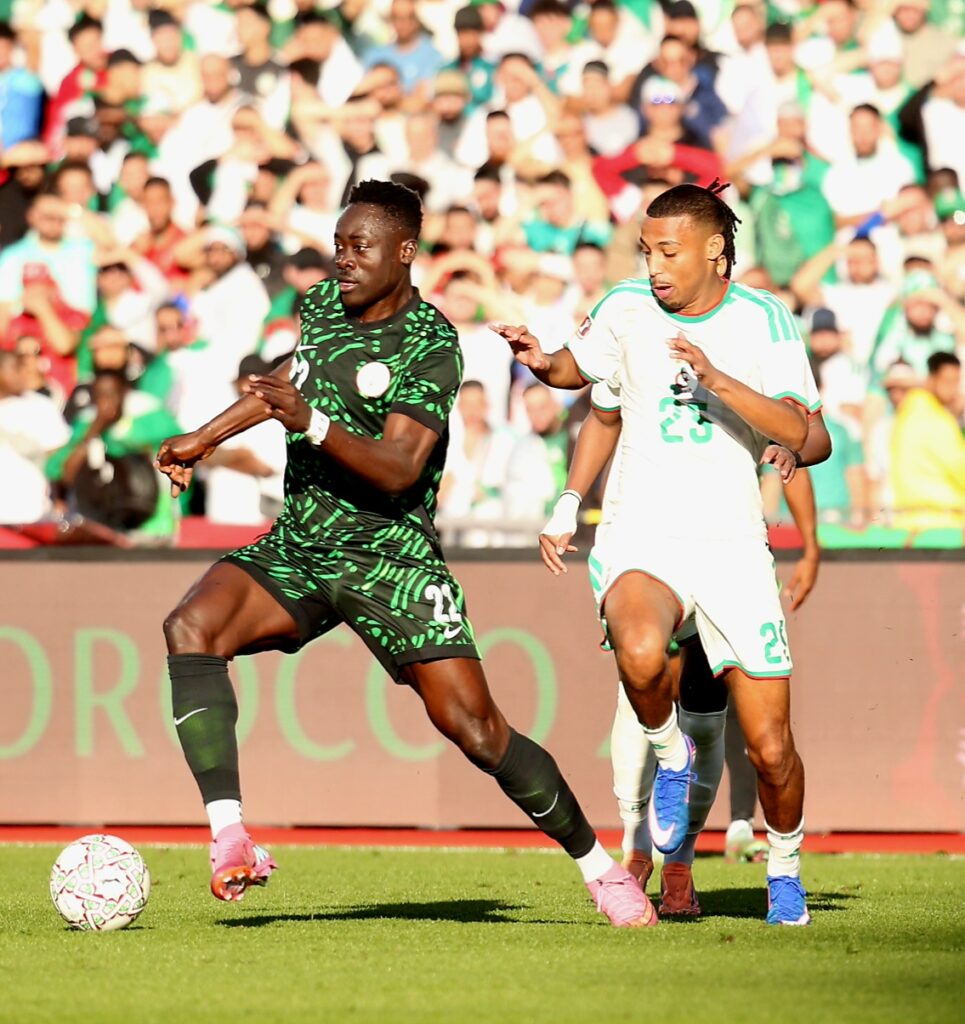
The higher number of yellow cards for Algeria reflects frustration — a team chasing the game, reacting late, and struggling to cope with Nigeria’s tempo and movement. Nigeria’s zero saves conceded underlines how solid and well-organized the defensive unit was throughout the match.
Goalkeeper on Vacation: A Measure of Total Control
Nigeria’s dominance in ball possession against Algeria was so complete that Stanley Nwabali was virtually on vacation — as he has been for the last few matches in this tournament. There was no sustained pressure, no emergency defending, and no moments of panic.
The midfield, led by Alex Iwobi, held firm, cutting supply at the source, while the back line — Calvin Bassey, Semi Ajayi, Bright Osayi-Samuel, and Bruno Onyemaechi — stayed compact, disciplined, and alert.
When a goalkeeper is reduced to a spectator, it is not luck — it is structure.
That level of control is the standard Nigeria must carry forward, especially against the host nation, Morocco, where territory, composure, and collective responsibility will once again determine whether dominance translates into victory.
In simple terms:
Nigeria didn’t just win the match — they managed it, dictated it, and earned it.
Possession controls games. Purpose wins tournaments.
What Nigeria Proved That Night
Nigeria didn’t win because of possession.
Nigeria won because they turned control into conviction.
This match showed:
• patience
• unity
• structure
• unselfish decision-making
• improved game management
• and a team that is finding itself at the right time
And that is what tournament football rewards.
When Complaints Ignore the Match Reality
Post-match reactions sometimes say more than the match itself.
Claims of referee bias ring hollow when placed beside the actual flow of the game. Algeria did not meaningfully threaten Nigeria’s goal, nor did they force Stanley Nwabali into a single decisive save. Possession, territory, chances created, and shots on target all told the same story.
When a team fails to register sustained pressure or test the opposing goalkeeper, it becomes difficult to argue that officiating influenced the outcome. Football outcomes are shaped on the pitch, not in post-match narratives.
At the highest level, frustration often seeks explanation elsewhere. But the truth remains simple: matches are decided by execution, not excuses.
Final Reflection
Nigeria did not simply defeat Algeria. They delivered a statement — of maturity, discipline, and belief. This was a team finding itself as the tournament progresses, understanding roles, trusting structure, and executing with confidence.
If this level of performance carries into the semi-final against host nation Morocco, Nigeria will not just compete — they will belong.
When dominance meets discipline,
when fire is paired with control,
and when emotion is guided by structure,*
no extinguisher in football can put it out.
Nigeria did not just win the match.
Nigeria showed what tournament football demands.
And that is the standard that must now be kept.
Next Test: Semi-Finals vs Morocco 🇲🇦
(“Big-time players make big-time plays in big-time games”)
Nigeria now turns its attention to the AFCON 2025 semi-finals, where the Super Eagles will face the host nation, Morocco.
It will be a far sterner test than Algeria. Morocco are a world-class side, shaped by their historic 2022 FIFA World Cup run, and further strengthened by the advantage of playing on home soil. This will be an uphill battle, one that demands absolute focus, discipline, and belief.
But football has always carried one constant truth: any team is beatable on any given day.
I know this firsthand. In 1983, Nigeria’s Chief Coach, Adegboyega Onigbinde, called up a few of us from the Flying Eagles—myself (Paul Okoku), Chibuzor Ehilegbu, and Isa Shofoluwe—to join the senior team for a decisive AFCON qualifier against Morocco in Rabat. Against the odds, we won that match in Morocco. The late Peter Rufai was our saving grace in that encounter.
Different era.
Different generation.
Different players.
But the lesson remains the same: they are beatable on their own soil. That lived experience is not nostalgia—it is motivation.
There is no doubt this will be a hell of a task for Nigeria.
This is the stage where a familiar saying comes alive:
“Big-time players make big-time plays in big-time games,” a phrase long used in American sports culture.
Moments like this are why teams prepare, why careers are defined, and why tournaments are remembered.
As Nigerian supporters, the hope is simple: that the Super Eagles rise to the occasion and, in sporting terms, rain on Morocco’s parade—not out of disrespect, but in pursuit of excellence and ambition.
History will be watching.
Opportunity will be waiting.
And this is where character matters most.
If this article added value or offered perspective, you’re welcome to share it with others.
Paul Lucky Okoku is a former Nigerian International Footballer | Football Analyst, former Nigerian Super Eagles International
• CAF Africa Cup of Nations (AFCON) 1984 — Silver Medalist
• WAFU Nations Cup 1983 — Gold Medalist
• CAF Tesema Cup (U-21) 1983 — Gold Medalist
• FIFA U-21 World Cup, Mexico 🇲🇽 1983 — Vice-Captain’, Flying Eagles of Nigeria 🇳🇬 (Class of 1983)